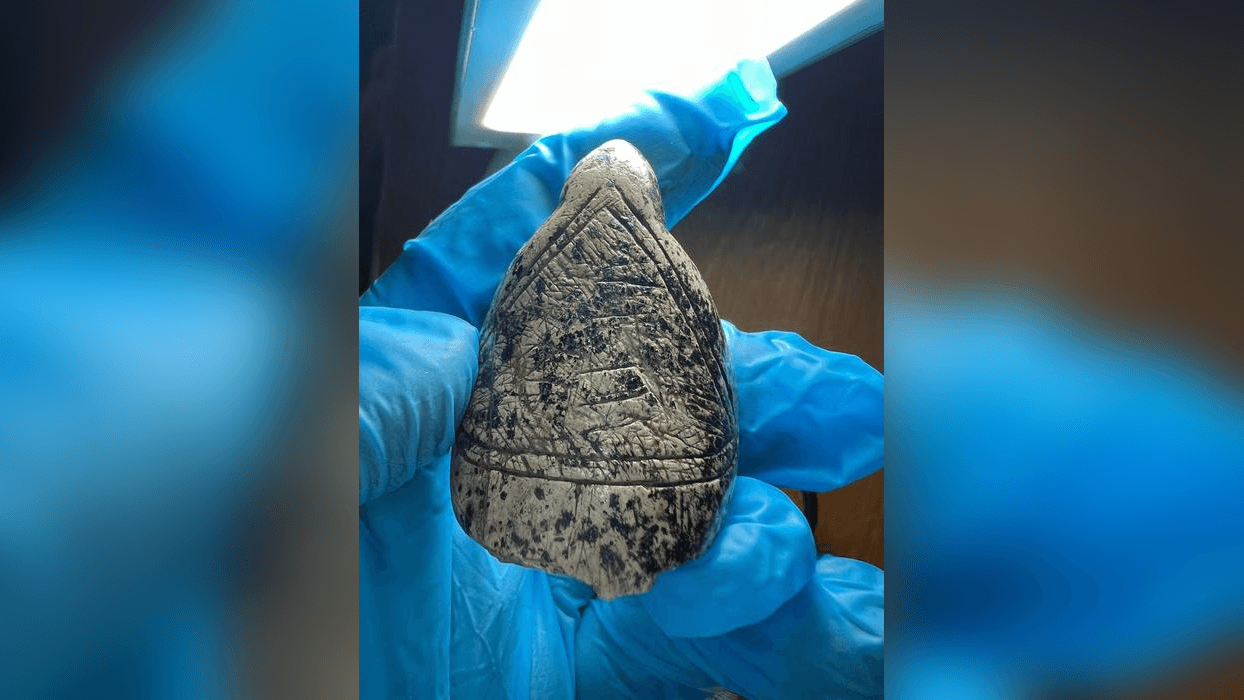
Around 18,000 years ago, artists living in what is now northern Ukraine carved small human figures from mammoth ivory. A new study suggests that the patterns covering these objects were shaped by the natural structure of the ivory itself.
Researchers made the discovery after examining 18 figurines from Mizyn, one of Ukraine’s most important Upper Paleolithic sites. High-resolution microscopy and 3D digital modelling revealed that Ice Age craftspeople used lines already visible within mammoth tusks to guide their engraved designs.
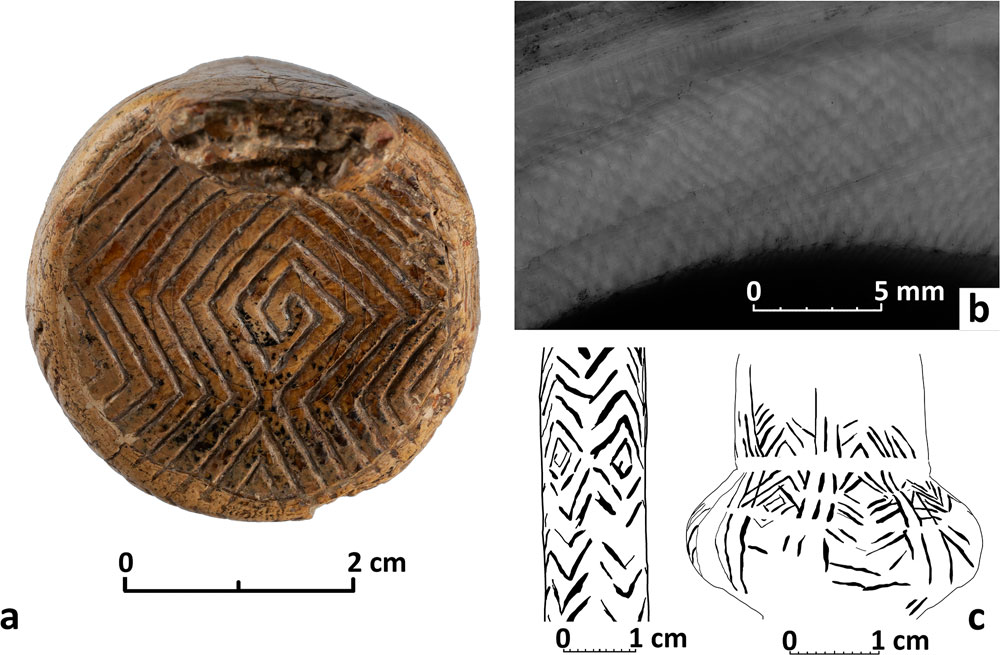
Artists followed the natural lines of the tusk
Mammoth ivory contains internal features known as Schreger and Owen lines. Schreger lines form intersecting patterns within the dentine, while Owen lines mark successive stages in the tusk’s growth, producing bands and flowing curves.
The Mizyn craftspeople did more than simply work around these natural features. They incorporated them into spirals, meanders and other geometric designs carved across the surfaces of the figurines.
On some objects, the engraved patterns closely follow the direction of the tusk’s growth lines. On others, the carvers transformed those natural features into more regular and elaborate decoration, demonstrating a detailed understanding of how mammoth ivory looked and behaved.
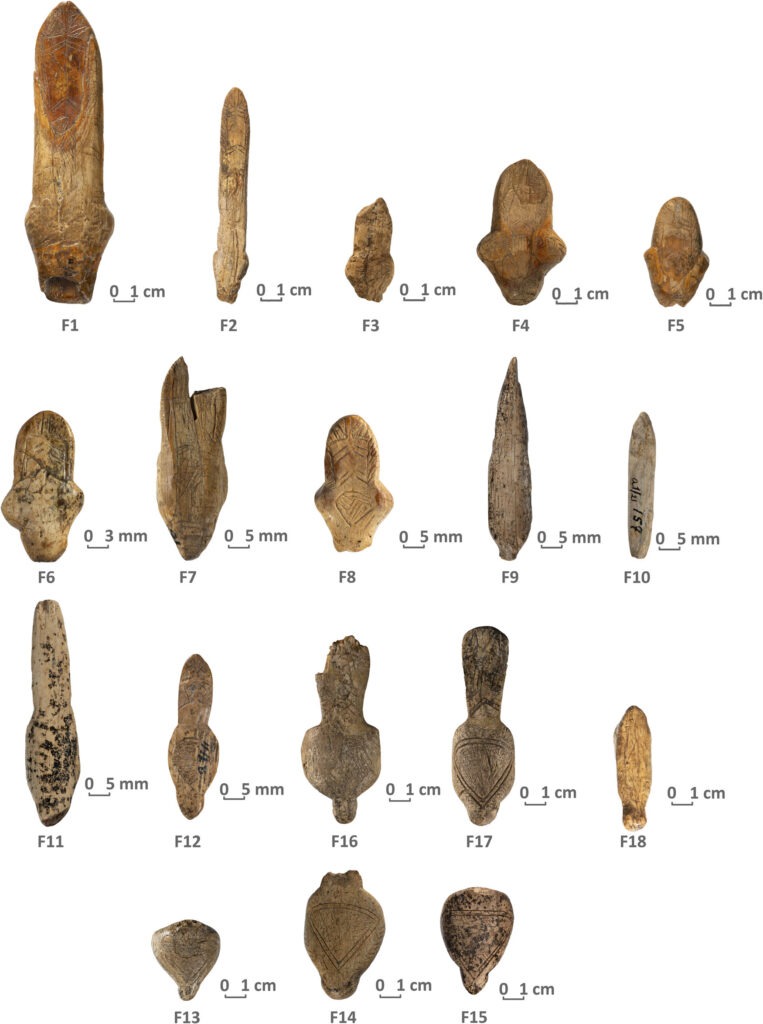
Eighteen figurines reveal a shared tradition
The Mizyn collection contains 18 small anthropomorphic figures traditionally interpreted as stylised female representations. Their forms vary considerably: some have long, narrow bodies, while others feature rounded lower sections and surfaces covered with dense geometric decoration.
Individual pieces have previously been described as female, bird-like, phallic or animal-shaped. The new analysis suggests that many may represent variations of the same artistic concept, with their differences partly determined by the original shape of the ivory and the amount removed during carving.

Several figurines combine a recognisable human outline with details interpreted as belts, pubic triangles, hair, clothing or fur capes. Geometric decoration appears alongside these features, blending three-dimensional sculpture with images engraved directly onto the surface.
A distinct artistic path in Eastern Europe
The figurines have been dated to between approximately 18,800 and 17,400 calibrated years before present. This places them among the earliest known anthropomorphic images created in Europe following the Last Glacial Maximum, although an earlier 27,000-year-old figurine with an expressive face discovered in France shows that Ice Age artists had already experimented with unusual forms of human representation.
The researchers also identified a gap of roughly 1,000 to 3,000 years in the production of human figurines across Europe during this period. When the tradition reappeared, the Mizyn objects emerged earlier than several better-known styles of highly abstract female imagery in Western Europe.
The collection may therefore represent an independent development in Eastern European Paleolithic art. Mizyn’s artists were not simply reproducing a style that had travelled from the west; the evidence suggests they developed their own approach around the physical properties of mammoth ivory.
Digitising the figurines during wartime
The research formed part of an urgent effort to preserve Ukraine’s cultural heritage digitally. In 2022, the National Museum of the History of Ukraine granted researchers limited access to the objects so they could create detailed digital records while the country remained at war.
Because the figurines are fragile and physical access was restricted, microscopic photography and 3D modelling became central to the investigation. These methods allowed the researchers to examine tool marks, engraving techniques and the position of each object within the original tusk.
The results show that mammoth ivory was more than a valuable raw material for Ice Age craftspeople. Its internal structure became part of the design, joining the natural growth of the tusk with the decisions of the human hand.
The peer-reviewed study, conducted by researchers from Ukraine, Norway, Germany and the United Kingdom, was published in npj Heritage Science.