
On a summer morning in 709 BCE, scribes in the court of the ancient Chinese state of Lu recorded a brief but astonishing line: “The Sun was totally eclipsed.”
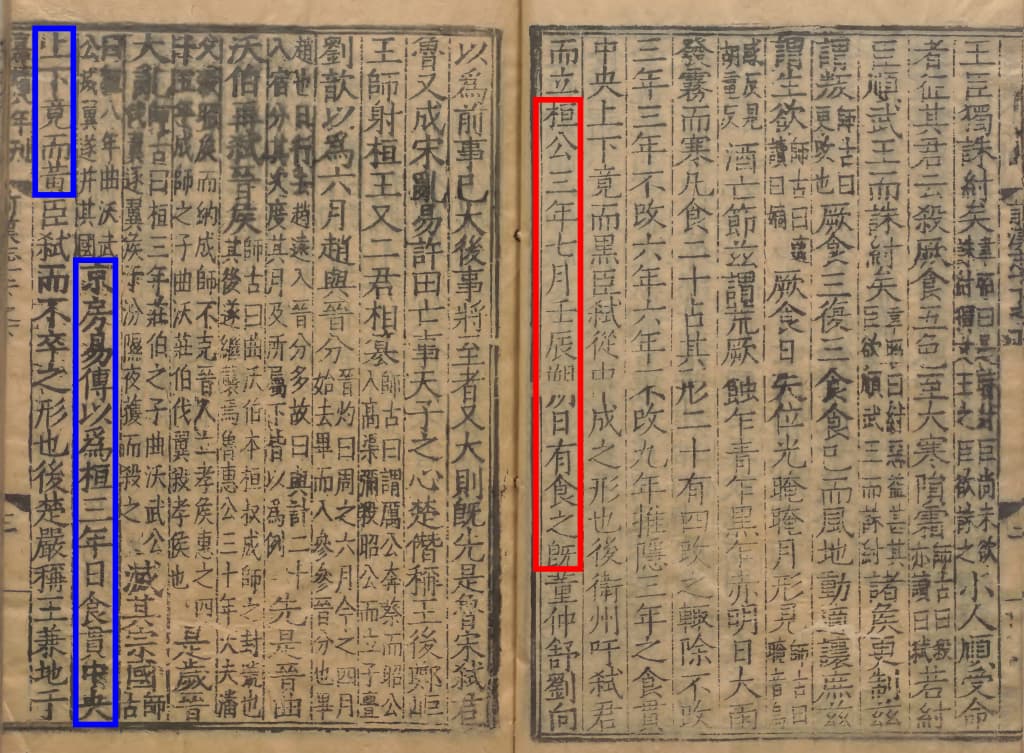
More than two millennia later, that simple sentence—along with a puzzling later note describing an eclipse “yellow above and below”—has now become the key to one of the most precise reconstructions ever made of Earth’s rotation and solar activity in the early first millennium BCE.
A reanalysis that connects astronomy, archaeology, and solar physics
A multinational team of researchers from Japan, the United Kingdom, and the United States has reexamined what is widely considered the earliest datable record of a total solar eclipse. The event, observed on 17 July 709 BCE, appears in the Spring and Autumn Annals (Chunqiu), and a later description survives in the Hanshu, compiled centuries afterward.
Their study—published in Astrophysical Journal Letters—combines historical geography, modern astronomical modelling, and archaeological data to tackle a long-standing mystery: did this eclipse really pass over the city of Qufu, the capital of Lu?
Modern astrophysical calculations had long suggested that totality should not have been visible from Qufu’s traditionally assumed coordinates. This mismatch hinted at a deeper problem—one that could distort both Earth-rotation modelling and historical eclipse reconstructions.
The archaeological key: Qufu was in the wrong place

Using excavation data and historical-geographical analysis, the team discovered that previous studies had mistakenly placed ancient Qufu eight kilometers away from its actual eighth-century BCE location.
Correcting this shifted the eclipse path precisely where the ancient record said it should be.
“With accurate coordinates, we were able to measure Earth’s rotation during the eclipse, determine the Sun’s rotational axis orientation, and simulate the corona’s appearance,” explained lead author Hisashi Hayakawa of Nagoya University.
This recalibration allowed the team to calculate ΔT—the parameter describing long-term changes in Earth’s rotation—at 20,264 to 21,204 seconds, one of the most precise values obtained for this period.
Coauthor Mitsuru Sôma of Japan’s National Astronomical Observatory emphasizes that this corrects earlier coordinate errors and strengthens the foundation for dating other ancient eclipses.
A rare, ancient glimpse of the solar corona
The Hanshu’s enigmatic description—“completely yellow above and below”—may refer to a symmetric, highly active solar corona. Although written centuries after the event and treated cautiously by the team, its morphology matches coronas observed during solar maximum, when magnetic activity peaks.
Crucially, the timing aligns perfectly with what tree-ring radiocarbon data indicate.
The eclipse occurred shortly after the end of the Neo-Assyrian (Homeric) Grand Solar Minimum (808–717 BCE), a prolonged period of weak solar activity. The 709 BCE event appears to capture the Sun as it emerged from centuries of magnetic quiet, returning to vigorous 11-year cycles.
“This unique historical hint on the corona provides a point-by-point reference for solar activity reconstructions derived from tree rings and ice cores,” said Mathew Owens of the University of Reading.
The match between textual morphology and radiocarbon-based solar models gives an independent validation of early first-millennium BCE solar cycles.
Ancient records, modern science
The study highlights the extraordinary scientific value of ancient Chinese astronomical documentation. Dynastic states maintained court astronomers and scribes not for scientific curiosity, but for ominology—the political and religious interpretation of celestial signs.
Yet their meticulous record-keeping has become one of the world’s richest archives for reconstructing historical astronomy.
As coauthor Meng Jin of the Lockheed Martin Solar and Astrophysics Laboratory observed:
“Some of our ancestors were exceptionally skilled observers. When we combine their careful notes with computational methods and historical evidence, we can recover information about Earth and the Sun from thousands of years ago.”
A 2,700-year-old eclipse as a modern scientific instrument
What began as a brief note in an early Chinese chronicle has become a precisely datable anchor point for:
- Earth’s rotational history
- Solar magnetic cycles
- The morphology of the ancient solar corona
- Archaeological reconstructions of early Chinese capitals
The total eclipse of 709 BCE now stands not only as a historical curiosity, but as a high-resolution probe into the behavior of our planet and its star across millennia—demonstrating how archaeology, history, and astrophysics can converge to illuminate the deep past with remarkable accuracy.
Hisashi Hayakawa, Mathew J. Owens, Meng Jin, Mitsuru Sôma, and Mike Lockwood, Analyses of the Ancient Chinese Report on the Total Solar Eclipse in 709 BCE: Implications for the Contemporaneous Earth’s Rotation Speed and Solar Cycles. ApJL 995 L1. DOI 10.3847/2041-8213/ae0461
Cover Photo: This image is an AI-generated artistic illustration created to visualize a hypothetical scene related to the 709 BCE solar eclipse. It does not depict a historical record or real individuals.