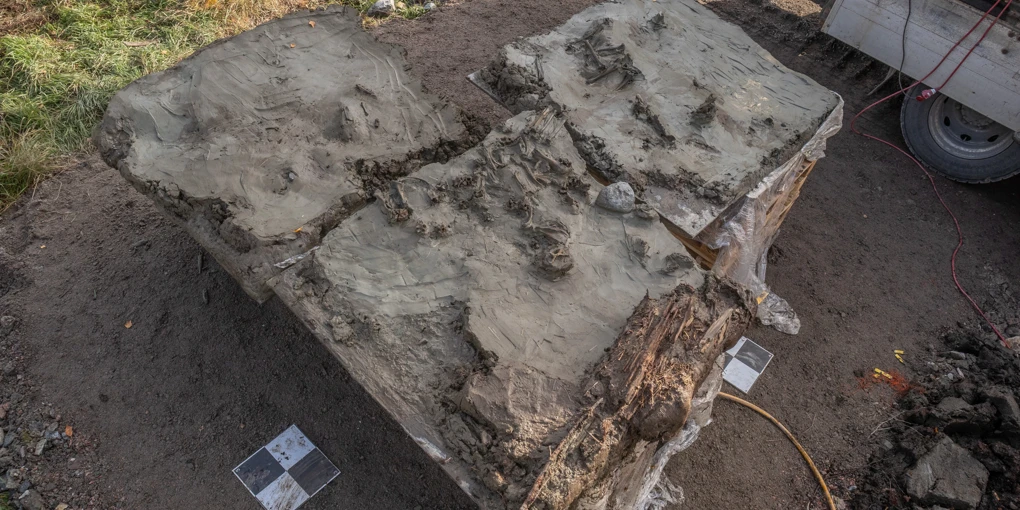
Five thousand years ago, in what is now southern Sweden, people deliberately lowered a large dog into a shallow lake and buried it with a finely crafted bone dagger. The discovery, made during railway construction near Stockholm, is one of the most extraordinary Stone Age animal burials ever found in northern Europe. Archaeologists say it offers rare insight into how humans viewed dogs, ritual, and the symbolic power of water in prehistoric life.
The burial was uncovered at Logsjömossen, a wetland near Järna southeast of Stockholm, during large-scale excavations linked to the Ostlänken high-speed railway project. What today is a peat bog was once a shallow lake surrounded by intensive human activity during the Late Neolithic period, roughly 3300–2600 BCE.
A burial placed beneath the water
Archaeological evidence shows that Logsjömossen was not a marginal landscape. Five millennia ago, people engineered the shoreline with sophisticated fishing installations, including woven wooden barriers and fish traps designed to funnel fish into baskets. The lake was a managed environment, central to daily survival.
It was into this setting that the dog was deliberately placed.

The skeleton was found about 1.5 meters below the present surface, roughly 30 to 40 meters from what would have been the prehistoric shoreline. Archaeologists believe the animal was wrapped in a hide or skin, weighted with stones, and carefully lowered into the water. The crushed skull suggests a purposeful act rather than an accidental death.
Beside the dog’s front paws lay a dagger measuring approximately 25 centimeters in length, carved from elk or red deer bone. Due to the oxygen-poor conditions of the wetland, both the skeleton and the dagger were exceptionally well preserved. The blade’s refined workmanship is so striking that it could easily be mistaken for a modern replica.
An animal with an active life
Analysis indicates that the dog was a large, powerfully built male, standing about 50–52 centimeters at the shoulder and between three and six years old at the time of death. Its bones show signs of an active life, suggesting close daily interaction with humans.
The animal likely moved alongside people, possibly assisting with hunting, guarding camps, or working near the fishing structures that dominated the site. While dogs were already integrated into Stone Age communities, complete dog burials are rare. Burials accompanied by weapon-like objects are rarer still.
“Finding an intact dog from this period is highly unusual,” said Linus Hagberg, archaeologist and project leader at Arkeologerna, part of the Swedish National Historical Museums. “That it was deposited together with a bone dagger makes the discovery almost unique.”
Ritual, symbolism, and belief
Why bury a dog with a dagger beneath a lake?
Archaeologists are cautious, but the evidence strongly points to a ritual act. In northern Europe, isolated dog skulls have occasionally been found near prehistoric fishing installations, including discoveries linked to the Fehmarn Belt tunnel project. A complete dog burial, however, carefully placed underwater and accompanied by a finely made dagger, sets Logsjömossen apart.
The dagger itself was unlikely to be an everyday tool. Its craftsmanship suggests symbolic value, possibly linked to status, protection, or ceremonial meaning. Placing it with the dog implies that the animal held a special role—perhaps as a companion, a guardian, or a participant in ritual practices connected to water, fishing, or the spirit world.
In many prehistoric belief systems, wetlands and lakes were viewed as liminal spaces, thresholds between the human realm and forces beyond it. The deliberate nature of the burial aligns with this wider pattern of watery offerings seen across prehistoric Europe.
Excavating a submerged past
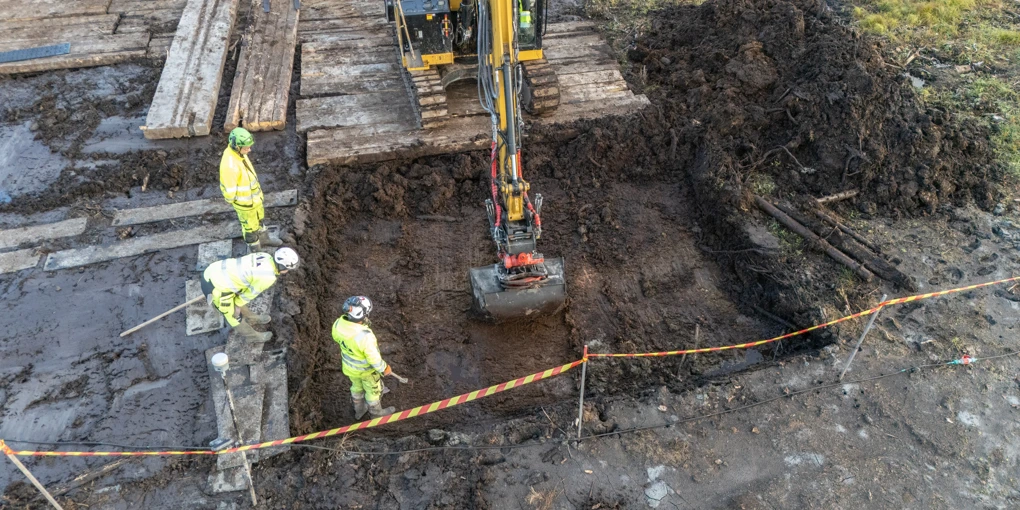
Recovering the burial was technically demanding. The excavation covered an area of roughly 2,500 square meters, divided into a grid of five-by-five-meter squares. The upper peat layers were saturated with water, making excavation extremely difficult.
To stabilize the site, archaeologists laid down around 200 timber mats to support heavy machinery. As each square was excavated, it quickly filled with water, requiring six pumps to operate continuously. Despite these conditions, the entire area was carefully documented using photogrammetry, producing detailed 3D models of every find in its original position.
“It has been a demanding fieldwork environment,” said Magnus Johansson, project manager for the Ostlänken Archaeology Project. “But the collaboration between archaeologists and construction teams worked extremely well.”
What the dog may still reveal
The dog, the dagger, and associated materials have now been transferred to conservation laboratories. Ongoing analyses, including radiocarbon dating, DNA sequencing, and isotope studies, aim to determine precisely when the dog lived, what it ate, and whether it was local or brought from elsewhere.
These results will illuminate more than the life of a single animal. They promise to deepen our understanding of how Stone Age communities organized their economy, related to animals, and embedded ritual meaning into landscapes shaped by water and survival.
Logsjömossen was already known as an important Late Neolithic site. With the discovery of a dog buried with a dagger beneath a vanished lake, it has become something rarer still: a direct glimpse into the emotional and symbolic world of prehistoric Scandinavia.
Sometimes, it seems, there really is a dog buried there—and its story reaches across five thousand years.