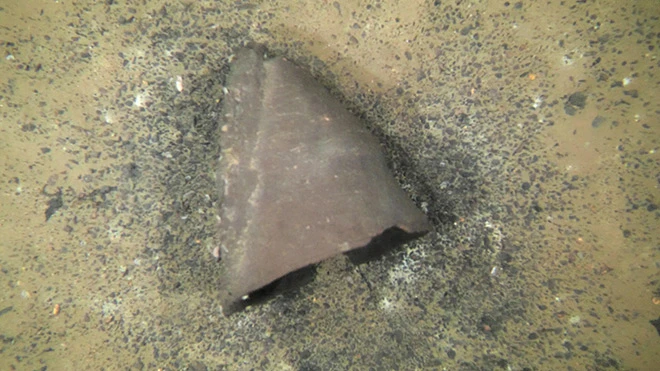
It began with a sweep of robotic sensors moving silently across the dark floor of Lake Biwa. What appeared first as a faint geometric outline soon resolved into one of the most extraordinary archaeological finds in Japan’s recent history: a nearly intact pottery vessel more than 10,000 years old, resting upright in the silt.
Recovered near the Tsuzuraozaki underwater ruins at a depth unreachable for most divers, the vessel is being described as a milestone that links the early Jomon world with the future of underwater exploration.
A Vessel Older Than Most Civilizations
Measuring about 25 centimeters tall and tapering into a pointed base, the vessel displays the engraved motifs characteristic of early Jomon craft traditions. Specialists attribute it to either the Jinguji-style or the Konami Upper-layer tradition, placing its creation between 11,000 and 10,500 years ago.
For Lake Biwa, this is unprecedented. Since the site was first noticed in 1924—when fishermen dredged up ancient shards by accident—nothing this old or this complete has ever been found.
The vessel’s survival is almost surreal. Unlike land sites where erosion and breakage are common, Lake Biwa’s deep basins create still pockets with minimal sediment accumulation. In the valley-like depressions around Tsuzuraozaki, tectonic activity keeps the lakebed exposed, preserving objects exactly where past communities left them.
The Early Jomon Signature
Archaeologists emphasize that the vessel bridges two important ceramic traditions.
The Jinguji-style is marked by soft contours, pointed bases, and delicate surface incisions—some of the earliest evidence for Japan’s experimentation with fired clay.
The Konami Upper-layer tradition, however, shows more refined firing control and linear decorative logic, representing a turning point when pottery began carrying social and aesthetic roles, not just utilitarian ones.
The Lake Biwa find sits precisely on this evolutionary threshold, offering researchers a rare, perfectly preserved reference for the earliest phases of Jomon ceramic culture.
Rewriting Underwater Archaeology Through Robotics
What makes this discovery exceptional is not only what was found but how it was found.
The October survey used a next-generation 3-D scanning system originally designed for submarine cable inspection. With four synchronized cameras, the platform generates underwater reconstructions with a clarity that rivals diver-recorded documentation—an almost impossible achievement in Lake Biwa’s murky, low-visibility environment.
Behind the scanners lies a larger technological shift. Over the past decade, Japan’s National Maritime Research Institute (NMRI) has transformed deep-sea robotics—AUVs with high-resolution sonar, autonomous navigation, and multi-vehicle coordination—into tools for inland archaeology.
Their hovering AUV “Hobalin” previously mapped submerged landscapes in Biwa; the latest systems go even deeper, operating far beyond the practical limits of human divers.
As underwater archaeologist Yoshifumi Ikeda notes, the new system produces data “comparable to what could be gathered by divers, even at depths exceeding 30 meters.”
The Lake Biwa vessel, recovered from 64 meters, demonstrates the power of these methods.
Layers of History Below the Waves
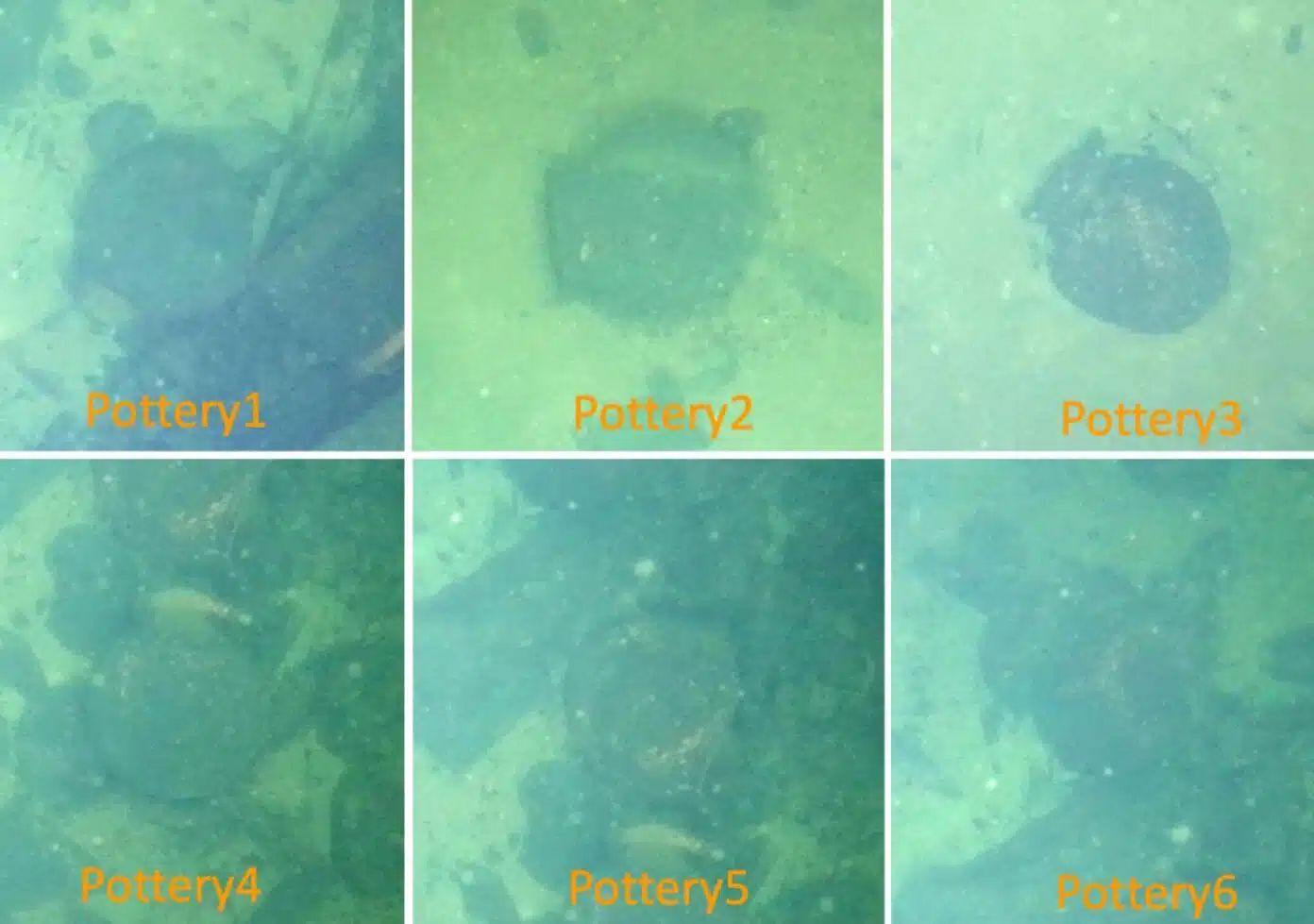
During the same survey, researchers identified six Haji-period jars dating to around 1,500 years ago—evidence that this deep-water zone has been touched by many communities across millennia.
Altogether, more than 200 pottery fragments from the Jomon to Heian periods have been documented since the early 20th century, yet the full scale of the Tsuzuraozaki site remains a mystery.
Scholars debate whether these materials represent ritual deposits, lakeside dwellings lost to land shifts, fishing communities displaced by rising waters, or episodes of seismic subsidence.
The newly discovered vessel—found upright, undamaged, and in situ—may provide the contextual anchor researchers have long needed.
A Turning Point for Global Underwater Research
What happened in Lake Biwa signals more than a single discovery. It marks a shift in how archaeology will approach deep-water environments worldwide. With nearly 400 underwater archaeological sites in Japan alone, robotic surveys are expected to accelerate dramatically, offering access to regions previously written off as unreachable.
As Professor Kenichi Yano observes, “This is a discovery that could only occur underwater. The preservation, location, and context offer insight impossible to obtain from land ruins.”
What emerges from the dark floor of Lake Biwa is not just a pottery vessel. It is the blueprint for a new era in archaeological science—one where robotics reveals prehistory with a clarity humans could never achieve alone.
Cover Image Credit: Pottery vessels observed on the lake floor using NMRI AUV technology, as reported in Latest Development Information on NMRI AUVs (2021).