
Nearly 8,000 years ago, Europe’s earliest farmers began confronting a problem no hunter-gatherer group had ever faced: what to do with the growing piles of rubbish created by a settled life. A new international project led by the University of York and Freie Universität Berlin argues that Neolithic waste is far more than an archaeological by-product — it is a cultural archive that reveals how early farming communities understood ownership, responsibility and the emotional weight of everyday objects.
Why Rubbish Stayed Close to Home
Across Europe, excavations consistently reveal pits filled with pottery sherds, butchered bones and domestic refuse positioned immediately beside houses. This pattern is striking. While mobile hunter-gatherer groups could simply relocate when waste accumulated, settled communities no longer had this option. Yet instead of distancing their rubbish, early farmers often kept it within the boundaries of the household.
For Professor Penny Bickle of the University of York, this shift may signal the emergence of a new mindset tied to sedentary life. Keeping broken or discarded items close could reflect a sense of ownership and responsibility — a recognition that waste remained part of the household’s material world even after its practical use ended. It may also point to intentional reuse or repair, a form of early recycling rarely acknowledged in popular narratives of prehistory.
The Emotional Afterlife of Broken Objects
Some of the strongest evidence for reuse comes from a new analytical technique developed by Dr. Bruno Vindrola-Padros at the Christian Albrecht University of Kiel. His method detects microscopic traces showing when pottery has been reshaped, reworked or repurposed. The findings suggest that broken vessels were not immediately considered “waste.” They often lived multiple lives.
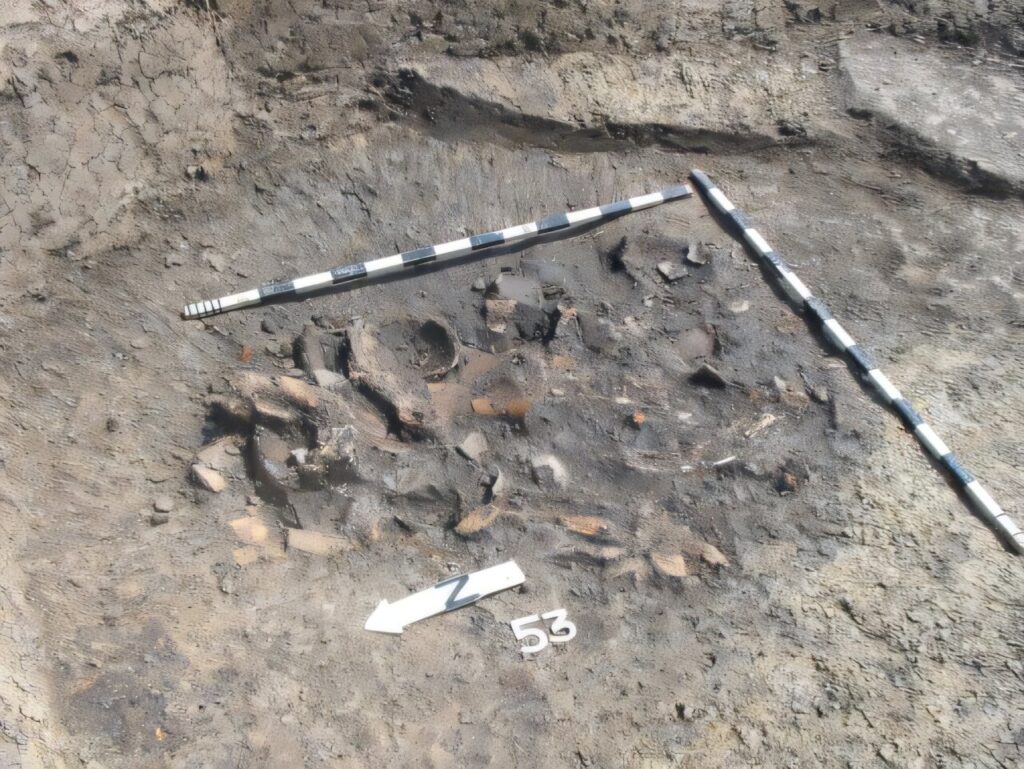
Vindrola-Padros argues that rubbish may even have held emotional or symbolic meaning. Certain broken objects appear in burial contexts, implying that their significance outlasted their functional role. If a vessel carried memory or identity, disposing of it far from home might have conflicted with the community’s values. In this light, Neolithic refuse pits become more than dumping grounds — they become archives of meaning.
Reconstructing the Afterlife of Pots and Bones
The project focuses on two of the most revealing material categories: pottery, which endures for millennia, and animal bone, whose decay patterns reveal environmental and daily-life conditions. Using microscopy, chemical analysis and digital reconstruction, the team will trace the “afterlife” of these objects — how they were used, broken, reworked and finally abandoned.
Research will take place at four sites stretching from the Balkans to the Baltic, enabling archaeologists to compare how different farming societies managed increasing quantities of refuse. This regional scope addresses a central question: did all early farmers treat rubbish similarly, or did local traditions shape how debris was understood?
Rethinking Waste Beyond the Neolithic
For Professor Henny Piezonka of Freie Universität Berlin, the findings have implications beyond archaeology. Modern societies treat waste as something to be removed from sight for hygiene and convenience. Yet Neolithic communities may have seen rubbish as potential material, as a persistent part of domestic life, or even as a connection to personal or ancestral memory.
The project — supported by the Deutsche Forschungsgemeinschaft (DFG) and the Arts and Humanities Research Council (AHRC) — brings together specialists from Austria, Poland, Romania, Serbia and Slovakia. Their goal is to uncover how the earliest European villages absorbed, reused and conceptualized waste, and how these choices shaped the structure and meaning of Neolithic household life.
Understanding these ancient strategies could inspire fresh ways of thinking about our own waste-driven world — reminding us that rubbish once carried meaning, responsibility and opportunity, not just inconvenience.
Cover Image: The illustration used in this article was generated with an AI-based image creation model to visually support the archaeological theme described in the text.