
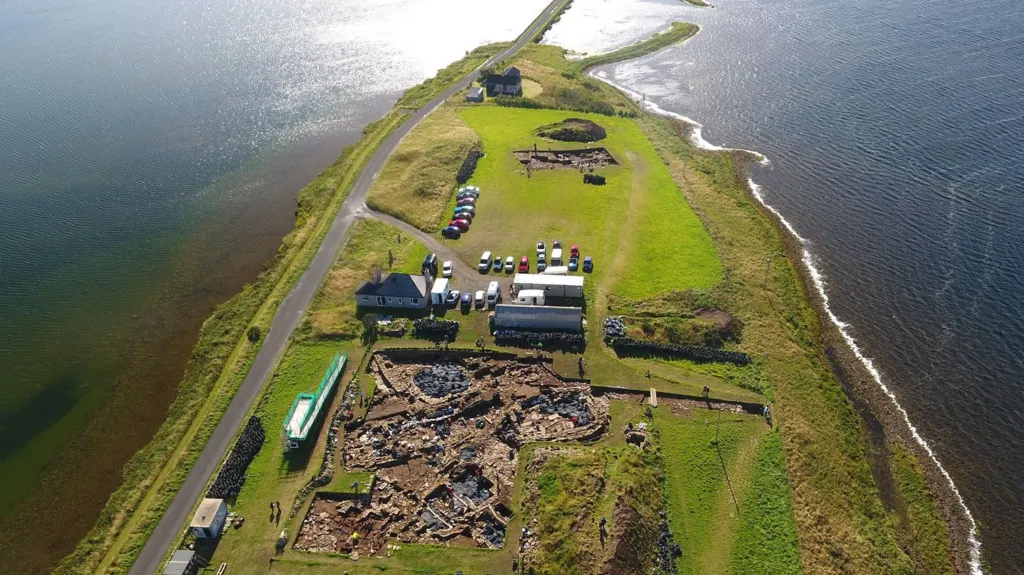
A site once thought thoroughly excavated may be preparing to deliver one of its most intriguing surprises. On Orkney’s Ness of Brodgar, new 3D Ground Penetrating Radar scans have revealed a puzzling subsurface feature that does not resemble anything previously documented on the site. The discovery has compelled archaeologists to return to a location where formal excavations concluded in 2024—but they are keeping quiet about what the anomaly might represent.
The find came during a new phase of geophysical exploration conducted last summer. For the first time in Scotland, researchers applied an advanced form of 3D GPR across the entire three-hectare complex, generating detailed images of the ground beneath the famous Neolithic structures. The results, according to the excavation team, exposed a shape entirely out of character with the rectilinear buildings and straight-line layouts that define the Ness.

Archaeologist Nick Card, a leading figure in the project since 2004, explained that the anomaly may challenge long-held assumptions about the site’s timeline. Speaking to BBC Radio Scotland, he noted:
“We think this is so unusual that it could add a new chapter to the history of the Ness.”
Card also emphasized that unlike the monumental Neolithic buildings uncovered over two decades, the newly detected feature sits in shallow deposits—meaning the upcoming work will be targeted rather than expansive.
“Don’t expect another 20 years of excavation,” he said. “The archaeology we’re about to uncover will be quite different. Possibly it is not Neolithic, but it could still be contemporary.”
Situated on a narrow strip of land between two lochs, the Ness of Brodgar has long been regarded as one of the most important prehistoric sites in Atlantic Europe. More than 40 structures—built between 3500 and 2400 BC—have been unearthed there, offering an unparalleled look into Orkney’s Neolithic world. The site lies just southeast of the Ring of Brodgar, a monumental stone circle often likened to a northern counterpart of Stonehenge.

Yet the anomaly revealed by the new radar survey suggests that the landscape’s story may not be fully told. The team’s immediate task is to transform the mass of geophysical data into precise 3D models, mapping the geometry of the feature before choosing a location for a small exploratory trench. Card describes this planned excavation as “keyhole surgery”, meant to verify what the technology has detected without disrupting preserved areas.
The renewed fieldwork will open to the public for four weeks in July 2026. The major Neolithic buildings, previously visible to visitors, will remain safely covered for conservation. Instead, visitors will witness a focused investigation into a feature that—whether Neolithic or later—has already raised more questions than answers.
For a site celebrated for its architectural clarity, the Ness of Brodgar may now be facing its most enigmatic discovery yet.
Cover Photo: Aerial view of the Ness of Brodgar, showing the excavated Neolithic structures positioned between the two lochs where the newly detected anomaly was identified during recent 3D GPR surveys. Credit: Scott Pike