
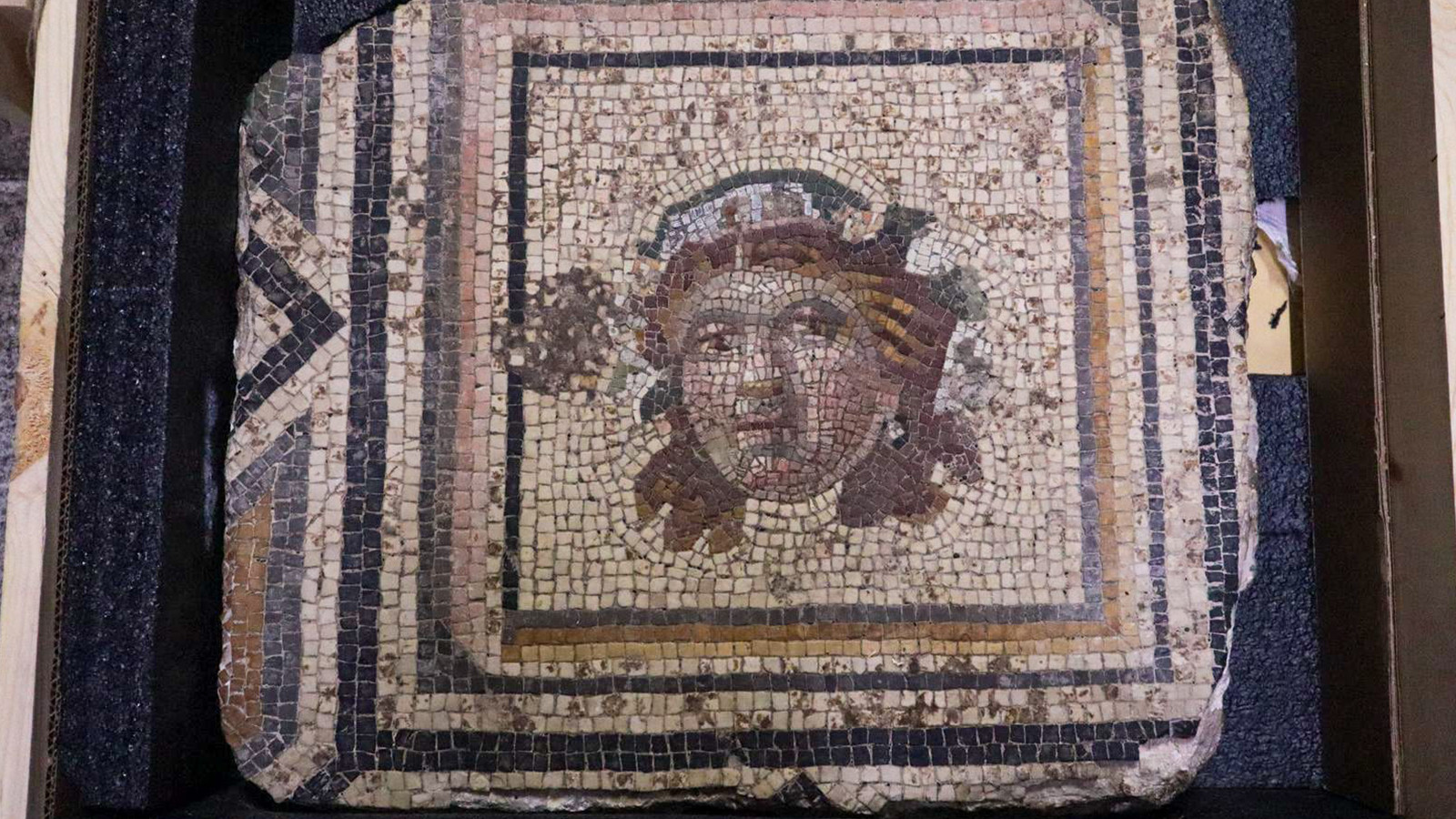
The Gypsy Girl mosaic, one of Turkey’s most recognizable ancient artworks, has gained another missing fragment after a panel linked to the Roman composition from Zeugma was returned from the United States.
Turkish Minister of Culture and Tourism Mehmet Nuri Ersoy announced on social media that the fragment, determined to belong to the famous “Gypsy Girl” mosaic composition from Zeugma, has been brought back to Turkey following scientific analysis and international cooperation.
The panel is now the 13th returned piece associated with the same large mosaic. Twelve other panels from the composition were previously repatriated from Bowling Green State University in 2018.
A Roman masterpiece broken apart
The “Gypsy Girl” mosaic was discovered during rescue excavations at Zeugma, the ancient city on the Euphrates in today’s Gaziantep province. The site is known for its richly decorated Roman villas and some of the finest mosaics ever unearthed in Turkey.
The larger floor mosaic, uncovered in 1998, measures roughly 9.25 by 13.50 meters. Its best-known figure, popularly called the “Gypsy Girl,” is widely interpreted as a Maenad, one of the female followers of Dionysus. Her direct gaze helped turn the image into an emblem of Gaziantep and one of the most recognizable faces of ancient art in Turkey.
But the mosaic’s modern story has also been shaped by loss. Parts of the composition were removed before the work came fully under protection, leaving scholars and museum officials to trace scattered fragments across collections and the art market.
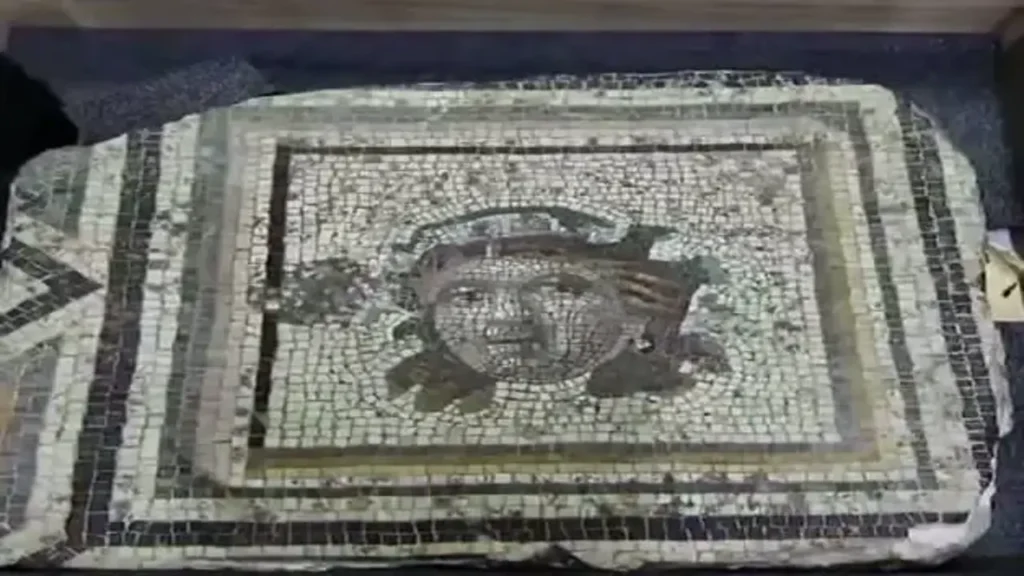
Auction listing raised the alarm
The latest panel came to attention after appearing for sale through an online auction platform. Dr. Djamila Fellague of Grenoble Alpes University noticed that the piece may have belonged to the Zeugma composition and shared the information with Prof. Dr. Kutalmış Görkay, head of the Zeugma excavations.
Görkay then informed the Turkish Ministry of Culture and Tourism, triggering a closer examination by ministry experts.
The assessment focused on more than surface resemblance. Specialists compared the colors of the tesserae, the geometric border, the composition scheme and the physical traces left by removal. These details supported the conclusion that the panel came from the same Zeugma mosaic group.
Evidence led to repatriation
After the technical evaluation, Turkey contacted U.S. Homeland Security Investigations. The case was strengthened by the earlier return of 12 Zeugma panels in 2018, which had already shown that sections of the same mosaic had left Turkey and entered foreign collections.
Following the investigation, the newly identified panel was handed over to the Turkish Consulate General in Chicago. It was then transported to Turkey by Turkish Cargo and delivered first to the Museum of Anatolian Civilizations in Ankara.
The piece is expected to be transferred to the Zeugma Mosaic Museum in Gaziantep after official procedures are completed.
For Zeugma, the return is more than an addition to a museum display. It is another step in rebuilding a fragmented Roman artwork whose missing pieces have become part of a much larger story about archaeology, looting, recovery and cultural memory.