
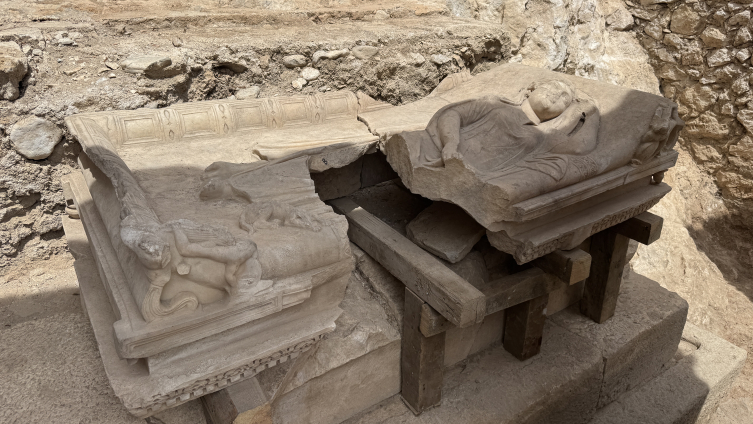
A monumental tomb uncovered in the ancient city of Olympos on Turkey’s Mediterranean coast is offering a rare look at how one elite woman was remembered in Roman-period Lycia.
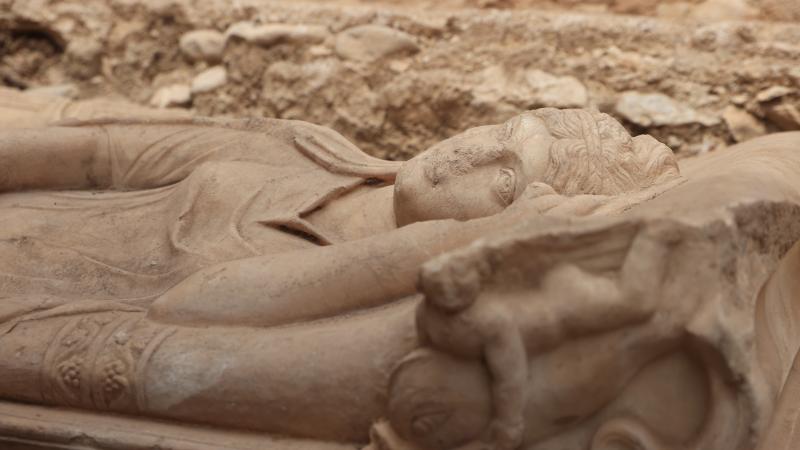
The discovery was made in the harbor district of Olympos, a coastal settlement in Antalya’s Kumluca district and one of the best-known cities of ancient Lycia. Inside a vaulted tomb rising about 10 meters high, archaeologists found a marble sarcophagus decorated with hunting scenes, Nike and Eros figures, and motifs associated with immortality.
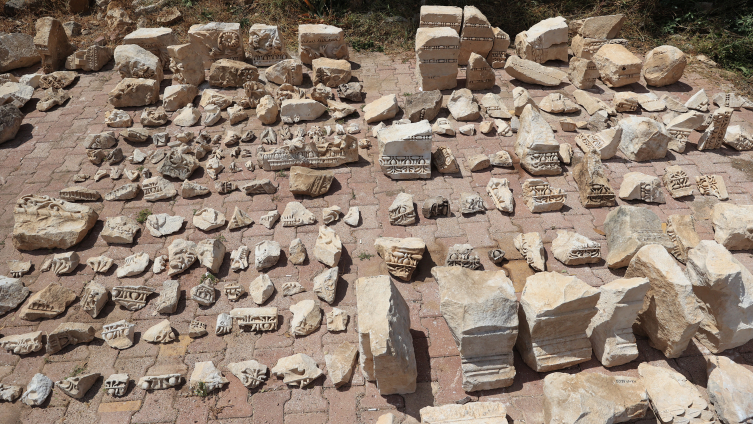
The sarcophagus was not found intact. Its lower section had been damaged, and nearly 50 fragments are now being restored by the excavation team. Once the pieces are reassembled and conserved, the tomb is expected to be opened to visitors.
An elite burial near the ancient harbor
The new tomb was identified in an area of Olympos already known for monumental burials. Until this season, archaeologists had documented two major tombs in this part of the site. The latest discovery confirms a third example, suggesting that the harbor zone also served as a prominent burial area for powerful families.
Excavation director Assoc. Prof. Dr. Gökçen Kurtuluş Öztaşkın of Pamukkale University told Anadolu Agency (AA) that the team found the structure while continuing work among the vaulted tombs near the port.
The placement is important. In an ancient harbor city, this was not a hidden cemetery on the edge of town. It stood close to a zone of movement, trade, arrival, and departure. For a wealthy family, building a tomb there meant placing memory in a visible part of the city.
A sarcophagus carved with power and immortality
The imagery on the sarcophagus helps explain why archaeologists identify the burial as aristocratic. Hunting scenes were especially popular among Roman elites. They were not only decorative. They projected control, courage, refinement, and social rank.
The figures of Nike and Eros add a more symbolic layer. Nike, associated with victory, and Eros, linked with love and desire, often appeared in Roman visual culture. On a funerary monument, however, such figures could carry meanings tied to remembrance, continuity, and the hope that death did not erase status.
The marble also tells part of the story. The sarcophagus was made from high-quality stone brought from İscehisar in Afyonkarahisar, a major marble-producing region in western Anatolia. Moving that material to Olympos required wealth and access to supply routes. It was the kind of choice made by a family with money, position, and a desire to be seen.
Olympos and the world of Roman Lycia
Olympos was one of the important cities of ancient Lycia, a region in southwestern Anatolia known for its distinctive tomb traditions, strong local identity, and participation in the Lycian League.
The city’s position helped shape its history. Set between mountains, a river valley, and the Mediterranean, Olympos connected inland Lycia with maritime routes across the eastern Mediterranean. Its ruins preserve traces of Hellenistic, Roman, and Byzantine life, including tombs, churches, bath structures, streets, and harbor remains.
The newly discovered tomb fits into that wider story. It shows how Roman-period elites in Olympos used local space, imported stone, and familiar mythological imagery to present themselves after death.
The restoration work also continues a larger pattern at the site. Last year, two sarcophagi discovered in Olympos were restored after being recovered in 722 separate fragments. The new sarcophagus, though less fragmented, will require the same careful process before it can be displayed.
For Olympos, the find adds more than another monument. It gives archaeologists a clearer view of elite female commemoration in a Lycian harbor city, where death, status, and public memory were carved into stone.