For more than four decades, archaeologists at Limyra in southern Turkey searched for a sanctuary they knew existed only through inscriptions. Season after season, the city surrendered new structures, new tombs, new fragments of memory — but the Zeus Temple remained elusive.
A Breakthrough Beneath the Orange Trees
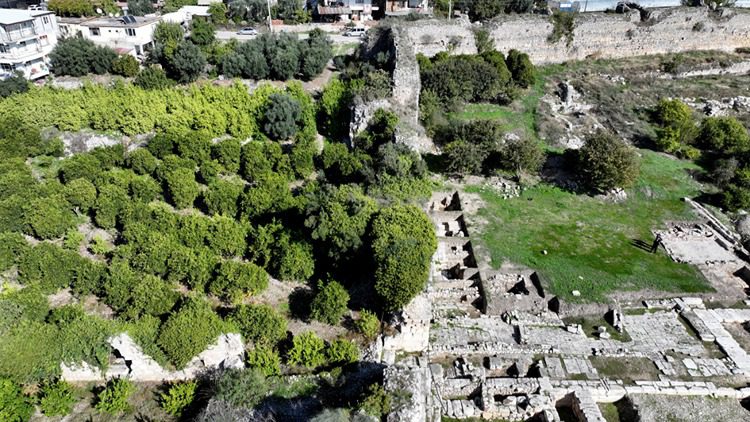
The 2024 excavation season, carried out with the Austrian Archaeological Institute and coordinated by Assoc. Prof. Kudret Sezgin, has finally pinpointed the temple’s location — concealed beneath a modern orange grove and partly overlain by a later Byzantine fortification wall.
Why This Temple Matters
Limyra, built against the foothills of Mount Toçak near modern Finike, was once a dominant center in eastern Lycia. Under Lycian King Perikle, it became a political stronghold; in the Byzantine era, it rose as a regional episcopal seat.
Despite the extensive mapping of its rock-cut tombs, the Ptolemaion, Roman baths, the Perikle Heroon, and the 6,000-seat theater, one structure never surfaced: the Zeus Temple, the city’s principal cult site in the Classical, Hellenistic, and Roman periods.
Its absence left a hole in the city’s sacred geography — a gap that archaeologists have finally been able to close.
Unearthing the Sanctuary
Excavations in the western zone revealed the temple’s eastern façade, including its main entrance and the ante walls that framed the processional approach.
The exposed frontage measures about 15 meters wide, making it one of the city’s more substantial Classical-period cult buildings.
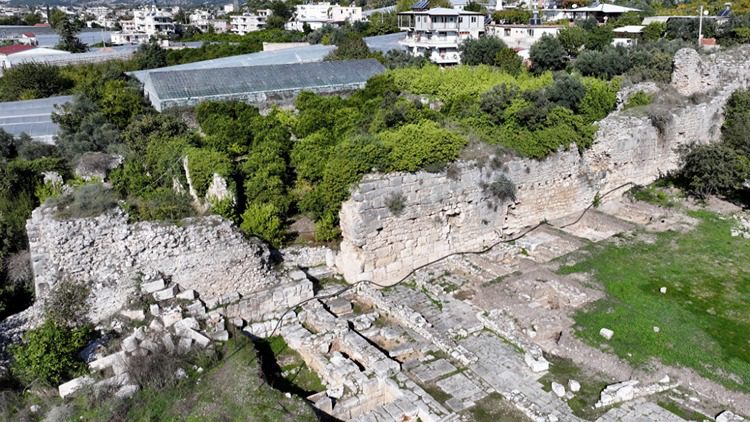
But the most intriguing detail lies underground: the cella, or sacred chamber, continues beneath a privately owned orange grove. Excavations will extend into this section once expropriation procedures conclude.
According to Sezgin, these finds reshape how the city’s ritual spaces were organized:
“We’ve known the temple existed for decades, but not where it stood. The new architectural evidence gives us the geometry we were missing.”
A Timeline Pushed Back 5,000 Years
Ceramic material uncovered around the sanctuary indicates that Limyra’s occupation stretches beyond the Classical horizon — reaching back to 3000 BCE.
This means the city’s roots go far deeper than traditionally assumed, linking it to much earlier settlement systems across southwestern Anatolia.
Rewriting Limyra’s Sacred Map
The discovery resolves several long-standing puzzles. A monumental propylon beneath the Roman Street — once interpreted as a civic gate — now appears to be the original entrance to the Zeus sanctuary during the Classical period.
Likewise, the so-called “Hellenistic fortification wall” is now understood as part of the sanctuary’s perimeter enclosure, not a military structure.
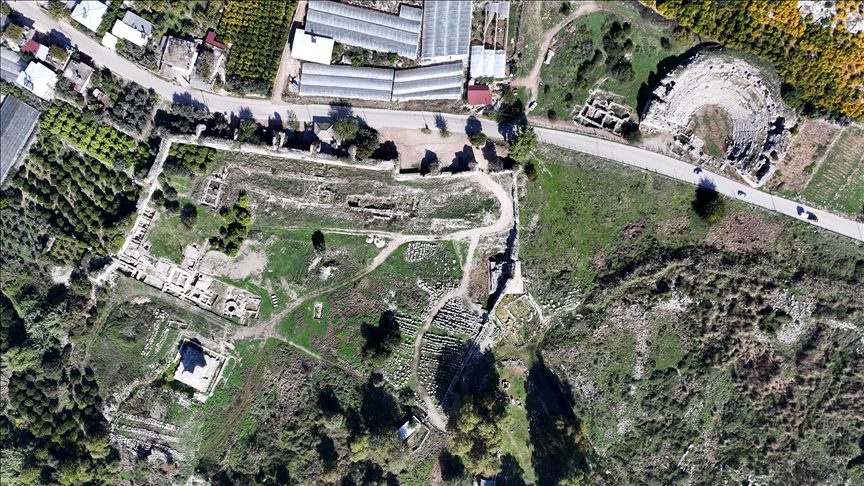
Limyra’s religious landscape, long interpreted through fragmented clues, has suddenly become legible again.
Cover Image: An aerial view of the western sector of Limyra, where the newly identified Zeus Temple lies partly buried beneath a modern orange grove. A Byzantine fortification wall runs directly over the temple’s eastern façade. Credit: AA