
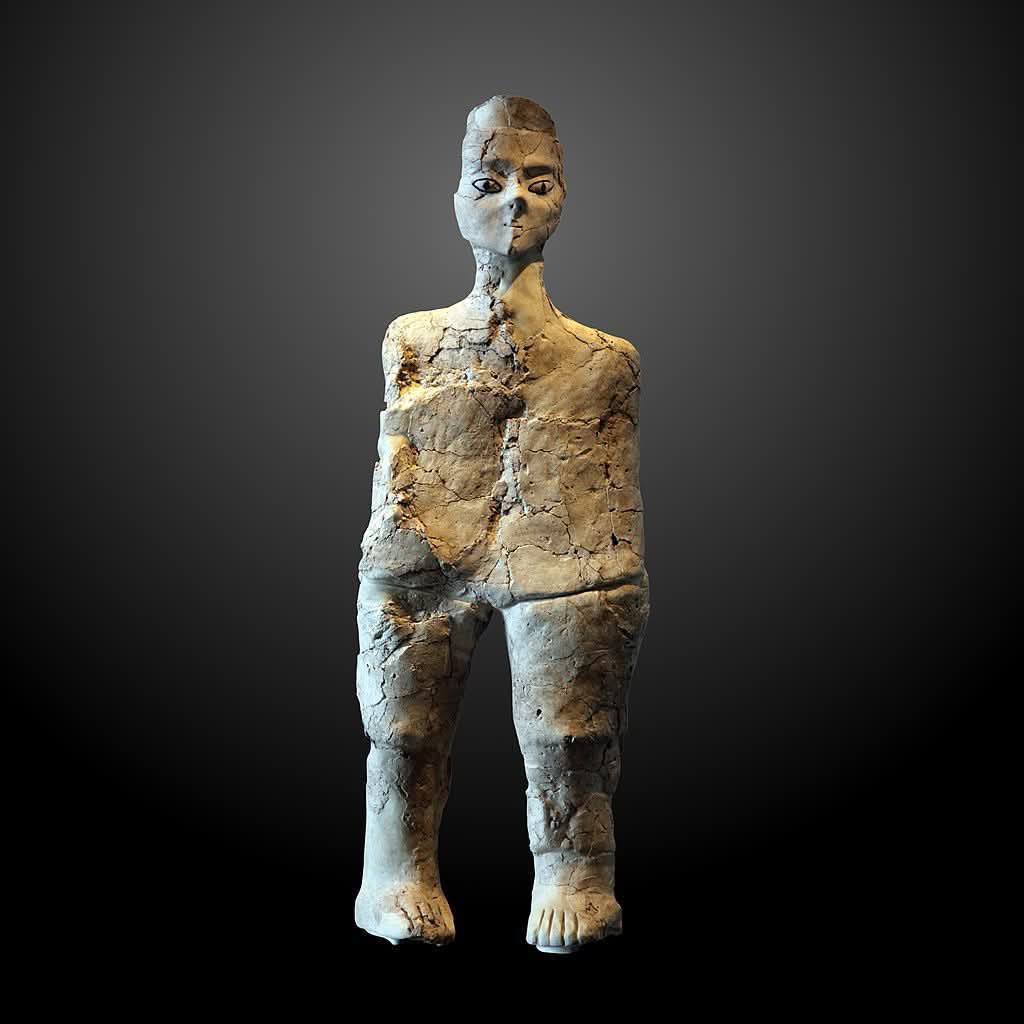
Archaeologists are once again turning their attention to one of the most startling artistic breakthroughs of the Neolithic world: the monumental statues of Ain Ghazal, dating back nearly 9,000 years. Crafted between 7200–6250 BCE, these lime-plaster and reed figures rank among the earliest large-scale human representations ever created — and they refuse to fit into any neat archaeological category.
Discovered in 1983 and 1985 in two separate underground pits, the cache includes 15 full statues, 15 busts, and several fragmented pieces. Each group was deliberately buried soon after being made, suggesting the figures were never intended for long-term display. Instead, they appear to have been produced for intense, short-term ritual use — and then sealed underground with purposeful care.

A Neolithic Settlement Capable of Monumental Art
Ain Ghazal, once a sprawling Pre-Pottery Neolithic settlement near modern Amman, housed as many as 3,000 people at its peak — a population size impressive for the 8th millennium BCE. While similar communities in the Near East produced small figurines, Ain Ghazal went a different direction entirely: human-sized sculptures with hauntingly stylized eyes, elongated limbs, and minimal features.
The technical sophistication is striking. Craftspeople shaped each figure using
- a bundled organic core made from reeds or twigs,
- coated with meticulously prepared lime plaster,
- finished with painted details.
This level of material control — especially the large-scale use of lime plaster — is extraordinary for such an early date.
Why Were They Buried? The Debate Continues

Researchers still disagree on the purpose of these statues. There is no consensus, but several competing theories dominate the field:
- Ancestor veneration: Their human-like proportions may reflect an attempt to represent founding figures of the community.
- Ritual or ideological icons: The identical, often expressionless faces point toward ceremonial use rather than portraiture.
- Community identity markers: Their sudden appearance and equally sudden disappearance around 6500 BCE may indicate a social transformation, collapse, or ideological shift.
What makes them even more unusual is the way they were disposed of: laid carefully in pits, handled as if they still “mattered” even after their function had ended. This is not waste. It’s closure.
From Amman to Paris and Abu Dhabi: The Statues Today
The majority of the figures are housed in The Jordan Museum and displayed at the Amman Citadel. However, several pieces traveled abroad on long-term loan:
- A near-complete statue stands in the Louvre Museum, Paris,
- Fragments of three others are held by the British Museum,
- One of the rare two-headed statues is displayed at Louvre Abu Dhabi.
Their global presence has transformed Ain Ghazal from a regional site into one of the most talked-about Neolithic discoveries of the past half-century.
Why Ain Ghazal Still Matters
Ain Ghazal forces archaeologists to confront a simple but uncomfortable fact:
complex artistic expression didn’t begin with cities, metallurgy, or state-level societies.
It began much earlier, with farming communities who were still experimenting with identity, ritual, and memory.
This is why these sculptures continue to draw international attention — not because they are mysterious, but because they prove early humans thought much bigger than we previously assumed.
Image: Ain Ghazal statues (c. 7200–6250 BCE).
Source: Public domain
Used for news reporting.