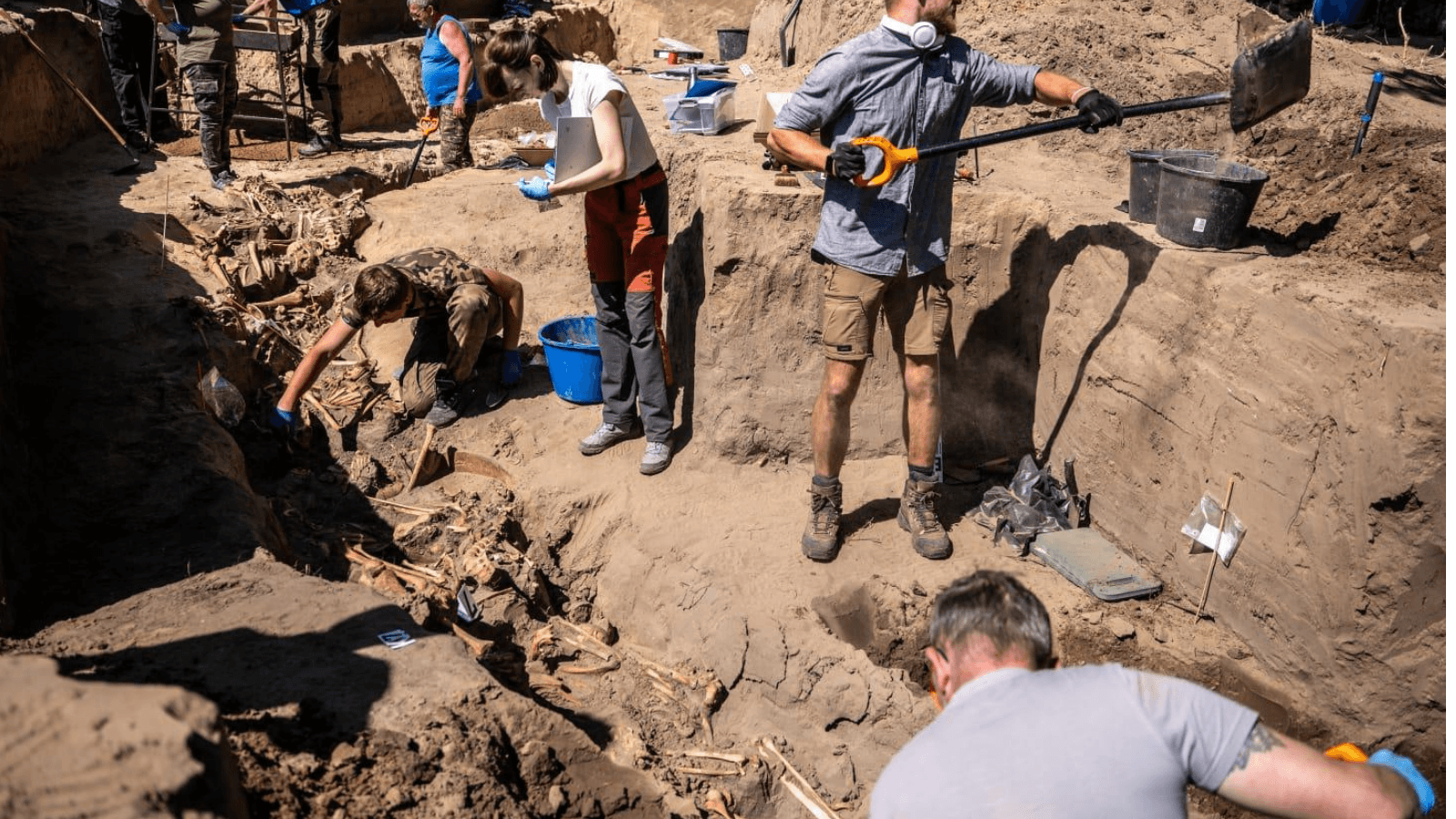
Archaeologists investigating a mass grave in northern Poland have documented the remains of at least 132 men killed during a Nazi campaign against people with mental disorders and disabilities in 1939. The grave also contained hundreds of clothing buttons, bullets and an insignia associated with German police and gendarmerie units.
The burial lies in the so-called Death Valley near Chojnice, where German forces carried out mass executions during the first months of the Second World War. Archaeologists uncovered the remains in May 2024, while a new study published in the Journal of Field Archaeology now presents the archaeological, anthropological and historical evidence in detail.
Researchers describe the site as the first archaeologically documented mass grave directly linked to people targeted under the Nazi concept of Lebensunwertes Leben — “life unworthy of life.” Nazi racial and eugenic policies used the term to justify the persecution and murder of people with mental disorders and disabilities.
A military trench became an execution site
Before Germany invaded Poland in September 1939, the Polish army had dug defensive trenches in fields north of Chojnice. German forces later used sections of those fortifications for executions and burials.
Historical testimony connects the newly studied grave with patients from the National Social Welfare Institutions in Chojnice, which included a branch of the psychiatric hospital at Kocborowo.
A former hospital employee testified that the facility housed 218 adult male patients. According to surviving accounts, German personnel began removing groups of patients by truck in late October and early November 1939. Staff were initially told that the men would be transferred to another hospital.
Witnesses later described patients being taken into nearby fields, led toward a military trench and shot with rifles and pistols. Historical investigations concluded that 218 patients from the institution were murdered. Only two have so far been identified by name.
Archaeologists spent several years examining the landscape through archival research, aerial photographs, geophysical surveys and test trenches. On May 14, 2024, excavation of Trench 27 exposed human remains at the bottom of the former military fortification.
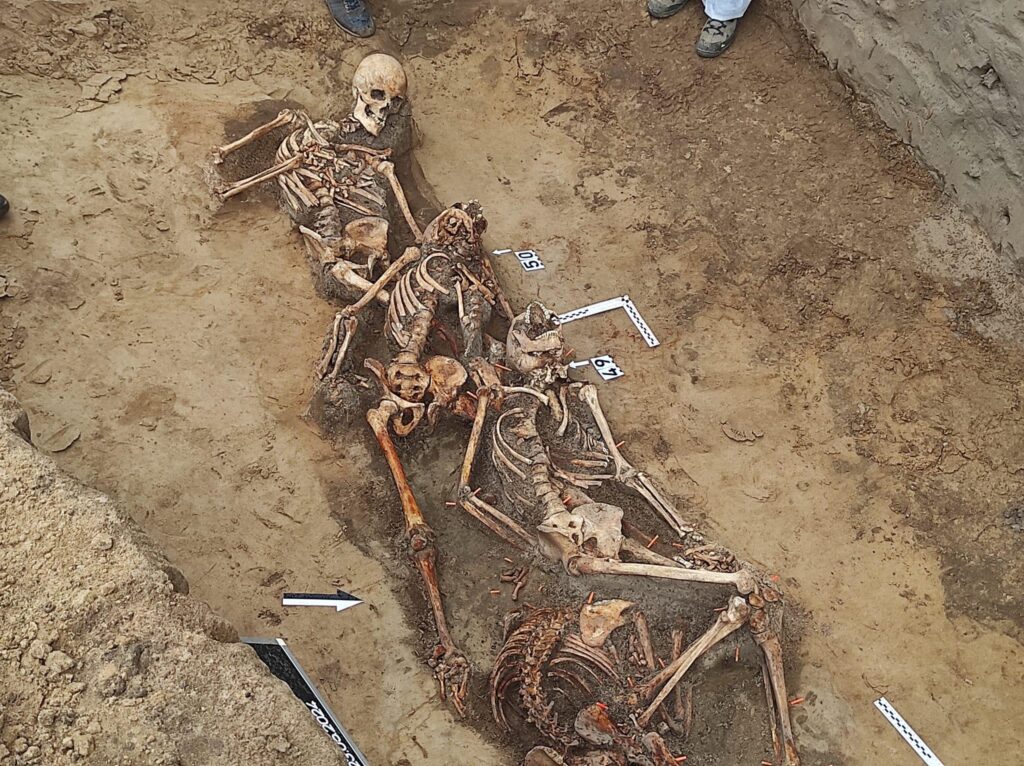
Anthropological analysis established a minimum of 132 individuals, based on the number of right upper-arm bones. All were male, and many were young adults.
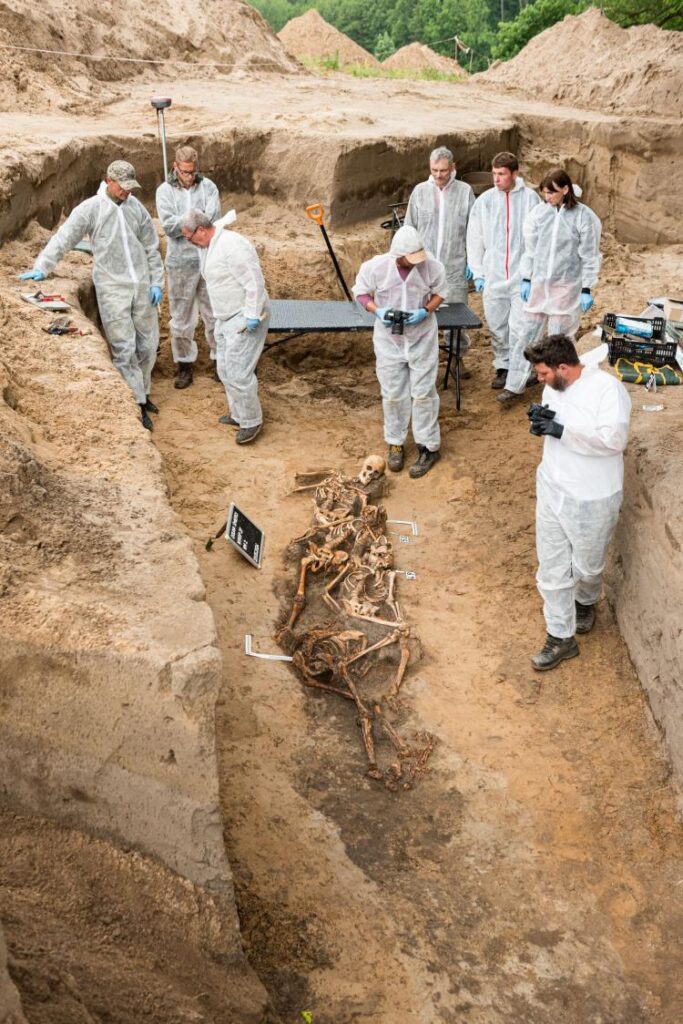
The bones also preserved evidence of gunfire. Researchers identified gunshot damage in at least 27 skulls, while 37 mandibles or mandibular fragments showed trauma sustained around the time of death. Bullets were found among and, in some cases, within the remains.
More than 300 buttons provided a crucial clue
The grave contained more than 300 small zinc buttons, a detail that helped connect the burial with institutionalized patients.
Witnesses had reported that some of the men wore pajamas and underwear when German personnel removed them from the institution. Fabric fragments were still present when investigators opened part of the grave in 1945, but the textiles had decomposed by the time archaeologists returned decades later. The metal buttons survived.
The absence of ordinary personal belongings provided another clue. A nearby mass grave containing members of the local elite yielded rosaries, crucifixes, medallions, keys, glasses, footwear and other possessions. The patients’ grave lacked the same range of everyday objects.
Researchers argue that this pattern fits people taken directly from an institution while wearing basic clothing rather than individuals arrested during normal daily life.
The ammunition recovered from the grave also helped reconstruct the killings. Archaeologists found cartridges and bullets associated with Mauser rifles, 9 mm Parabellum weapons and 7.65 mm Browning pistols.
Several Browning bullets carried nickel-plated jackets linked to ammunition available on the civilian market and used by German police and gendarmerie units. Excavators also recovered an aluminum eagle emblem worn on the shako-style caps of German police and gendarmerie personnel.
Taken together, the finds support the study’s conclusion that members of these units participated in the executions.
A grave partly opened in 1945
The condition of the skeletons revealed another part of the site’s history.
Polish investigators exhumed 61 skulls from the grave in 1945 but left much of the remaining skeletal material behind. During the recent excavation, archaeologists encountered 40 skeletons without skulls or mandibles, a pattern consistent with that earlier intervention.
The Chojnice killings formed part of a much larger Nazi campaign. The study estimates that German forces murdered approximately 4,000 psychiatric patients in the pre-war Pomeranian Voivodeship during the occupation.
At other execution sites, German units later returned under Aktion 1005 to exhume and burn bodies in an effort to destroy evidence of mass murder. Much of the Chojnice burial examined in the new study, however, remained intact enough for archaeologists to document the victims and associated objects more than eight decades later. Elsewhere in Poland, archaeologists are also investigating six unidentified skeletons found beneath Hermann Göring’s former residence at Hitler’s Wolf’s Lair, although their date and circumstances of death remain unresolved.
That survival allowed researchers to compare human remains, ammunition, clothing fasteners, archival records and eyewitness testimony within the same archaeological context.
The importance of the Chojnice grave therefore goes beyond identifying another Nazi execution site. It provides physical evidence of how a policy that classified people with mental disorders and disabilities as “life unworthy of life” was put into practice during the opening months of the war.
Cover Image: Archaeologists excavate a mass grave in Death Valley near Chojnice, Poland, where victims killed by German forces in 1939 were uncovered. Credit: Institute of National Remembrance (IPN), Gdańsk Branch