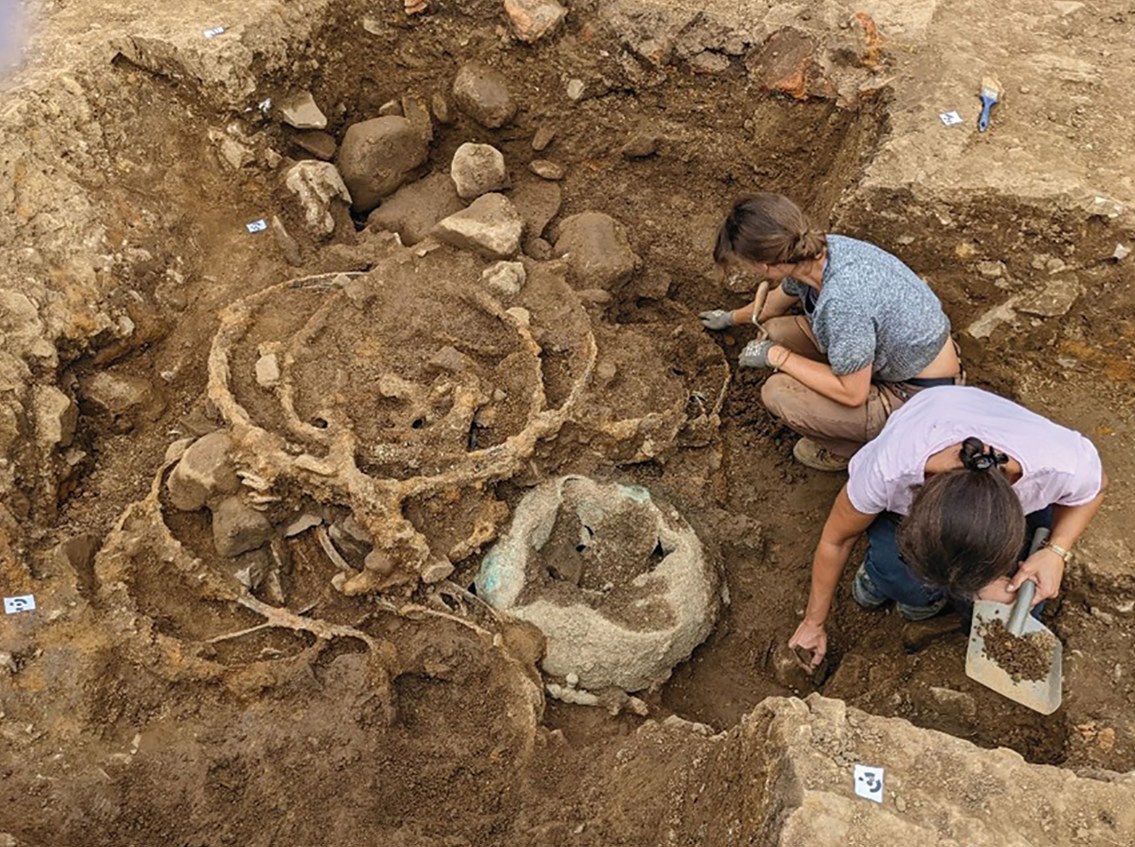
An Iron Age wagon discovery in northern England is offering rare insight into ancient transport and elite power. Near the village of Melsonby, archaeologists uncovered a vast deposit of deliberately destroyed vehicles, weapons, and ceremonial objects dating back more than 2,000 years.
The excavation brought to light two large hoards containing nearly 1,000 metal artifacts, most of them associated with horse-drawn transport. Among the most important findings is clear evidence for four-wheeled wagons in Iron Age Britain, a type of vehicle previously known mainly from continental Europe.
A Carefully Structured Deposition
The objects were not scattered randomly but placed in a controlled and deliberate way. In one of the deposits, archaeologists found 28 iron wheel rims stacked together, all of them bent or deformed before burial. This detail is critical, because it suggests that entire vehicles were intentionally dismantled and symbolically destroyed before being placed underground.
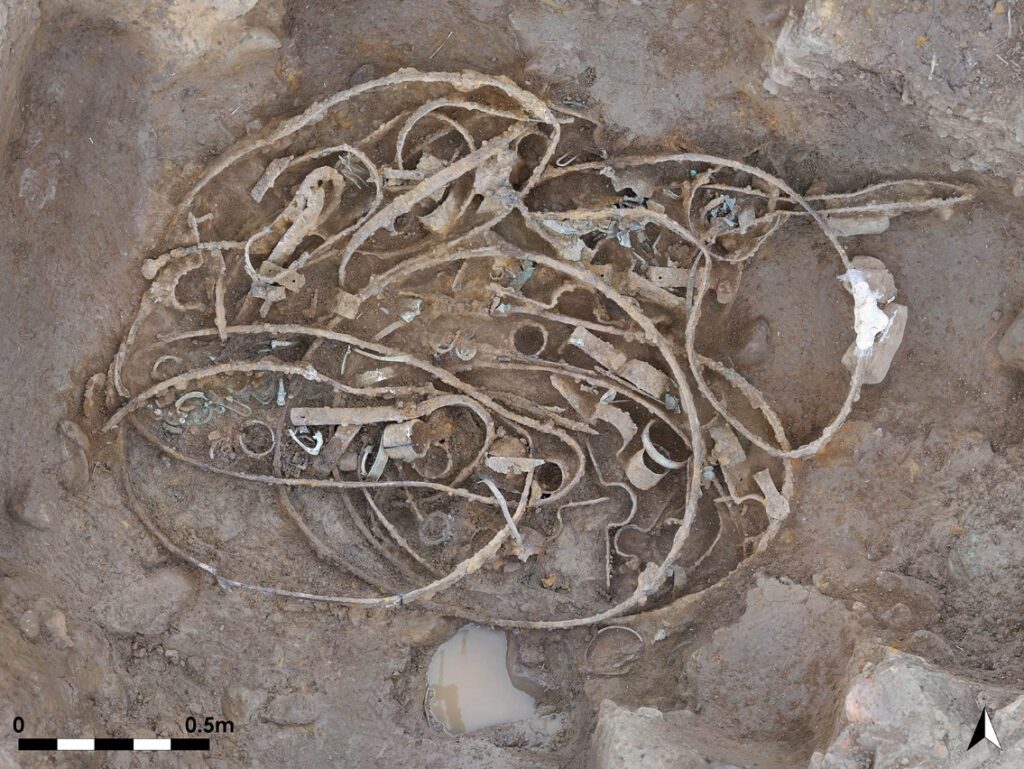
A second deposit revealed a different but equally striking pattern. The objects had been compressed into a dense bundle, so compact that it had to be removed as a single block. Later scans showed spearheads, harness fittings, and metal components tightly grouped together, likely wrapped before burial. This level of organization points to a single, carefully planned event, not a gradual accumulation.
Evidence That Changes the Narrative
For decades, the dominant interpretation was that Iron Age Britain relied mainly on two-wheeled chariots. The Melsonby discovery challenges that view in a fundamental way. The presence of large wheel components, kingpins used for steering, and heavy structural fittings indicates the use of substantial four-wheeled wagons.
Researchers estimate that the assemblage represents at least seven vehicles, possibly more. These were not lightweight chariots but larger constructions that may have played roles in transport, ceremony, or elite display.
Wealth on Display—Then Destroyed
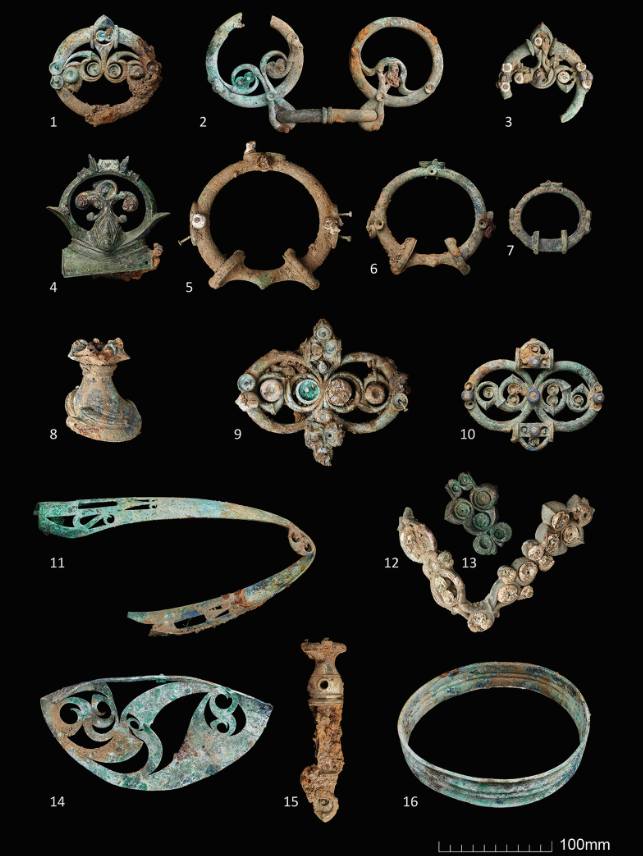
The hoards also reveal a society capable of displaying and then sacrificing considerable wealth. The artifacts include ornate horse harnesses decorated with coral and glass, large feasting vessels, and weapons such as spearheads. Among them is an unusually large iron mirror, a rare object that likely carried symbolic meaning.
Many of these items were deliberately damaged, bent, or exposed to intense heat before burial. This was not disposal in a practical sense. Instead, it reflects a controlled act of destruction, often interpreted as a form of conspicuous consumption, where wealth is dramatically removed from circulation to signal power and status.
Not Scrap, But Symbolism
At first glance, such a large metal assemblage might be interpreted as a metalworker’s stockpile. However, the evidence does not support this. There are no traces of workshops, tools, or recycling processes. Instead, the selection of objects is highly specific, focusing on vehicles, harness equipment, and elite items.
This strongly suggests that the deposits were symbolic. Some elements, including signs of burning, are consistent with materials exposed to funerary pyres, even though no human remains were found. This raises the possibility that the act itself—rather than a burial—was the central ritual.
A Landscape of Power
The location of the discovery adds further meaning. The site lies close to Stanwick, a major Iron Age center associated with the Brigantes. During the late first century BC and early first century AD, this region functioned as a key political hub.
The scale and nature of the Melsonby hoards suggest they were connected to this wider power structure. They may reflect a political transition, a major communal event, or the death of a high-status individual. While figures such as Queen Cartimandua are often discussed in this context, no direct link has yet been established.
A Discovery That Reshapes the Iron Age
What sets Melsonby apart is not only the quantity of artifacts but the way they were deposited. The combination of vehicles, weapons, and ceremonial objects—destroyed and buried in a single episode—has no close parallel in Britain.
The discovery suggests that Iron Age communities in northern Britain possessed far greater wealth, complexity, and cultural expression than previously assumed. It also highlights a society in which power could be expressed not only through accumulation, but through carefully staged acts of destruction.
Adams, S., Armstrong, J., Bayliss, A., Moore, T., & Williams, E. (2026). Vehicles of change: two exceptional deposits of destroyed chariots or wagons from Late Iron Age Britain. Antiquity. Cambridge University Press. https://doi.org/10.15184/aqy.2026.10311