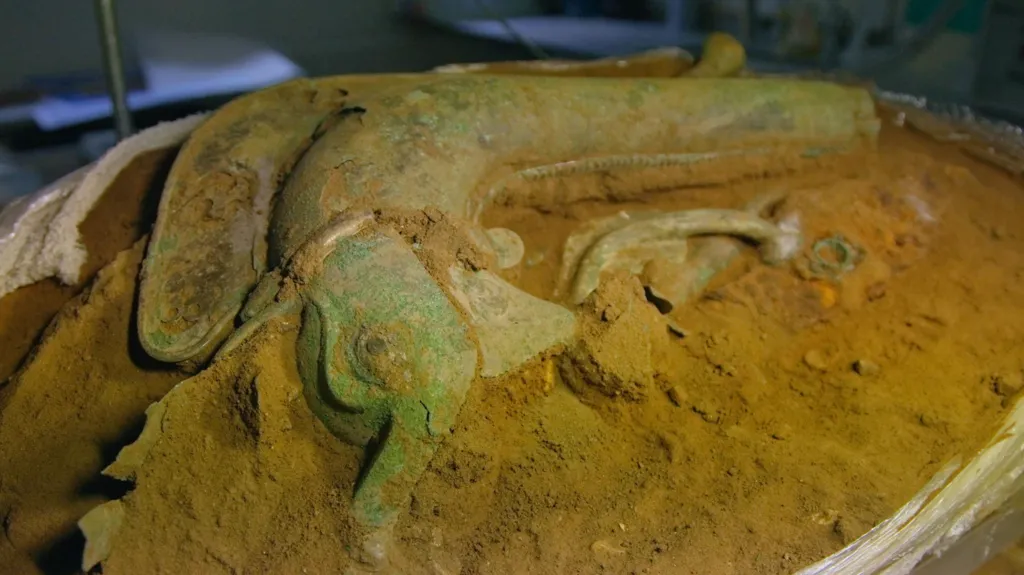
An unassuming construction site in eastern England has yielded one of the most extraordinary Iron Age discoveries ever made in Britain. Archaeologists working near Thetford, in Norfolk, have uncovered two exceptionally rare war objects buried together—a combination so unusual that researchers say it could transform how Iron Age warfare, symbolism, and sound are understood.
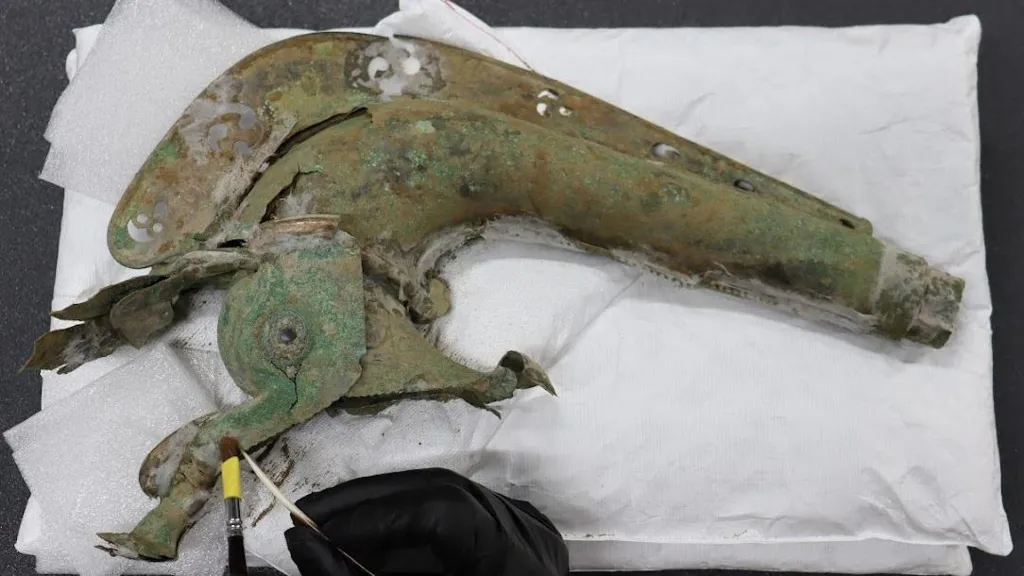
At the center of the find is the most complete Iron Age battle trumpet (carnyx) ever discovered in Europe, accompanied by the first boar’s head war standard ever identified in Britain.
The Voice of Iron Age Warfare Emerges from the Ground
The carnyx—an elongated bronze war trumpet once used by Celtic communities across Europe—was designed not for music but for intimidation. Its distorted, animal-like sound was intended to unsettle enemies while rallying warriors on the battlefield.
What makes the Norfolk example exceptional is its preservation. Unlike fragmentary finds elsewhere, this instrument survived with its tube, mouthpiece, and bell all intact, offering scholars a rare opportunity to study how Iron Age sound was produced and deployed in conflict.
Roman authors and artists were deeply fascinated by the carnyx, frequently portraying it as a symbol of “barbarian” warfare. Yet complete instruments are almost unknown, making this discovery a watershed moment for Iron Age studies.
A Fierce Symbol Raised in Battle
Equally striking is the accompanying boar’s head standard, crafted from sheet bronze and designed to be carried aloft like a flag. Such standards functioned as visual rallying points during combat, helping warriors maintain formation amid chaos.
The boar was no random choice. In Iron Age belief systems, it embodied strength, ferocity, and resilience—qualities admired in both hunting and warfare. Scholars note that facing a wild boar was among the most dangerous challenges of the hunt, making it a fitting emblem for martial power.
Until now, no such boar standard had ever been documented in Britain.
Buried in the Land of the Iceni
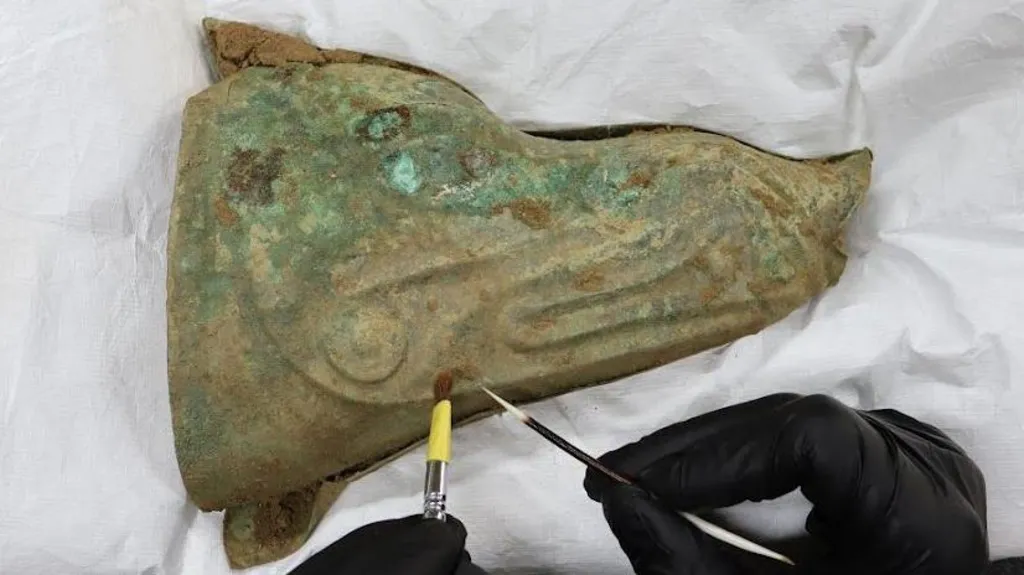
Image credit: Norfolk Museums Service
The hoard dates to roughly 50 BC–AD 50, a turbulent period in eastern Britain associated with the Iceni, the powerful Iron Age tribe later led by Boudica in her famous uprising against Roman rule.
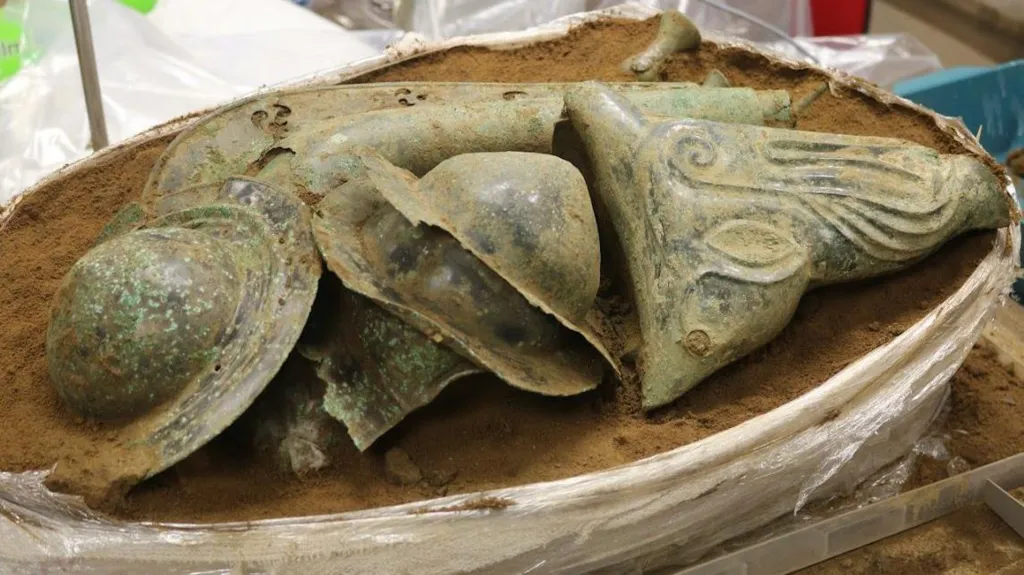
The deliberate burial of these objects—alongside shield bosses and other iron fittings—suggests ritual deposition rather than accidental loss. Researchers believe the hoard may represent a symbolic act tied to warfare, territory, or social memory.
Fragile Survivors of a Violent Age
Despite their dramatic appearance, the objects are extraordinarily delicate. The carnyx was made from extremely thin metal sheets that have become brittle after two millennia underground. To prevent damage, archaeologists removed the hoard as a single soil block and conducted detailed scans before conservation began.
Source: Norfolk Museums Service
Experts emphasize that full analysis could reshape modern understanding of Iron Age music, battlefield communication, and ritual behavior, areas that have long relied on Roman descriptions rather than physical evidence.
Reassessing Norfolk’s Iron Age Legacy
The discovery is currently undergoing legal assessment to determine whether it qualifies as treasure. Meanwhile, conservation and research efforts are being coordinated by Historic England, the Norfolk Museums Service, and the National Museums Scotland.
For archaeologists, the significance extends well beyond rarity. This hoard offers a rare, tangible connection to how Iron Age communities in Britain prepared for war, projected power, and ultimately chose to consign their most potent symbols to the earth.
Cover Image: Archaeologists have called the joint discovery of a carnyx and a boar’s head flag standard within the same hoard an once-in-a-career find, underscoring the exceptional rarity of uncovering both Iron Age objects together.
Source: BBC / Rare TV