
New research suggests the answer may lie not in their behaviour or anatomy, but in the way their feathers and fur reflect light. Spectroscopic measurements indicate that both animals display colour profiles closely resembling moonlight, potentially explaining their connection to Thoth, the ancient Egyptian deity of wisdom, writing, magic and the moon.
The study, conducted by researchers from the University of St Andrews and Dartmouth College, was published in the journal Time and Mind.
The mystery behind Thoth’s two sacred animals
Ancient Egyptian gods were often represented in animal or hybrid form. Horus was associated with the falcon, Anubis with a canine and Sobek with the crocodile. Thoth, however, could appear as either an ibis-headed man or a seated baboon.
The association with the sacred ibis has traditionally been linked to visible features of the bird. Its long, curved beak resembles a crescent moon, while its contrasting black-and-white plumage may have reinforced its celestial symbolism.
The baboon has proved more difficult to explain.
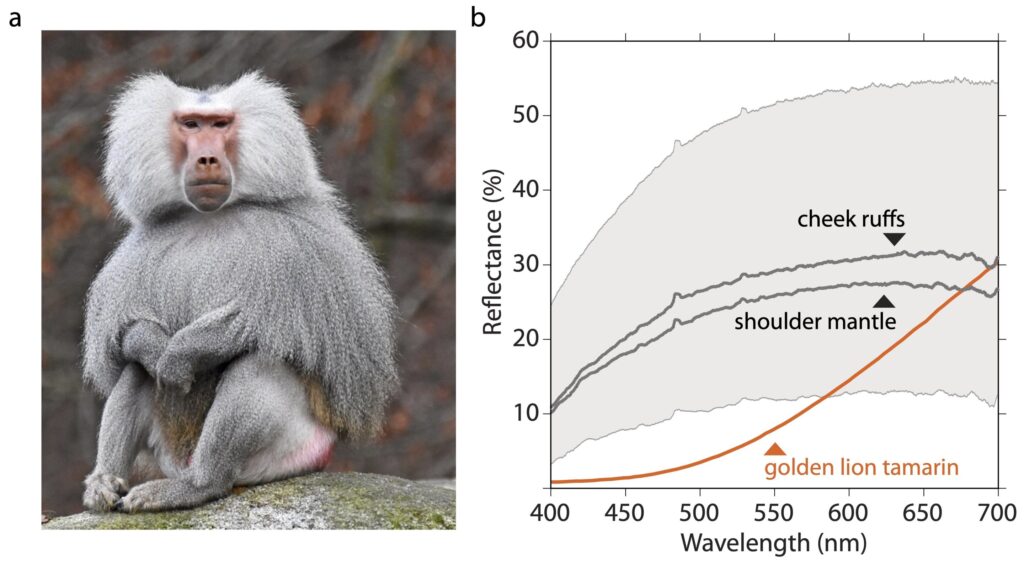
Ancient Egyptians knew several primate species, including different baboons and monkeys. Yet it was the hamadryas baboon, whose adult males develop a prominent mantle of pale silver-grey hair, that became closely connected with Thoth.
According to the new study, this choice may have been influenced by a quality shared with the sacred ibis: both animals could appear strikingly bright and moonlike.
Researchers measured colour rather than describing it
Comparisons between animal coloration and moonlight are usually based on human visual impressions. These can vary according to lighting conditions, surrounding colours and cultural expectations.
To reduce this subjectivity, the researchers used spectroscopy, a method that measures how materials reflect light across different wavelengths.
They compared the spectral characteristics of moonlight with the coloration of the sacred ibis and the hamadryas baboon. Within the measurements used in the study, the animals’ spectral profiles could not be clearly distinguished from that of moonlight.
The result provides a measurable visual connection between two species that otherwise differ greatly in appearance, behaviour and habitat.
“Why would two such different animals be used to represent one deity?” said lead author Professor Catherine Hobaiter, a primatologist at the University of St Andrews.
She noted that ancient Egyptians were familiar with several species of ibis but selected the predominantly white sacred ibis as an embodiment of Thoth. They also knew other primates, yet gave special religious importance to the pale, silver-coated hamadryas baboon.
“What unites them is their moon-like colour,” Hobaiter said.
Colour may have carried religious meaning
The interpretation also supports earlier linguistic research into the Egyptian name of Thoth. Scholars have proposed links with North African terms referring to a bright or white object, possibly connecting the god’s name with luminosity.
If this interpretation is correct, the animals associated with Thoth may have been selected partly because their bodies appeared to reproduce the cool, pale brilliance of the moon.
This does not mean colour was necessarily the only reason the ibis and baboon became sacred. Ancient Egyptian religious symbols developed over long periods and could carry several meanings at once.
The ibis’s crescent-shaped beak, the baboon’s behaviour and the animals’ roles in ritual or temple culture may also have contributed to their association with Thoth. The new findings instead identify a previously overlooked physical quality shared by both species.
Why Egypt’s baboons remain unusual
The divine status given to baboons in ancient Egypt is especially striking because human attitudes toward the animals have often been negative.
Across many parts of Africa, baboons have historically come into conflict with people by raiding crops and competing for food. Ancient Egyptians, by contrast, not only represented them in religious art but also elevated them as manifestations of a major deity.
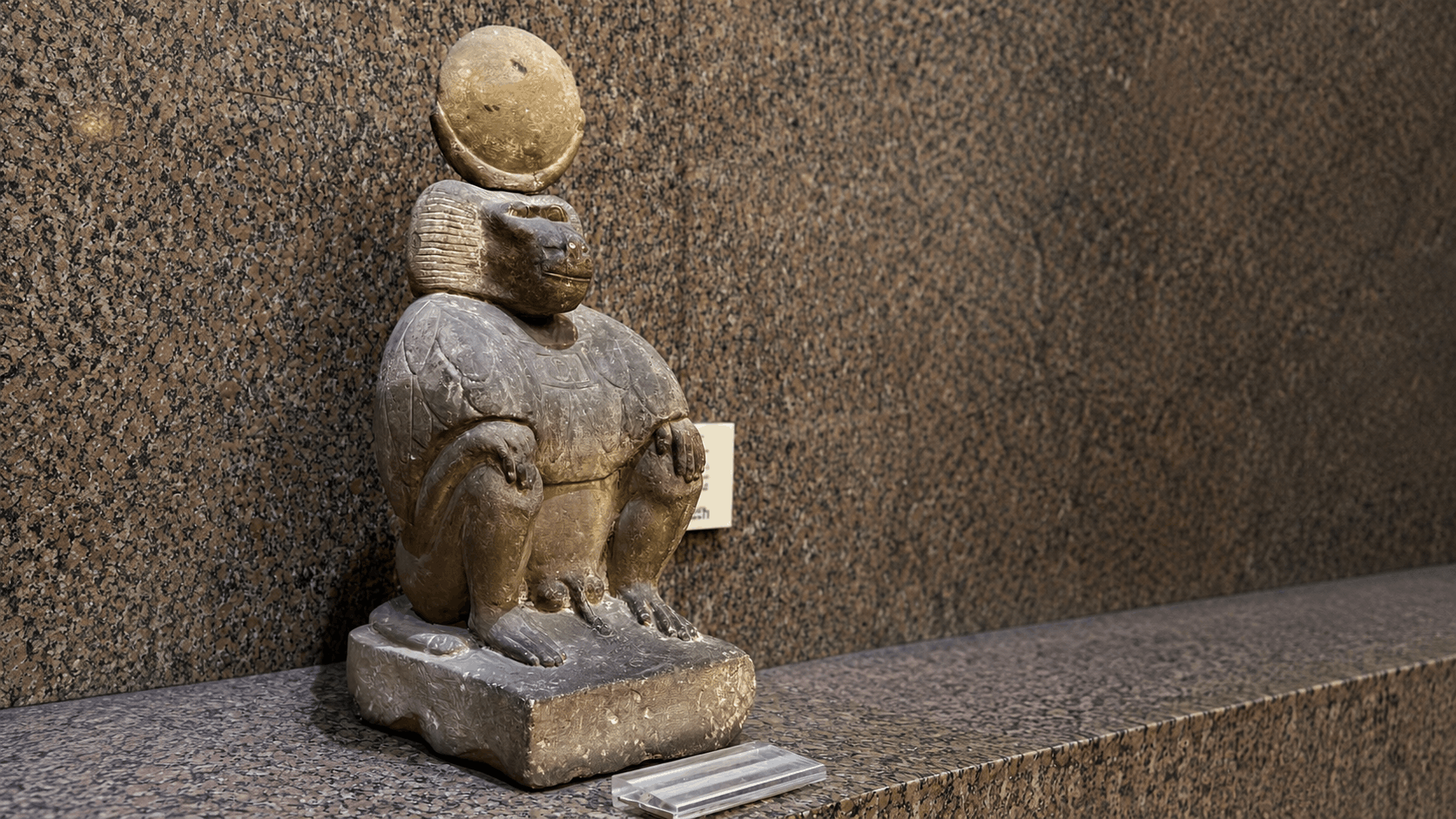
Baboons associated with Thoth were often shown seated upright, sometimes wearing a lunar crescent and disc. Their presence in Egyptian religion has long puzzled both Egyptologists and primatologists.
The new study cannot reconstruct every belief ancient Egyptians attached to these animals. It does, however, offer rare evidence for how visual perception may have shaped their religious world.
The sacred ibis and hamadryas baboon may have looked entirely different to modern observers. To ancient Egyptians, however, their pale feathers and silver fur may have reflected the same celestial quality—the light of the moon.
Cover Image: Thoth as baboon. Credit: Catherine Hobaiter
Nathaniel J. Dominy et al, Moonlight and the apotheosis of sacred baboons, Time and Mind (2026). DOI: 10.1080/1751696x.2026.2696260