
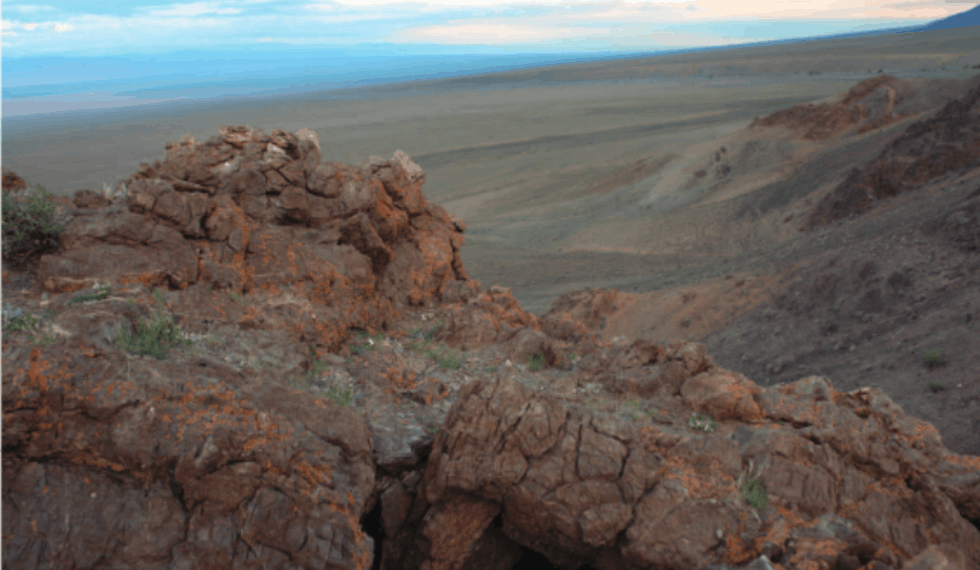
A rock tomb excavated in western Mongolia has preserved two exceptional objects from the early medieval Eurasian steppe: a composite bow reportedly built around a peach wood core and a horse-head stringed instrument bearing ancient Turkic runic writing.
The Jargalant Khairkhan burial was discovered in 2008 in Mongolia’s Khovd Province. Its unusually dry and inaccessible setting allowed wood, leather, bark, silk and other organic materials—objects that normally decay—to survive alongside the remains of a young man.
A Hidden Burial High Above the Steppe
Local herder Namsrai Dandar encountered the nearly concealed cave on May 25, 2008, while retrieving sheep that had wandered toward the rocky summit known as Nükhen Khad.
Looking into the narrow opening, he first saw a wooden object and a pair of stirrups. After entering the cave, he recovered a saddle, a yellow-colored bow and a quiver containing arrows. When further digging exposed human ribs, vertebrae and pelvic bones, Dandar realized he had found a burial and stopped disturbing the site.
The discovery was reported through local history teacher Chimeddorzh Enkhtör. Archaeologists from the Institute of Archaeology of the Mongolian Academy of Sciences excavated the tomb on June 26, 2008.
The cave was located approximately 1,866 meters above sea level. Its entrance was barely visible, while the interior was so confined that researchers had to crawl or enter headfirst.
Inside lay the remains of a man aged between 20 and 25. His burial equipment included a saddle, stirrups, armor plates, a bow case, quiver, arrows, knife, belt fittings, silk fragments and a wooden musical instrument.
A Rare Composite Bow
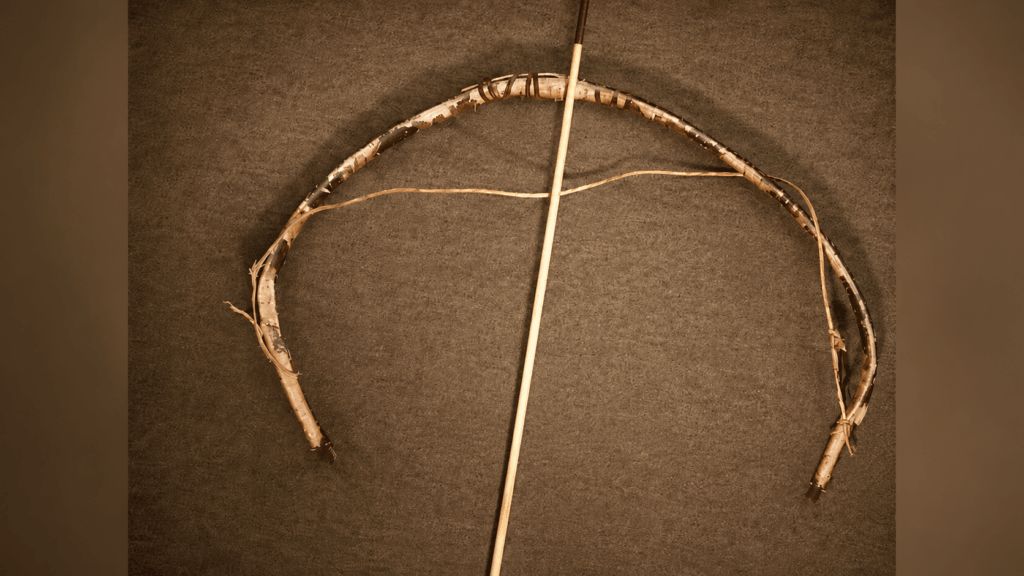
The bow survived in two sections but retained enough of its original construction to provide rare evidence of early medieval composite-bow technology.
Recent Russian-language reporting on the conserved artifact identifies its wooden core as peach wood. The same account describes a layered construction incorporating horn from mountain goats and wild cattle, animal sinew and fish-based adhesive, with birch bark and leather used as protective coverings.
These material identifications should be distinguished from the original archaeological preliminary report, which was published before the scientific analyses were completed. That study records plans to determine the wood species, arrow feathers, pigments and adhesives and to examine the bow and other composite objects through computed tomography.
The quiver contained 23 wooden arrow shafts and 20 iron arrowheads. Different painted markings were visible near some of the nocks, possibly helping the owner identify arrows fitted with different types of points while they remained inside the quiver.
Later reporting states that the shafts were made from rosehip shoots and stabilized with golden eagle feathers. Together, the bow, quiver and arrows preserve a sophisticated system in which wood, horn, sinew, bark, leather, metal and feathers were combined according to their different mechanical properties.
A Horse-Head Instrument Unlike the Modern Morin Khuur
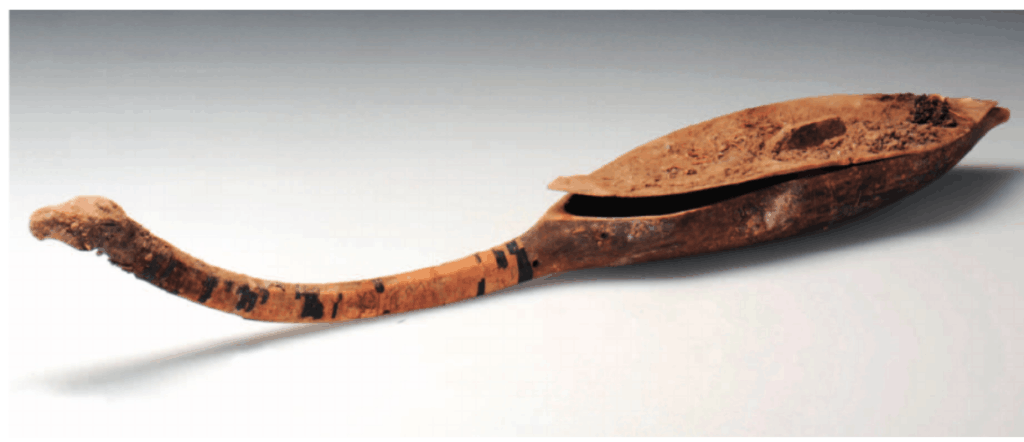
An equally important object was found behind the dead man’s head. It was a well-preserved wooden stringed instrument with a neck ending in the carved figure of a horse.
Researchers cautiously described it as a horse-head fiddle, potentially related to the Mongolian morin khuur. However, the ancient instrument differs significantly from most modern examples.
A modern morin khuur normally has a separate neck attached to a trapezoidal sound box. The Jargalant Khairkhan instrument instead has an elongated, spoon-like form carved as a continuous structure. Its body was made from birch, while the resonance top and bridge were produced from willow.
Because of this construction, researchers argued that it more closely resembles the šanagan chuur, or ladle-fiddle, which has been regarded as a predecessor of the modern horse-head fiddle.
Runic Writing Hidden Beneath Dark Bands
Twelve ancient Turkic runic characters were carved into the instrument’s wooden neck. The letters were later covered by dark bands, apparently concealing them from the player’s view.
The inscription is difficult to interpret because it is short, lacks clear word separators and contains characters that can be confused with natural lines in the wood. Researchers suggested that it might preserve the maker’s name or another private message rather than a text intended for a wider audience. A second possible inscription carved into the shoulder of the sound body remains undeciphered.
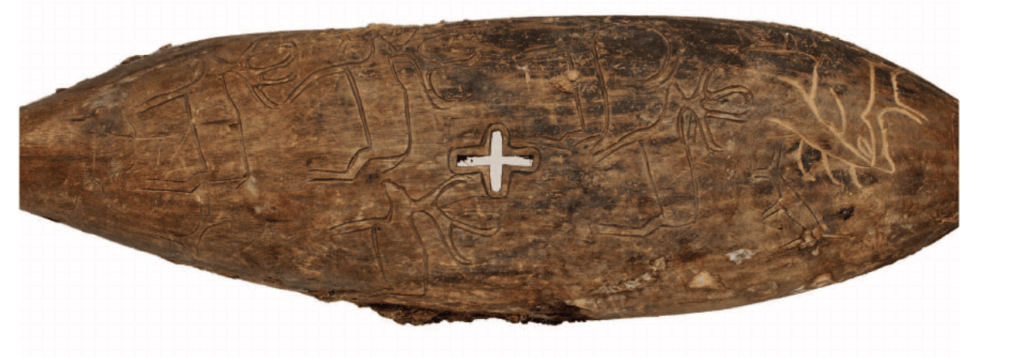
The underside of the instrument carries another remarkable feature: a petroglyph-like hunting scene. It shows a human figure holding a drawn reflex bow, accompanied by stags, ibexes and dogs. Another stag, depicted in a different style and with little patina, may have been added later by another person.
Evidence from Mongolia’s Turkic Period
The grave inventory closely resembles equipment documented in other burials associated with the Ancient Turkic period. The oval stirrups, broad saddle, armor plates, bark quiver, bow case, belt fittings and runic writing support a date between the sixth and eighth centuries AD.
The deceased had also suffered a sharp-force injury to the left side of his forehead. The wound had healed before his death, showing that he survived the incident. Although the bow, saddle and armor evoke the world of mounted warfare, the archaeological report does not establish his precise military or social status.
Approximately 50 fragments of silk were also recovered, including a yellow piece marked with Chinese characters. These textiles provide evidence of the broader exchange networks connecting communities across Inner Asia.
More Than an Armed Rider’s Burial
The significance of Jargalant Khairkhan lies not in a single spectacular object but in the survival of an unusually complete group of organic artifacts.
The bow reveals how early medieval craftspeople combined several natural materials to produce a compact and powerful weapon. The horse-head instrument preserves a much rarer intersection of music, carved imagery and runic literacy.
Found together in the same confined cave, the two objects broaden the picture of Turkic-period life in Mongolia. The burial reflects not only mounted archery and specialized craftsmanship but also personal expression, musical practice and written communication on the eastern Eurasian steppe.