
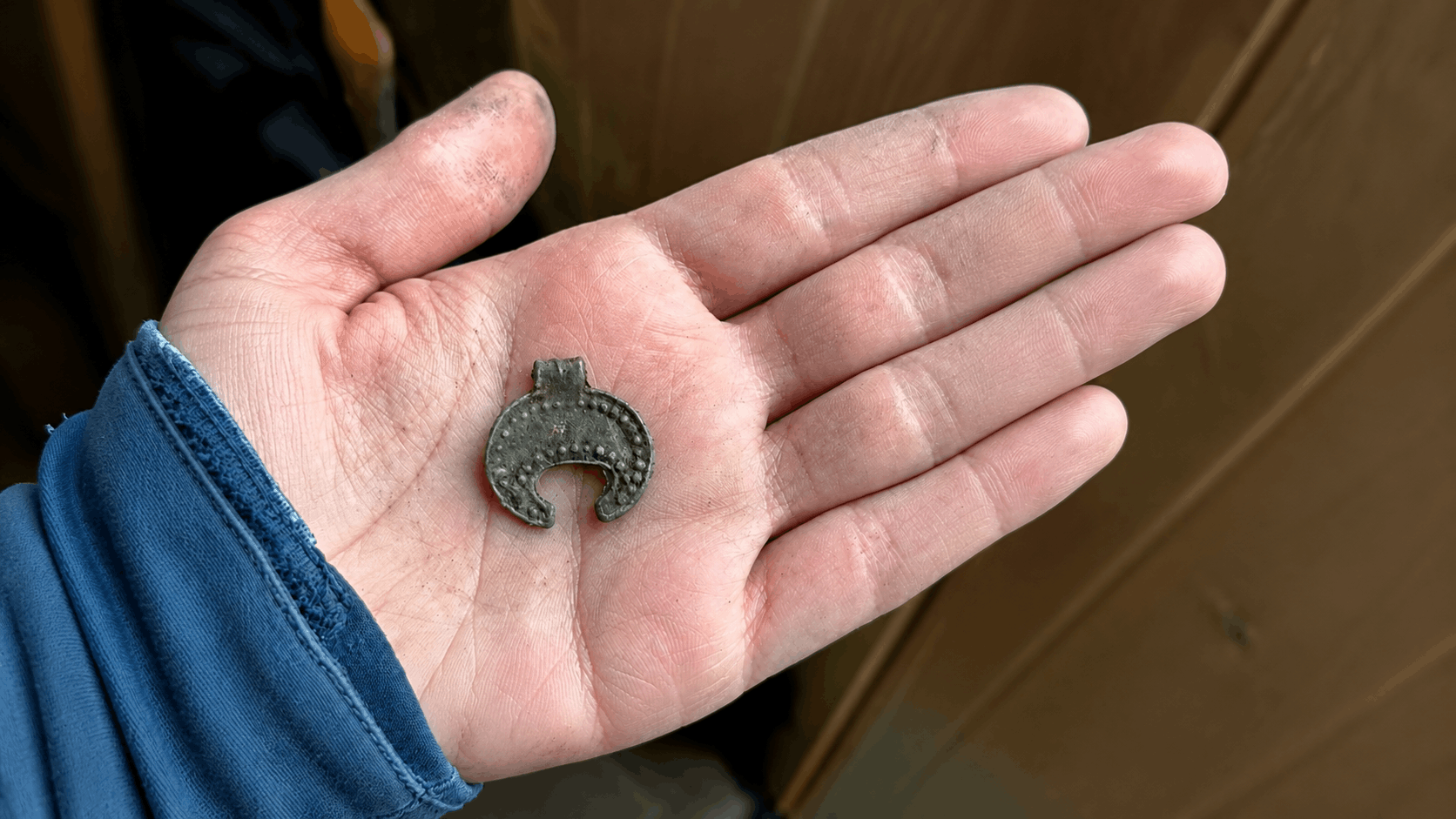
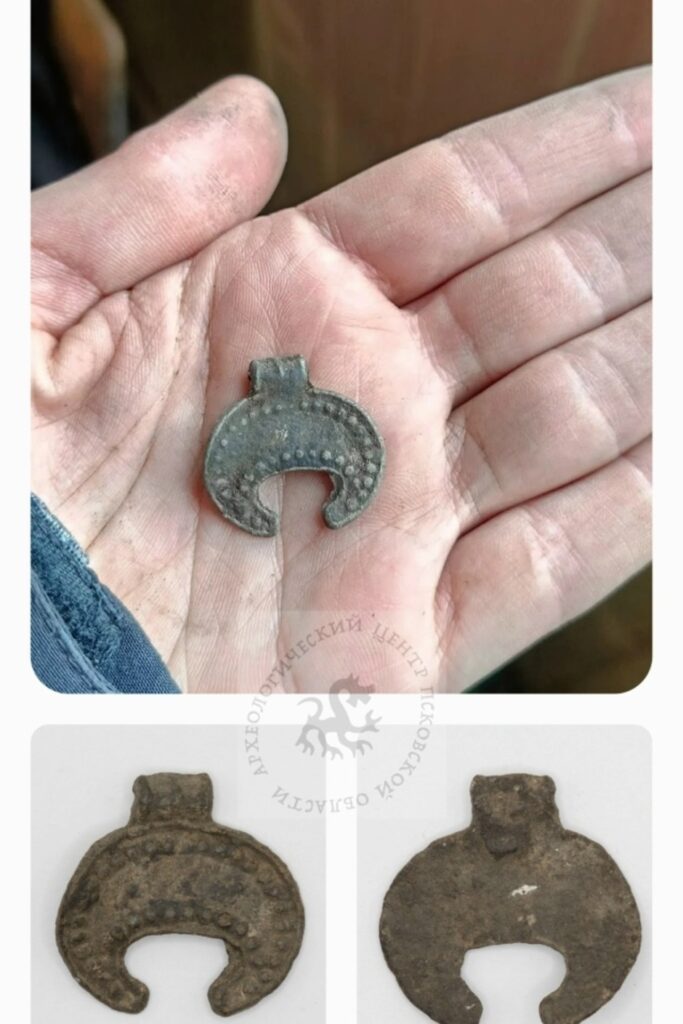
A crescent-shaped pendant unearthed in the Russian city of Pskov may once have been worn as more than jewellery. Known as a lunitsa, the small ornament belongs to a tradition often associated with protection, the moon and female dress—but its history is far less straightforward than the familiar label “Slavic pagan amulet” suggests.
The pendant was discovered at the Olginsky-10 excavation in Zavelichye, the historic district lying across the Velikaya River from central Pskov. According to the Archaeological Center of the Pskov Region, it has now joined the city’s growing collection of lunitsas.
Researchers have not yet determined the composition of the metal alloy. That analysis will take place after the field season, and the center has not announced a precise date for the find.
Until its archaeological context and material are studied in greater detail, the pendant cannot be assigned to a narrow period. Its crescent form, however, places it within one of the most persistent jewellery traditions of ancient and medieval Eurasia.
A Crescent Worn as Protection
The word lunitsa is used for ornaments shaped like a crescent moon. They could appear as necklace pendants, earrings or parts of more elaborate personal adornment.
Similar forms are known from the Bronze Age and were worn by communities across Europe, Asia and Africa. They were not limited to the Slavic world, nor did they necessarily carry the same meaning everywhere.
The moon-like outline led many scholars to identify lunitsas as apotropaic amulets—objects intended to guard the wearer against illness, bad fortune or harmful forces. The crescent could also evoke fertility, renewal and the repeating cycle of time.
That interpretation remains plausible, but no symbol has a single meaning across thousands of years. A crescent ornament could be protective in one community, fashionable in another and both at once somewhere else.
People in the past did not always separate jewellery, belief and personal identity into distinct categories. An ornament could display taste or status while still being trusted as a defence against misfortune.
Older Than the Slavic World
The wide distribution of lunitsas across Eastern Europe between the 10th and 13th centuries encouraged an enduring assumption that they were characteristically Slavic pagan amulets.
The archaeological record offers a different picture.
Crescent-shaped jewellery was already present in Eastern Europe before the broad settlement of Slavic-speaking populations. Researchers have also noted that the familiar two-horned lunitsa does not appear in securely pagan Slavic contexts of the sixth and seventh centuries.
Its arrival in Slavic lands has instead been connected with a new group of women’s ornaments that spread under Byzantine cultural influence during the late seventh and early eighth centuries.
The form was adopted, copied and reshaped as it moved between regions. By the time lunitsas became widespread in the lands of early Rus’, they were part of a mixed jewellery tradition influenced by trade, elite fashion and local craftsmanship.
Some examples were made from silver and decorated with filigree or granulation. Others were simpler cast objects that imitated more expensive designs.
The pendant found at Olginsky-10 may eventually be placed somewhere within this broader sequence, but the necessary analysis has not yet been completed.
When Crescents Appeared Beside Crosses
The most intriguing lunitsas are not necessarily those found in clearly pagan settings. Some come from burials containing Christian crosses and devotional objects.
In graves dating from the late 10th century onward, crescent pendants occasionally formed part of necklaces that also included crosses. Medieval craftsmen even produced ornaments that combined the crescent and cross within a single design.
A burial from the second half of the 12th century in the Pskov region contained a sharp-horned lunitsa alongside small devotional icons depicting the Dormition of the Virgin and Christ the Saviour.
Such finds make it difficult to treat every lunitsa as proof of pagan belief.
The ornaments may have retained a protective reputation after the spread of Christianity. Some could have acquired new interpretations, while others may simply have survived as familiar items of dress.
A Christian wearer may not have seen any conflict in carrying both a crescent and a cross. The two objects could have served different purposes, or their meanings may have overlapped in ways that archaeology can no longer reconstruct.
A Symbol That Survived Religious Change
Lunitsas gradually became less frequent in medieval archaeological layers, but crescent-shaped ornaments did not disappear.
Related earrings and amulets were still worn in parts of Russia during the 19th and early 20th centuries. By then, any connection with Byzantine jewellery or early medieval religious ideas may have been distant, transformed or forgotten.
The shape survived because it remained recognizable and adaptable.
The new Pskov find adds another object to that long history, but it does not yet reveal whether its owner regarded it as a talisman, an ornament or both.
Laboratory analysis may clarify what metal was used and help archaeologists compare the pendant with other examples from Pskov. Its precise personal meaning will probably remain beyond reach.
What survives is a small crescent that passed through a world where old symbols could continue under a new religion—and where a piece of jewellery might still be trusted to keep danger away.
Cover Image Credit: Archaeological Center of the Pskov Region / VKontakte