
A fossilized backbone found in northeastern Thailand has led palaeontologists to identify a previously unknown species of long-necked dinosaur.
Named Uragasaurus kalasinensis, the plant-eating dinosaur lived during the Late Jurassic and belonged to Mamenchisauridae, a sauropod family known for animals with unusually long necks. It is the first member of this family to be formally named from Thailand.
The study, led by Apirut Nilpanapan of Mahasarakham University, was published in Scientific Reports.
An Unusual Bone from Phu Noi
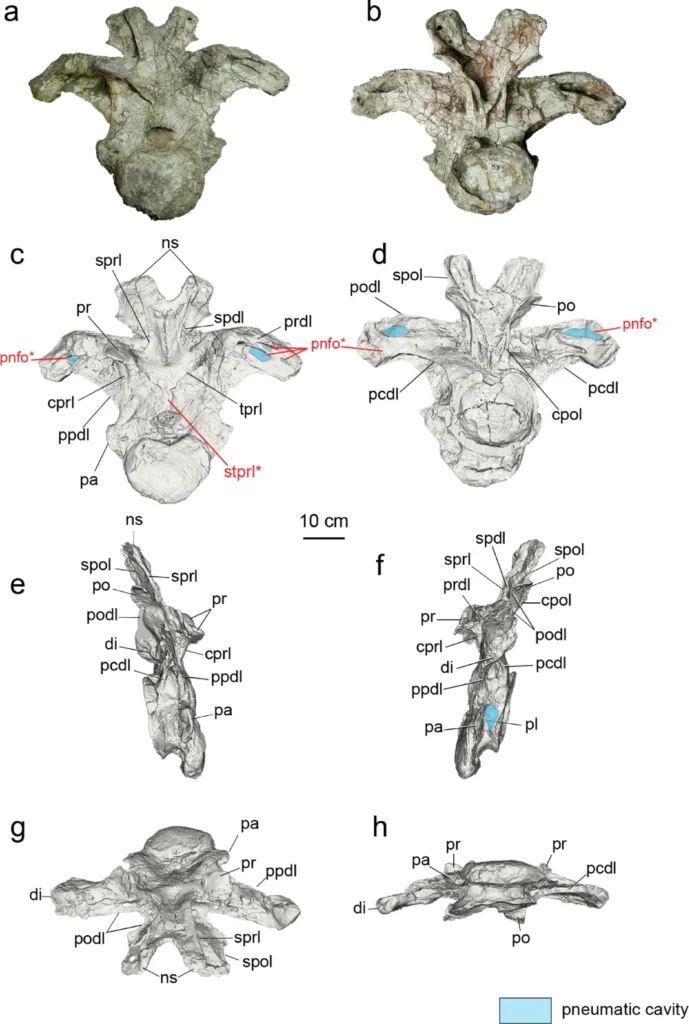
The new species was identified from an anterior dorsal vertebra, a bone from the front section of the dinosaur’s back. The specimen was excavated at Phu Noi in Kalasin Province, one of Thailand’s richest Late Jurassic fossil sites.
Several details set the vertebra apart from those of other known mamenchisaurids. These include elongated, teardrop-shaped depressions and a distinctive Y-shaped arrangement of supporting bony ridges known as laminae.
A CT scan also revealed a network of small chambers inside the vertebra. These air spaces made the skeleton lighter without sacrificing strength, an adaptation widely associated with the enormous bodies and elongated necks of sauropod dinosaurs.
The internal chambers alone were not enough to establish a new species. Researchers based their diagnosis on the complete combination of ridges, depressions and internal structures preserved in the bone.
How Much Can One Vertebra Reveal?
Several other sauropod fossils were recovered close to the specimen, including additional vertebral fragments, a rib, part of a shoulder bone and a fibula. Because the remains could not be securely linked to the same animal, they were excluded from the defining specimen.
The scientific description of Uragasaurus kalasinensis therefore rests on a single vertebra.
That may sound limited, but vertebrae can preserve highly distinctive anatomical structures. In sauropods, their ridges, cavities and internal air spaces often provide enough information to distinguish between related groups.
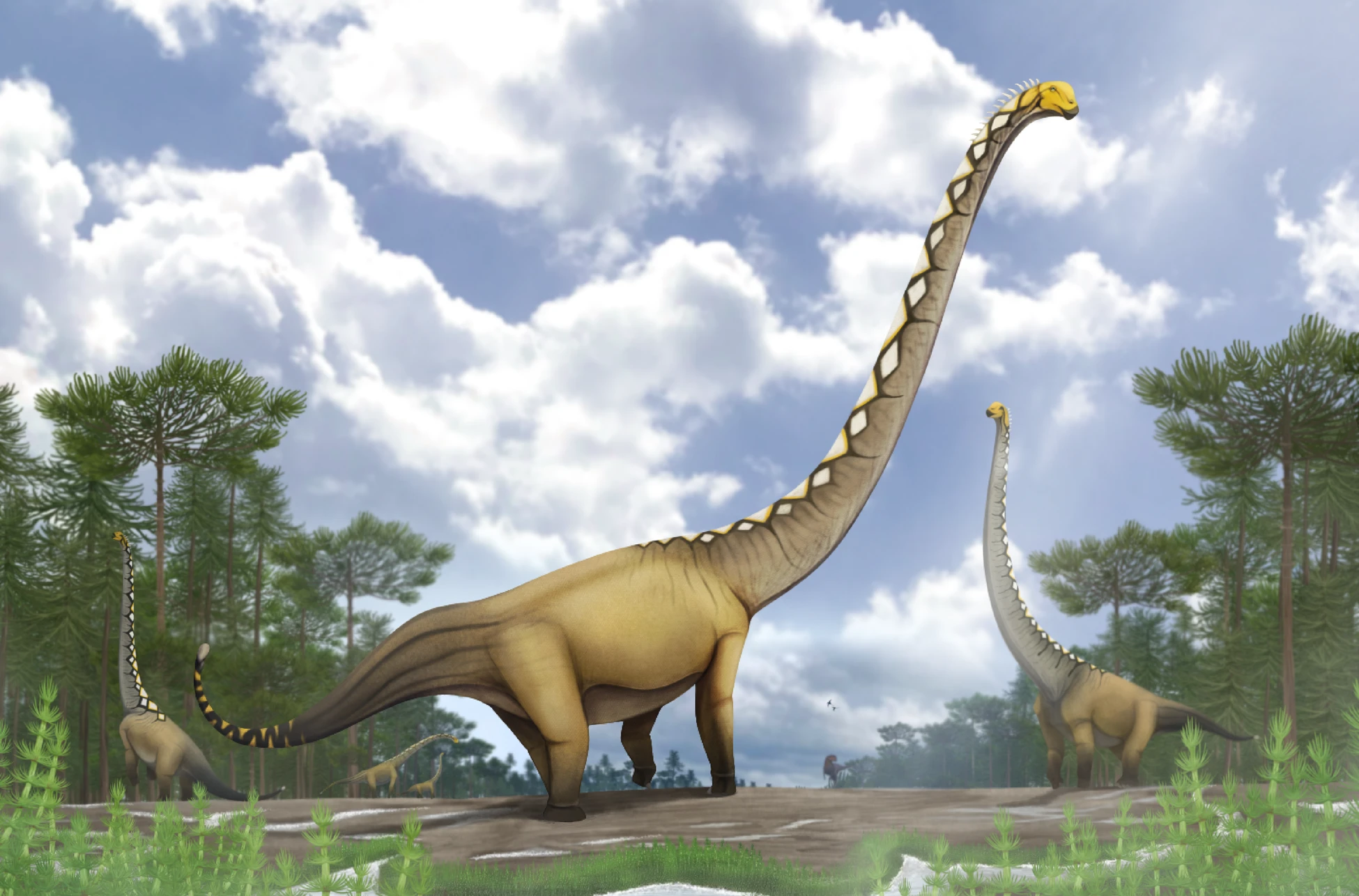
The animal’s full appearance remains uncertain. Reports suggesting that it reached about 20 metres in length are based on comparisons with better-preserved relatives; the published study does not provide a formal estimate of its total length or weight.
Its extreme neck length is also inferred from its position within Mamenchisauridae. No complete neck belonging to Uragasaurus has been recovered.
A Late Jurassic Dinosaur from Thailand
The fossil came from the lower Phu Kradung Formation, a sequence of river and floodplain deposits generally assigned to the end of the Jurassic Period.
The widely reported age of about 150 million years should be understood as an approximation. The specimen has not been directly dated through a nearby volcanic layer. Its age is based on geological evidence and comparisons with fossils from other Asian sites.
Phu Noi has produced a dense concentration of prehistoric remains since excavations began there in 2008. Researchers have recovered fossils belonging to dinosaurs, turtles, freshwater sharks, lungfish, crocodile relatives and other vertebrates.
More than 90 percent of the vertebrate material collected from the site has reportedly consisted of dinosaur remains, making Phu Noi an important location for reconstructing the poorly understood Late Jurassic ecosystems of Southeast Asia.
Thailand’s First Named Mamenchisaurid
Mamenchisaurids are best known from China, where several species with extraordinarily long necks have been discovered. Fragmentary fossils previously found in Thailand had already suggested that members of the family lived farther south.
Those earlier specimens were not sufficiently diagnostic to support a new genus and species. Uragasaurus kalasinensis is therefore Thailand’s first formally named mamenchisaurid, rather than the country’s first evidence of the family.
The genus name combines uraga, a Sanskrit word for snake or serpent, with the Greek sauros, meaning lizard. The species name refers to Kalasin Province, where the fossil was found.
One vertebra cannot provide a complete portrait of the animal. It does, however, add a new branch to the dinosaur record of Southeast Asia and shows that the long-necked sauropods of Late Jurassic Asia were more geographically widespread than the better-known Chinese discoveries alone suggest.
Cover Image: Artist’s reconstruction of five Uragasaurus kalasinensis moving through a Late Jurassic forest in Thailand, with two rhamphorhynchoid pterosaurs overhead and a metriacanthosaurid theropod nearby. Credit: Pakorn Chotchaiyaporn (Jæsica ẞababi)
Nilpanapan, A., Manitkoon, S., Suteethorn, V., & Lauprasert, K. (2026). A new mamenchisaurid sauropod from the Lower Phu Kradung Formation, Upper Jurassic of northeastern Thailand. Scientific Reports, 16, Article 21205.