
In eastern Turkey, close to the Iraqi border, a group of massive spherical stones discovered during roadworks continues to raise unanswered questions—three years after they were first uncovered.
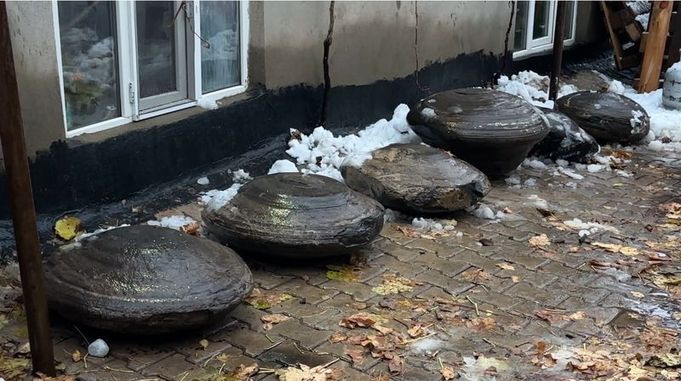
The stones were found in the Aktütün area of Şemdinli district, in Hakkari Province, during a road expansion project carried out near the Turkey–Iraq border. Workers excavating the route unexpectedly exposed six unusually shaped, rounded stones buried beneath the soil. Each weighs more than 200 kilograms and differs markedly from ordinary rock formations in the region.
A local decision to protect the stones
The unusual appearance of the stones immediately drew the attention of Konur village headman Cafer Gezer. Concerned that the objects might be scientifically significant, Gezer intervened to prevent potential damage or loss.
Using construction machinery, the stones were removed from the roadside and transported to the front of his home, where they have been kept under protection ever since.
“I noticed several different stones during the roadworks,” Gezer said. “Some had already emerged near the road, others appeared when I dug around them. I brought them directly to my doorstep to keep them safe.”

“I believe they could be fossils”
After the discovery, Gezer began researching the stones on his own and came to believe they might not be ordinary geological formations. He suspects they could be fossilized remains of extinct animal species, possibly dating back millions of years.
“I believe these are fossils,” he said. “Their structure and appearance are very different. They are not like the stones we usually see in this area.”
Gezer stated that he contacted Hakkari University to report the find. According to him, university representatives suggested that the stones could be transferred to the Van Museum for further examination. He also said that specialists who reviewed images of the stones indicated that they might be fossils, although no formal scientific analysis has yet been conducted.
Three years without scientific examination
Despite the potential importance of the find, the stones have remained unexamined by archaeologists, geologists, or paleontology experts for nearly three years. During this time, Gezer says he has carefully protected them, ensuring they are not damaged or removed.
“We want the mystery of these stones to be solved,” he said. “We want to know exactly what they are.”
Gezer has now publicly called on Turkey’s Ministry of Culture and Tourism, as well as specialists from relevant scientific fields, to carry out an official investigation in the region.
Possible scientific and regional significance
If the stones are confirmed to be fossils, they could represent a rare and significant discovery for eastern Anatolia, a region better known for its rugged geography than for large-scale fossil finds. Even if they prove to be unusual geological formations, their size, shape, and concentration in a single area would still merit detailed study.

Beyond their scientific value, Gezer believes the stones could also contribute to local tourism by drawing attention to a remote border region that remains largely unexplored.
For now, the spherical stones remain where they have stood for three years—lined up in front of a village home, carefully guarded, and still unexplained—waiting for experts to determine whether they are remnants of ancient life or remarkable products of nature itself.