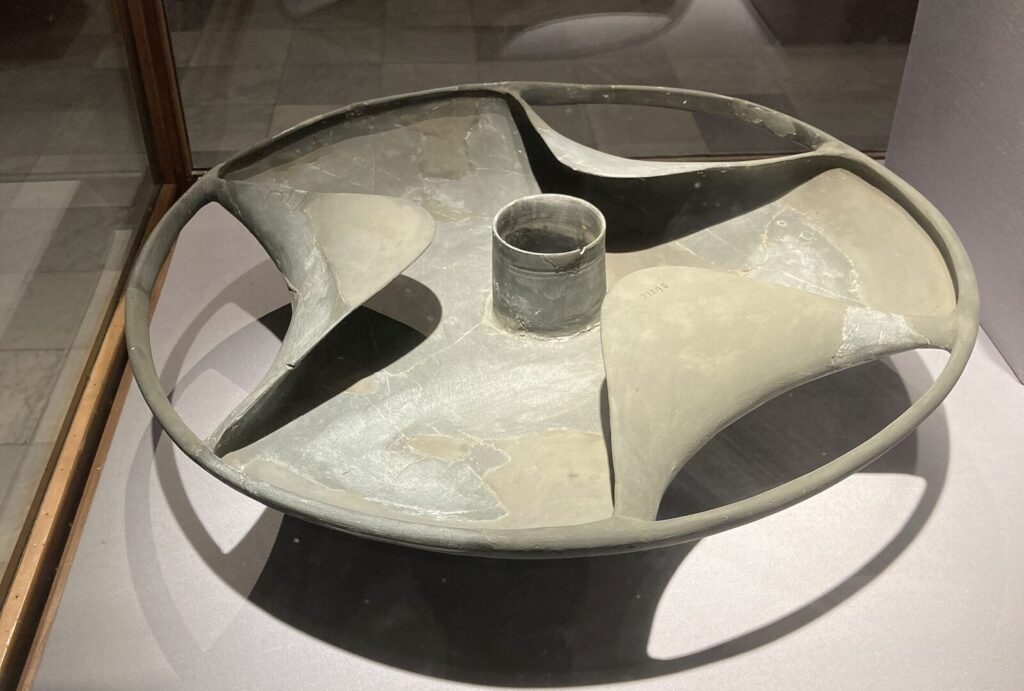
The Sabu Disk was carved in Egypt more than 5,000 years ago, yet its original purpose remains unknown. With its broad circular body, three curved lobes and raised central opening, the stone object has no securely identified parallel from the same period.
Its unusual geometry has led to comparisons with propellers, turbines and mechanical rotors. No machinery was found beside it, however, and no surviving Egyptian image shows how it was used.
Discovered in fragments inside an elite tomb at Saqqara, the Sabu Disk remains one of the most distinctive objects to survive from Egypt’s First Dynasty.
Found broken inside an elite tomb at Saqqara
The Sabu Disk was discovered in 1936 during excavations led by British Egyptologist Walter Bryan Emery at North Saqqara.
It came from Mastaba S3111, a large mud-brick tomb belonging to Sabu, a high-ranking official buried during Egypt’s First Dynasty around 3000 BCE. Although the burial complex had been disturbed in antiquity, excavators recovered pottery, stone vessels, flint and copper objects, animal remains and other funerary goods.
The disk was found in fragments and later reconstructed.
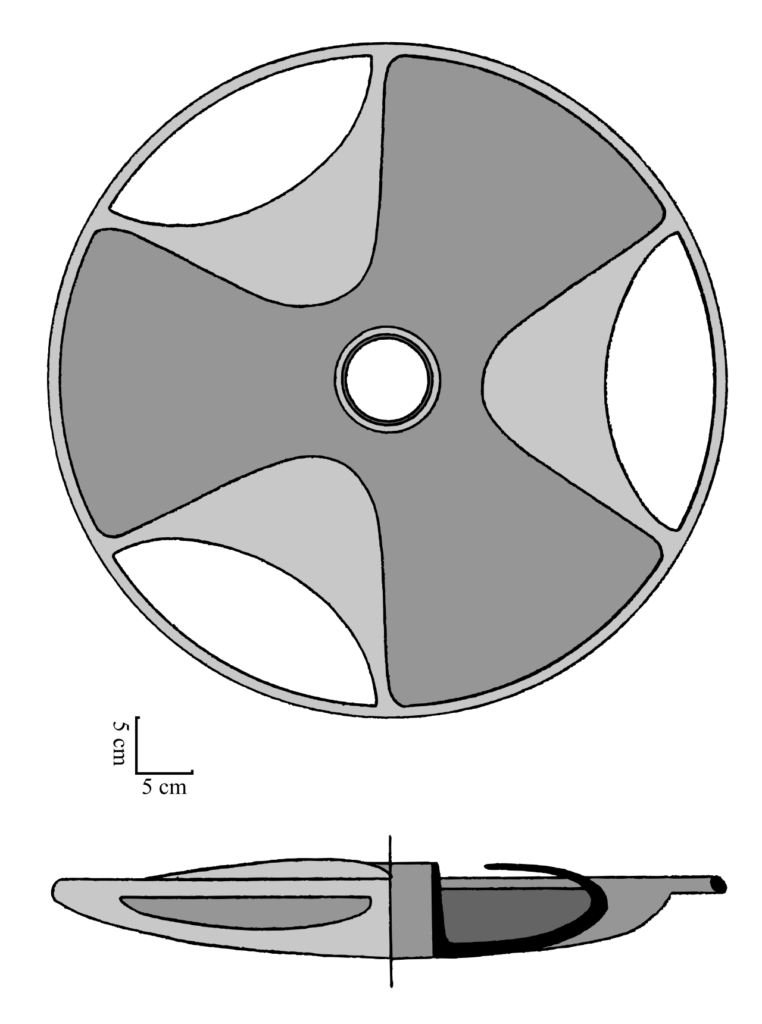
Once restored, it measured approximately 61 centimeters in diameter and slightly more than 10 centimeters in height. Emery described it in his excavation report as a tri-lobed ornamental bowl. The object is now held by the Egyptian Museum in Cairo under the inventory number JE 71295.
Older publications usually identify the material as schist. It has also been described more precisely as siltstone or metasiltstone, a fine-grained rock used for vessels, palettes and other objects in early Egypt.
Its thin rim and projecting lobes would have required careful carving, grinding and polishing. The same features also made it vulnerable to damage, which may explain why it was recovered in pieces.
An unusual form within an established tradition
The Sabu Disk is sometimes presented as an object that Early Dynastic Egyptians should not have been able to produce. Egypt’s stone-vessel tradition, however, was already highly developed by the time Sabu was buried.
Craftspeople shaped limestone, calcite, siltstone, diorite and other rocks into bowls, jars, plates and ceremonial containers. Some vessels had narrow openings, thin walls or highly polished surfaces that demanded considerable labor and precision.
Stone vessels were especially common in elite tombs during the Predynastic and Early Dynastic periods. They could serve as containers, offerings or markers of status.
The Sabu Disk can be examined within this broader tradition, although its design remains exceptional. Shallow bowls are well documented, as are vessels with raised centers or internal divisions. No securely dated Egyptian object has yet been identified with the same combination of three inward-curving lobes, a central opening and a narrow outer rim.
That absence has made comparison difficult. Archaeologists often identify unfamiliar objects by studying better-preserved examples from similar contexts. In this case, no clear parallel has survived.
The tomb context offers clues but no answer
Because the disk was found among funerary equipment, some researchers have interpreted it as a ceremonial or offering vessel.
Its shallow body may have held food, oil or another substance. The central opening could have fitted over a stand, supported a second object or formed part of a larger arrangement. The lobes may have divided the contents or helped position something placed inside the vessel.
None of these possibilities has been confirmed.
No stand or attachment was securely associated with the disk during the excavation. Published accounts have not identified residue that would reveal what it once contained. Since the tomb had been entered and disturbed in antiquity, any accompanying component may have been removed or destroyed.
Another proposal is that the stone object copied a form normally produced in metal, wood or another material.
Its thin edges and folded-looking lobes might have been easier to create in hammered copper than in stone. Egyptian craftspeople sometimes reproduced the forms of baskets, metal containers and other everyday objects in more durable materials for burial.
A corresponding metal version of the Sabu Disk, however, has not been found.
Why it is often compared to a machine
The central opening and three curved lobes resemble features seen in modern rotating equipment. That visual similarity has inspired interpretations involving pumps, turbines, mixers and devices for moving water.
Other proposals have linked the object to oil lamps, incense burners or brewing equipment.
Modern replicas have been rotated, placed in liquids and incorporated into experimental devices. Such tests show how the shape behaves under selected conditions, but they have not been connected to physical evidence from Sabu’s tomb.
A mechanical interpretation would be stronger if the artifact preserved clear attachment points, rotational wear or repeated abrasion around the central opening. No published examination has produced evidence that has led to broad agreement on such a use.
The stone itself also raises questions about theories involving high-speed movement or heavy mechanical stress. The thin lobes have led some researchers to consider slower, lighter or primarily ceremonial functions instead.
At present, the object’s resemblance to modern machinery remains the starting point for many theories rather than evidence of a specific ancient mechanism.
Part of a larger object may be missing
The disk may not have been intended to function alone.
It could have rested on a pedestal, fitted over a container or supported another vessel. A component made from wood, textile or another perishable material would be unlikely to survive for five millennia. A metal attachment may have been removed when the tomb was disturbed.
Its reconstruction creates an additional difficulty. The museum object provides a convincing impression of its original design, but damage around the rim, center or lobes may have erased small details connected with its use.
Future analysis could narrow the possibilities. Microscopic examination may reveal wear left by repeated contact. Residue testing could identify traces of oil, grain, plant material or another substance. Detailed three-dimensional measurement could also determine whether the object is symmetrical enough to have rotated or was designed to remain stationary.
For now, the Sabu Disk cannot be securely identified as a machine part, lamp, brewing tool or ceremonial bowl.
It remains an accomplished piece of Early Dynastic stonework whose function has been lost with the missing evidence around it.
Emery, W. B. (1949). Great Tombs of the First Dynasty: Excavations at Saqqara (Vol. 1). Cairo: Government Press. Pages: 98- 99