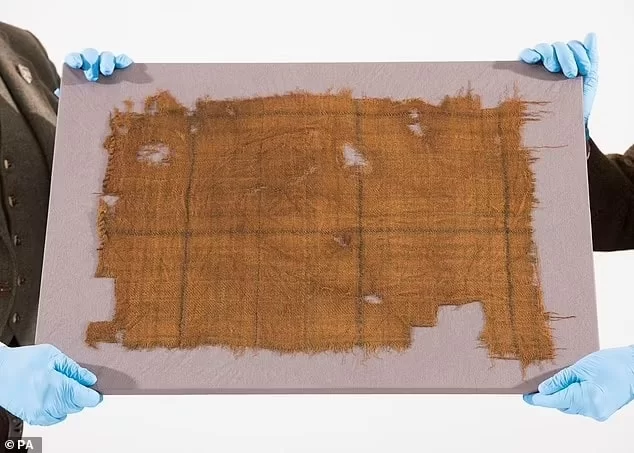
A faded piece of cloth, quietly preserved for decades in a peat bog in the Scottish Highlands, is now rewriting the early history of tartan.
New scientific analysis suggests the fragment—first recovered in the early 1980s in Glen Affric—may represent the oldest known example of traditional tartan ever identified in Scotland.
Scientific Tests Reveal Unexpected Age
The textile itself is modest in appearance: a small fragment measuring roughly 55 by 43 centimeters, marked by faint intersecting patterns in green and brown. Yet under the microscope, a far more complex story begins to emerge.
Researchers applied a combination of radiocarbon dating and dye analysis, supported by high-resolution digital microscopy. The results were striking.
The fabric contains traces of at least four colors—green, brown, and possibly red and yellow—indicating a deliberate, structured pattern rather than random coloration.
Crucially, scientists found no evidence of synthetic or semi-synthetic dyes, a key indicator in dating historical textiles. This absence strongly places the fabric before the widespread introduction of artificial dyes in the mid-18th century.
Taken together, the data points to a production date between 1500 and 1600, positioning the fragment centuries earlier than many surviving tartan examples.
A Rare Survivor from a Harsh Environment

Textiles rarely survive in Scotland’s acidic soils. Organic materials typically degrade rapidly, leaving archaeologists with little direct evidence of early clothing traditions.
This fragment endured for one reason: peat.
Buried deep within a waterlogged bog, the fabric was shielded from oxygen and microbial activity—conditions that effectively halted decomposition. Such preservation environments are rare but invaluable, offering glimpses into everyday materials otherwise lost to time.
Peter MacDonald, Head of Research and Collections at the Scottish Tartans Authority (STA), emphasized the significance of the find:
“Textile survivals in Scotland are exceptionally rare due to soil conditions. The fact that this piece has endured at all is remarkable—and what it reveals makes it even more important.”
Not a Noble Garment, but Everyday Life
Despite its historical importance, the textile itself appears far from luxurious.
Experts describe it as a coarse, utilitarian fabric, more consistent with outdoor working clothing than elite dress. Its construction suggests practicality over display—something worn in fields or rugged Highland landscapes rather than formal settings.
This detail matters. It implies that tartan-like patterned textiles were not limited to high-status identity, but were already embedded in everyday life by the 16th century.
A Clan Connection—Still Uncertain
The discovery site, Glen Affric, lies within territory historically associated with the Clan Chisholm, raising the possibility of a clan link.
However, researchers remain cautious.
No definitive pattern match or documentary evidence ties the fabric to a specific clan identity. The fragment predates the later codification of tartans as formal clan symbols—a process that largely developed in the 18th and 19th centuries.
In that sense, the textile may represent a pre-clan tartan tradition, where patterns existed but were not yet rigidly standardized.
Rethinking the Origins of Tartan
For decades, the narrative around tartan has been shaped by later historical developments, particularly the romanticized Highland identity of the modern era.
This discovery complicates that story.
Rather than emerging suddenly as a symbolic marker of clan identity, tartan may have evolved gradually from practical, regionally produced patterned textiles used by ordinary people.
The Glen Affric fragment does not just push the timeline backward—it reframes tartan as something rooted in daily life, not just tradition or symbolism.
And perhaps most intriguingly, it suggests that many early tartans—like the one preserved in this bog—remain lost, unnamed, and unrecorded, waiting to be rediscovered.