
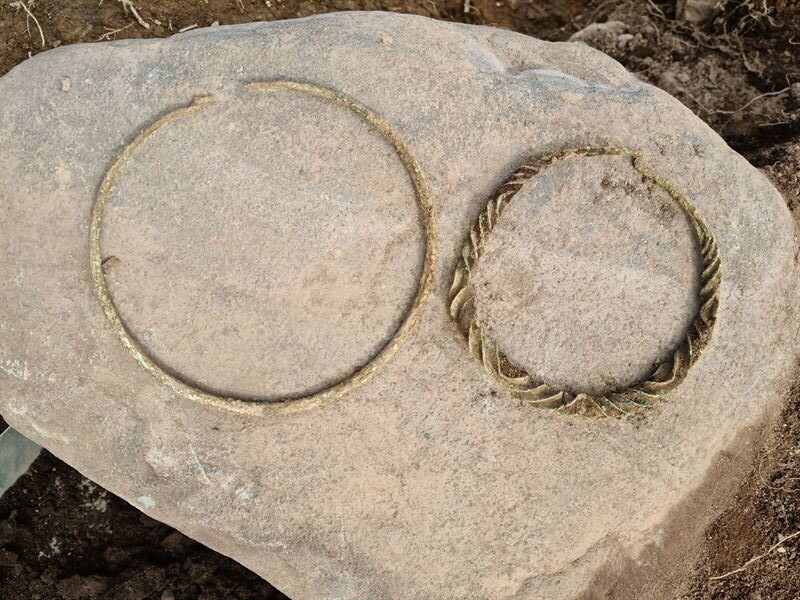
Archaeologists excavating at Marby, east of Norrköping in Sweden, have uncovered two rare bronze neck rings inside a Late Bronze Age grave monument. The ornaments, more than 2,500 years old, were found in a setting that researchers describe as highly unusual, perhaps even unique.
The discovery was made during archaeological investigations ahead of planned housing development in an area already known for graves, rock carvings and settlement traces from the Late Bronze Age, roughly 1100 to 500 BC. The excavation is being carried out by Arkeologerna, part of the National Historical Museums in Sweden.
Project manager Alf Ericsson said the rings were probably not ordinary burial goods. Their position inside the grave suggests they may have been placed there as deliberate ritual offerings. “Finding them in a setting like this is highly unusual, perhaps unique,” Ericsson said in the announcement.
Bronze Rings Hidden Among the Stones
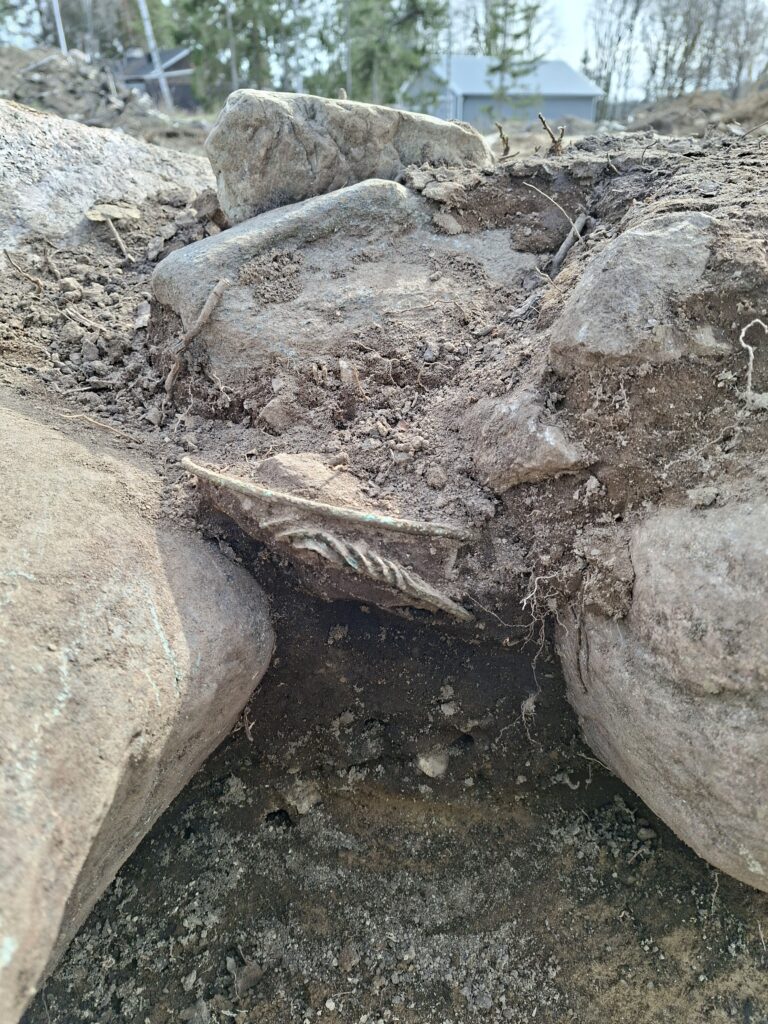
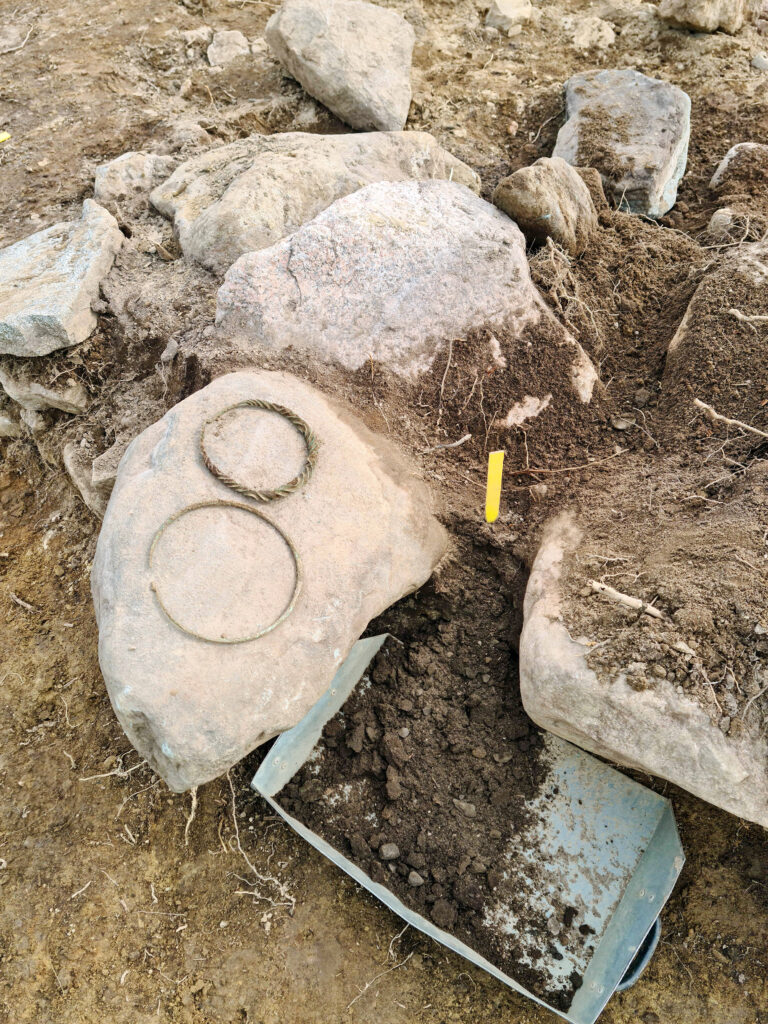
The rings were found inside a stone setting built around a central block. Within the grave monument, archaeologists identified cremated human bones deposited in several ways. Some were placed in an urn, while others had been set into small pits in the ground. Additional bone fragments were scattered through the stone and soil filling the monument.
The two bronze rings were not found directly beside the human remains. Instead, they were discovered near the eastern edge of the grave, wedged between stones. That detail is one of the reasons the find stands out.
Bronze Age neck rings are known from Sweden, but they are more often recovered from hoards or ritual deposits, especially in wetlands and watery places. Finding two of them together inside a grave monument containing human remains gives the Marby discovery a very different character.
A Rare Type of Late Bronze Age Ornament
The objects are known as wendel rings, a rare form of Late Bronze Age ornament made from cast bronze. They are recognized by their twisted design, with the metal turning alternately to the right and left.
The two Marby rings are not identical. One is larger and thinner. The other is smaller, heavier and more strongly profiled. This difference may indicate that the objects carried separate meanings within the same ritual act, although further study will be needed before archaeologists can say more.
Neck rings are often associated with women in Bronze Age societies, but the picture is not simple. The Swedish History Museum notes that similar objects also appear on small male figurines and in some male burials. They were not merely decorative. Such rings could signal identity, status and a person’s place within a symbolic world shaped by metal, ancestry and ritual practice.
Bronze itself was a valuable material in Scandinavia. It required copper and tin, raw materials that had to be imported from regions such as Central and Southern Europe or the British Isles. This means that even a single bronze object could carry evidence of long-distance exchange, skilled craftsmanship and social prestige.
In that sense, the Marby rings are more than ornaments. They represent a connection between local burial customs and much wider European networks of movement, trade and ritual value.
A Find That Differs From Earlier Discoveries
According to Arkeologerna, about ten similar rings had previously been found in Östergötland. A nearby example from Häradshammar included two wendel rings placed in a bog, a type of deposit that fits well with known Bronze Age offering practices.
Marby is different. Here, the rings were not placed in a wetland or a separate hoard. They were found inside a grave monument, in direct association with cremated human remains and carefully arranged stones.
During the Late Bronze Age in southern Sweden, cremation was common. Burned bones were often placed in vessels, small pits or graves marked by stone settings. At the same time, older traditions of large burial mounds became less dominant, while deposits of bronze objects on land or in water became more visible in the archaeological record.
The Marby grave appears to bring several of these practices together. Cremated bones, a stone-built monument and rare bronze ornaments were all part of the same ritual space. This suggests that the grave was not only a place for the dead. It may also have been a place where the living shaped memory, status and belief through carefully chosen objects.
Traces of a Bronze Age Coastal Landscape
The wider excavation has revealed more than the grave itself. Archaeologists have also identified house remains and two burnt mounds made from fire-cracked stone. Such mounds were once often explained as domestic waste from cooking or heating. Recent research has shown that some of them may have had more complex roles, especially when they appear near graves or contain human bones, pottery, bronze objects or carefully built stone features.
At Marby, one burnt mound had already been transformed into a grave monument during the Bronze Age, which archaeologists consider highly unusual. Another contained large quantities of fire-cracked stone, pottery fragments and clay daub from a fire-damaged house. At its base, archaeologists found two concentric stone circles, a feature more commonly linked with grave monuments from the same period.
The ancient landscape adds another layer to the discovery. During the Late Bronze Age, Marby lay near a bay close to the sea. Coastal routes, waterways and maritime movement played an important role in the Nordic Bronze Age, connecting communities across long distances and shaping how people exchanged goods, ideas and ritual practices.
Further osteological analysis may reveal how many people were buried in the stone setting and how the remains were treated before deposition. For now, the two bronze neck rings from Marby offer a rare glimpse into a world where death, status, metal and landscape were closely connected.
The discovery does not simply add two valuable objects to the record. It points to a 2,500-year-old ritual landscape in which the dead and the living were linked through fire, stone and bronze.