
Italy has formally acquired the François Tomb of Vulci, bringing one of the greatest surviving monuments of Etruscan painting into state ownership after more than a century of public interest.
The €15 million acquisition, signed at the Ministry of Culture in Rome, places the painted tomb cycle under Italy’s national heritage system. The frescoes will be permanently assigned to the National Etruscan Museum of Villa Giulia, where they are expected to return to public view from June 25.
For scholars and visitors alike, the move is not only a museum acquisition. It is the recovery of one of the rare places where the Etruscans still seem to speak for themselves, through painted names, political memory, mythological violence, and aristocratic self-image.
A tomb that preserved an Etruscan version of history
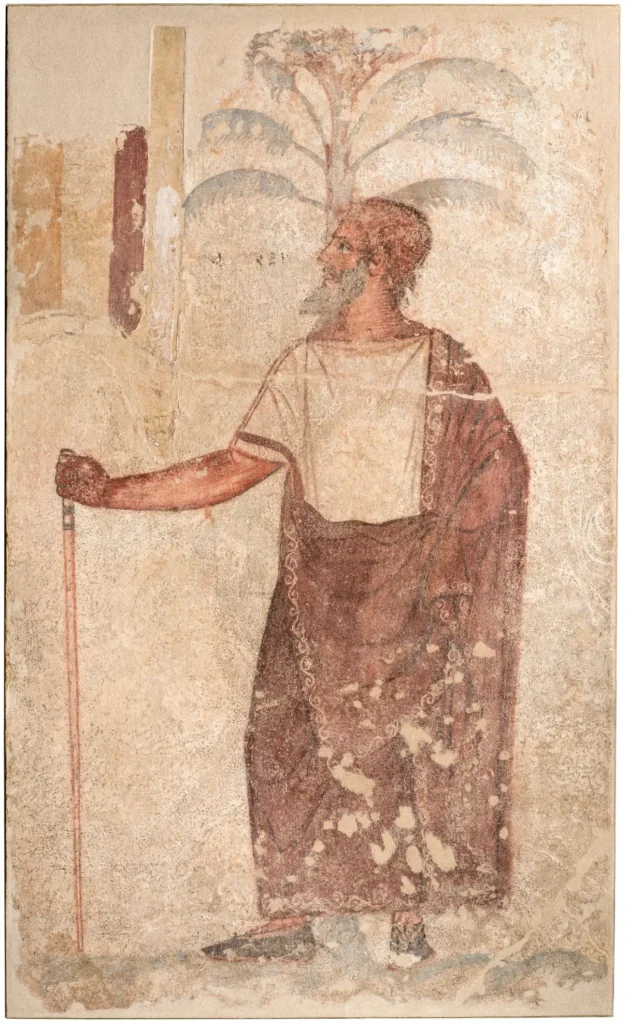
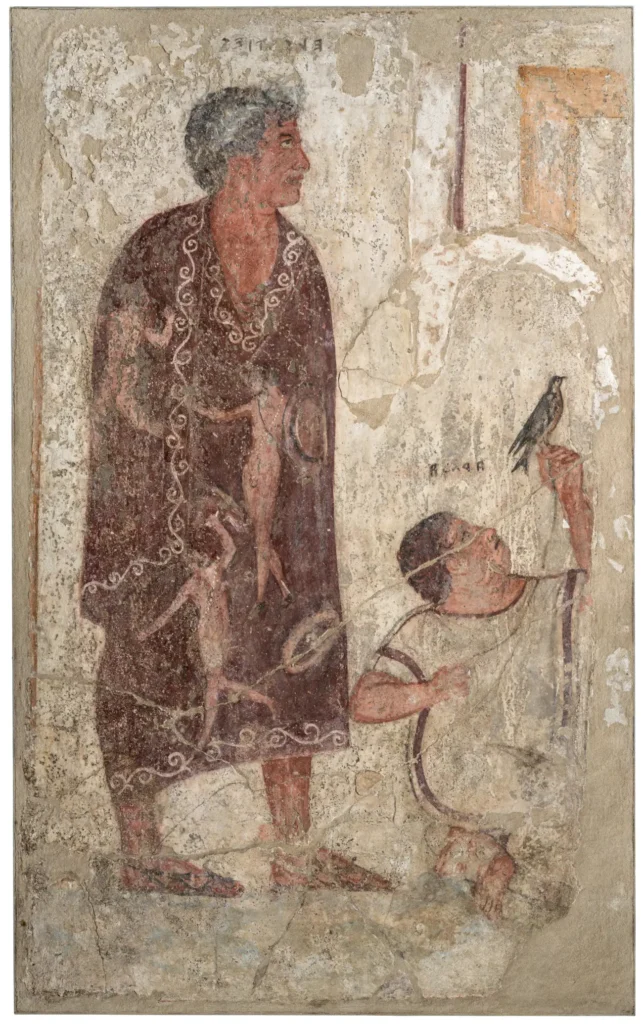
The François Tomb was discovered in 1857 by Alessandro François in the Ponte Rotto necropolis at Vulci, one of the major cities of ancient Etruria. Cut into tuff and dated to around 340–320 BC, the tomb belonged to a period when Etruscan elites were living under growing pressure from Rome but had not yet disappeared into Roman history.
That tension is one reason the tomb matters so much.
Its painted cycle does not simply decorate a burial chamber. It builds a visual argument about power, ancestry, death, and memory. Across 37 painted panels, Greek heroic myth appears beside figures connected to early Roman and Etruscan political tradition. The result is one of the most complex narrative programs known from the ancient Mediterranean.
Greek myth, but not in a Greek voice
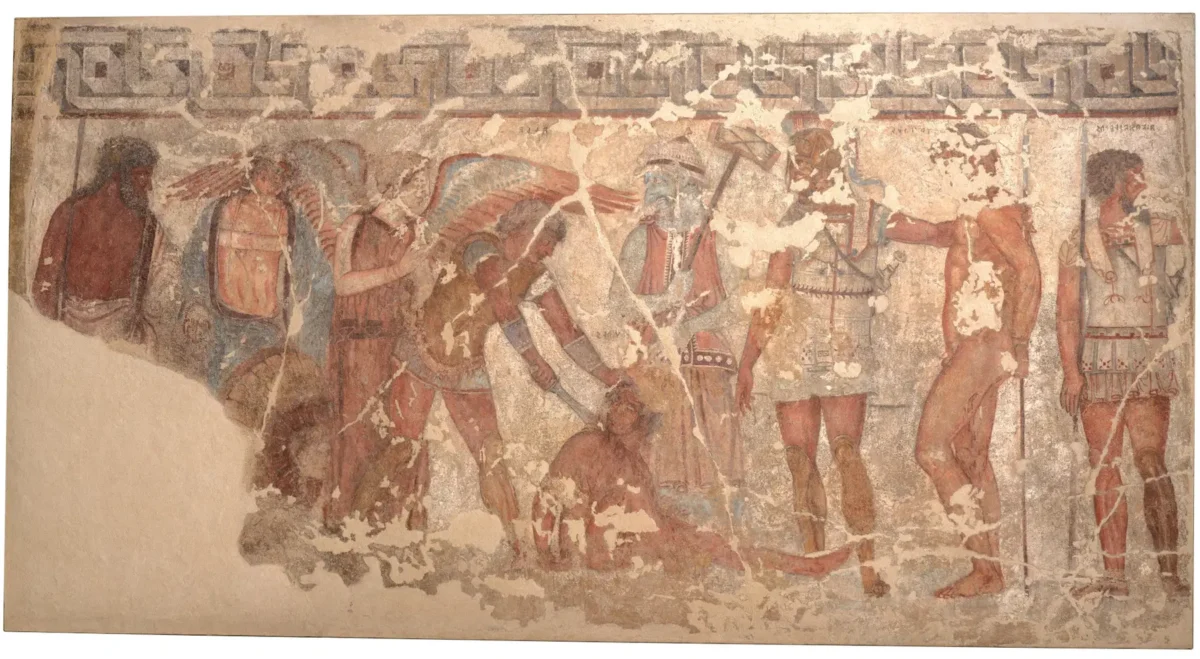
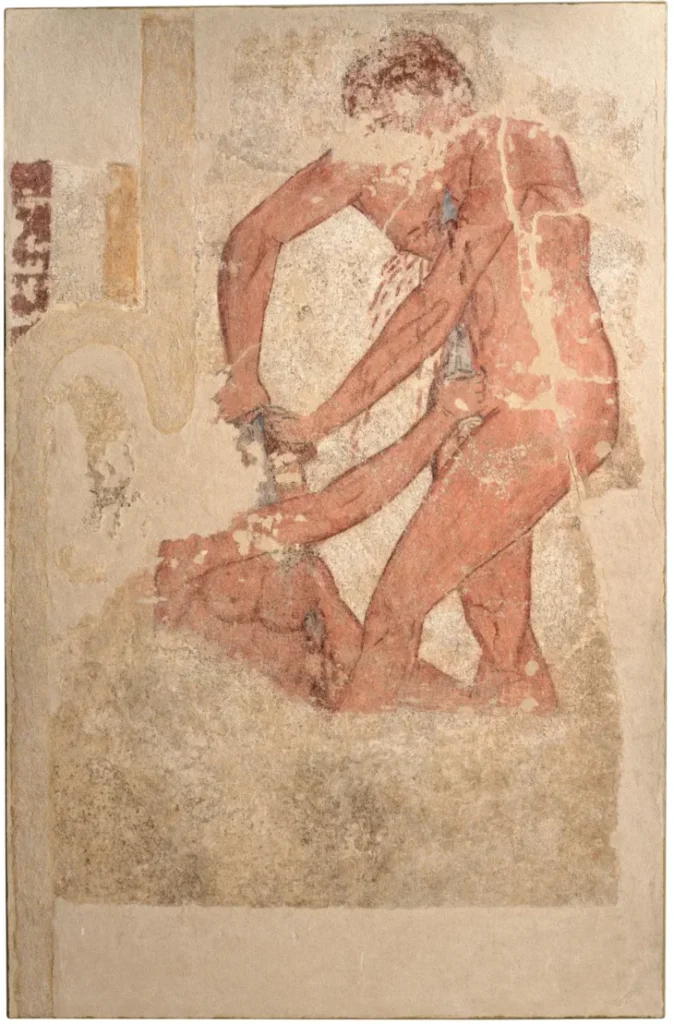
Among the tomb’s most famous scenes is the sacrifice of Trojan prisoners at the tomb of Patroclus. Achilles stands at the center of the episode, a familiar figure from Greek epic. Yet the scene does not feel like a straightforward import from Greece.
The Etruscan underworld is present. Charun, the hammer-bearing demon of death, and Vanth, the winged female figure associated with transition to the afterlife, transform the myth into something darker and more local. The story may have Greek roots, but its emotional and religious language is Etruscan.
This is where the François Tomb becomes more than an artwork. It shows how Etruscan artists absorbed Mediterranean traditions without surrendering their own imagination of death.
The scene that complicates early Rome
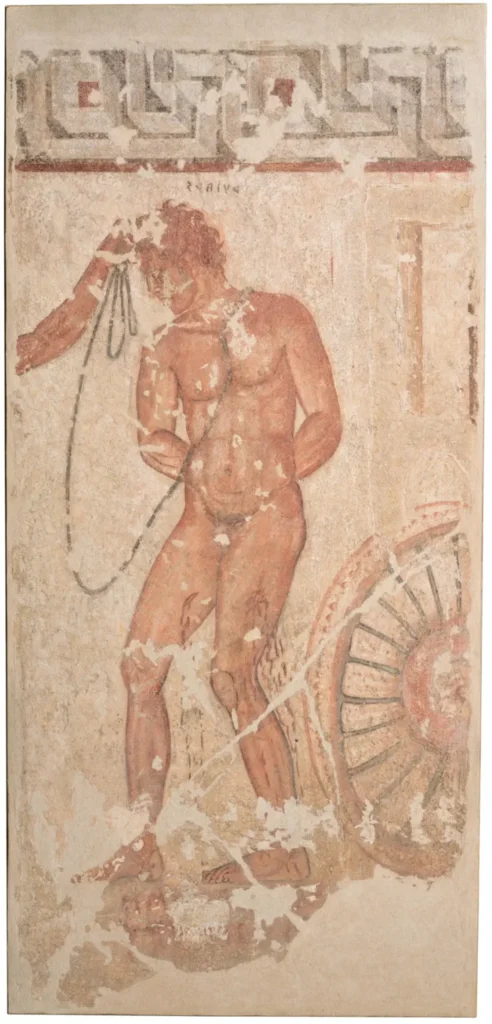
On another wall, the tomb turns from myth to political memory. The fresco showing the liberation of Caelius Vibenna by Aulus Vibenna and Macstarna has long fascinated historians. Macstarna is traditionally linked with Servius Tullius, the sixth king of Rome.
That identification matters because it opens a window onto a version of early Rome shaped by Etruscan memory rather than later Roman literary tradition. In a world where Etruscan written voices survive only in fragments, a painted historical scene with named figures carries unusual authority.
The tomb suggests that early Rome was not simply a Roman story waiting to be told by Roman writers. It was also part of a wider Etruscan political world, remembered in different ways by the aristocracies of central Italy.
Why Villa Giulia is the right home
The National Etruscan Museum of Villa Giulia is already one of the most important institutions for the study of pre-Roman Italy. Housing the François Tomb there gives the cycle a setting where it can be read not as an isolated masterpiece, but as part of the broader Etruscan world of Vulci, Tarquinia, Cerveteri, Veii, and other powerful city-states.
The coming exhibition will also reconstruct the tomb’s original setting and collecting history, with loans from major European institutions including the Louvre, the British Museum, the Vatican Museums, and the German Archaeological Institute in Rome.
Italy’s acquisition of the François Tomb is therefore not just the purchase of a celebrated fresco cycle. It restores public access to a monument that still forces a larger question: how much of ancient Italy’s story has been told through Rome, and how much remains waiting on Etruscan walls?
Cover Image Credit: Italian Ministry of Culture