
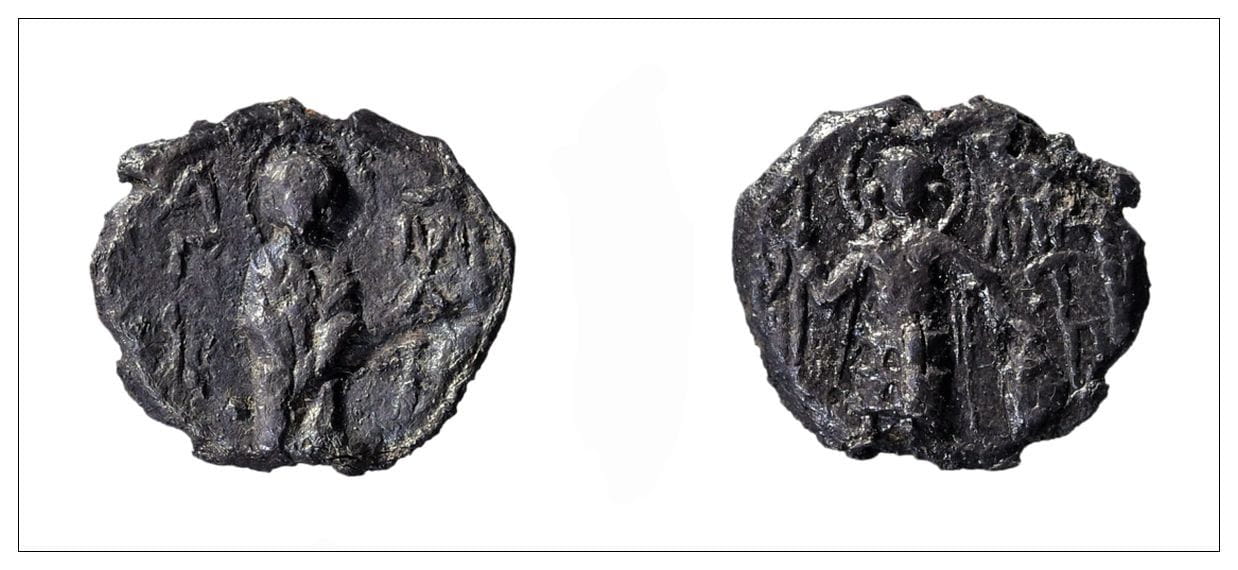
Two lead seals uncovered during rescue excavations in Vladimir, Russia, have been identified as belonging to Princess Maria Vsevolzhaya, a prominent woman in northeastern Rus’ before the Mongol invasion.
Dated to the late 12th or early 13th century, the seals once secured documents that have not survived. Their identification suggests that Maria took part directly in administrative and legal affairs, an unusual role for a woman in the princely government of medieval Rus’.
Maria was the wife of Prince Vsevolod III Yuryevich, better known as Vsevolod the Big Nest, and the mother of his 12 children. She was also closely associated with the foundation of the Dormition Knyaginin Monastery in Vladimir.
Saint Mary and Saint Demetrius appear on the seals
Both seals were produced with the same pair of dies.
One side shows Saint Mary standing and holding a cross near her chest. Researchers believe the figure may represent Mary of Egypt or Mary of Persia. An inscription beside the image identifies her as Saint Mary.
The reverse depicts Saint Demetrius holding a spear in his right hand and a shield in his left.
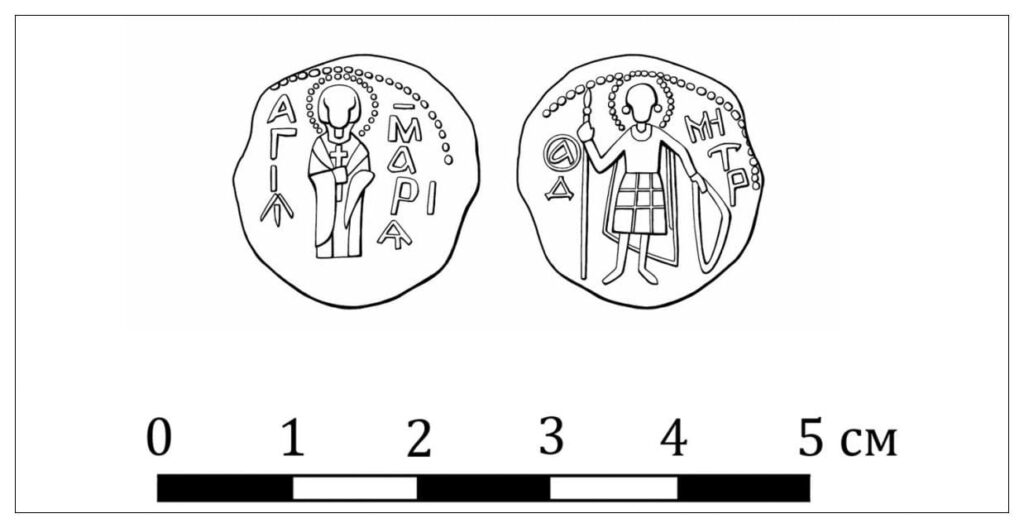
The saint was closely connected with Vsevolod, whose baptismal name was Demetrius and whose patron saint was Demetrius of Thessaloniki. This combination of figures became a central part of the attribution.
Archaeologists also recovered another seal from the same excavation that can be securely linked to Vsevolod. It bears images of Saint Demetrius and Saint George. Vsevolod’s father, Yuri Dolgoruky, was known by the Christian name George.
The imagery, findspot and comparison with other known seals led researchers to identify the newly discovered examples as the personal seals of Vsevolod’s wife, Maria.
Only three matching seals were previously known
The finds belong to a very rare group.
Before the Vladimir excavation, only three seals made with the same dies had been recorded. One was found in Novgorod, although its inscriptions and images were heavily worn.
A second was discovered at the medieval settlement of Mogutovo in the Moscow region, while a third came from the Alexandrov district of the Vladimir region.
The latter two were reportedly found through unauthorized searches. One is now held by the State Historical Museum in Moscow, while the other remains in a private collection.
Unlike those examples, the Vladimir seals were recovered during a controlled archaeological excavation. Their precise context played a major role in identifying their owner.
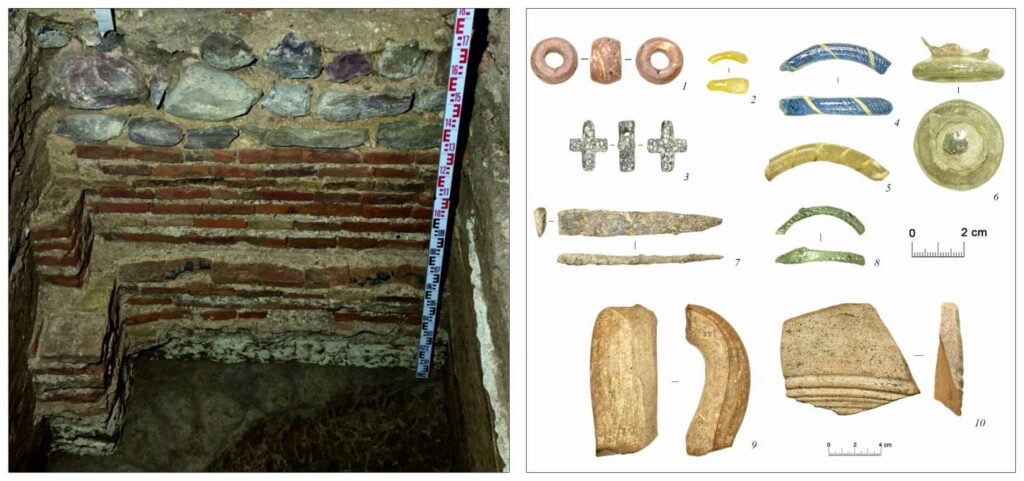
Finds dating from the second half of the 12th to the early 13th century discovered in central Vladimir: 1 – slate spindle whorl; 2 – glass ring; 3 – stone cross; 4, 5 and 8 – glass bracelets; 6 – base of a glass vessel; 7 – iron knife; 9 and 10 – amphora fragments. Credit: Institute of Archaeology, Russian Academy of Sciences (IA RAS).
Why female seals are difficult to identify
Princely seals used by members of the Rurik dynasty followed a recognizable pattern from the mid-12th century to the early 14th century.
They usually carried the images of two saints. One represented the prince’s own patron saint, while the other was linked to his father. More than 1,000 seals of this type have been found.
A much smaller group shows a female saint on one side and a male saint on the other. Scholars interpret these as seals used by princesses. Around 20 such types are currently known.
Attributing them to a specific woman is difficult. Medieval chronicles often identified women through their fathers or husbands rather than recording their own Christian names in detail.
Researchers therefore need several pieces of evidence: the baptismal name of the princess, the names of her husband and father, the saints shown on the seal and reliable information about where the object was found.
Without that combination, such objects are generally classified simply as seals of unknown princesses.
The Vladimir examples are different because the archaeological and historical evidence align closely. Four of the five known seals showing Saint Mary and Saint Demetrius were found in northeastern Rus’, and two came from Vladimir, where the princely court and the residences of people close to the ruler were located.
The seals were found in medieval Vladimir
The two seals were discovered in the historic center of Vladimir during excavations carried out before the construction of a hotel.
Archaeologists opened an area of about 400 square meters and identified occupation layers dating from the second half of the 12th century to the early 13th century.
The excavation revealed parts of two urban estates separated by a street approximately six meters wide.
Finds from the site included fragments of amphorae and glass vessels, pieces of glass bracelets and rings, a stone cross, metal dress accessories and household objects.
Together, the material shows that the area was actively occupied during the pre-Mongol period, when Vladimir was one of the major political centers of northeastern Rus’.
Maria’s role went beyond the princely household
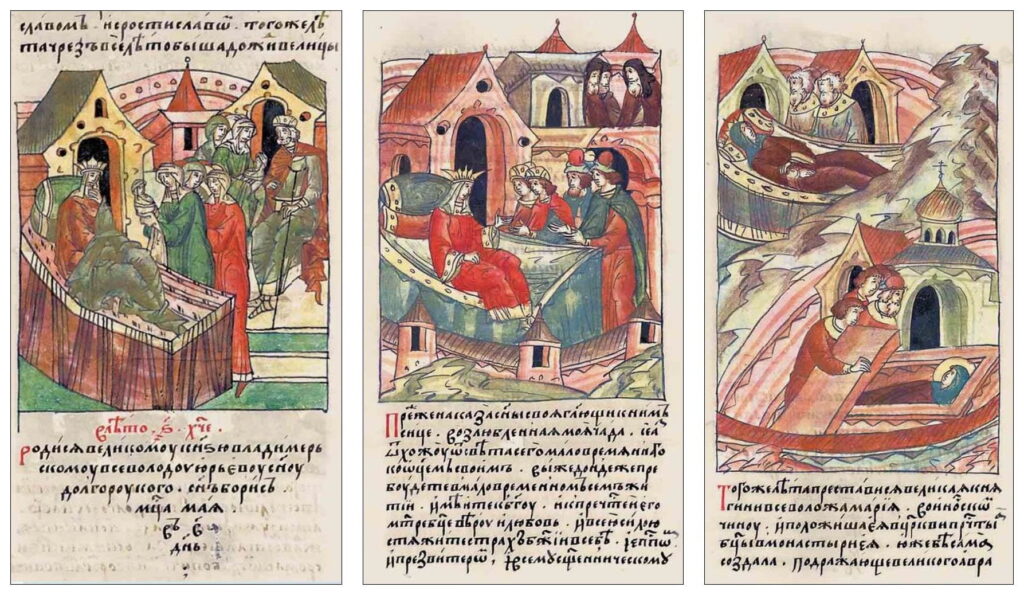
Maria Vsevolzhaya married Vsevolod no later than 1175 and became the mother of 12 children. Through her descendants, she became the ancestor of a major branch of the Rurik dynasty, including the later princes of Moscow.
Medieval sources also associate her with the Dormition Knyaginin Monastery, founded in Vladimir in 1200. The monastery became known as the “Princess’s Monastery” and later served as a burial place for members of her family.
Maria suffered from a serious illness for several years and entered the monastery shortly before her death in 1206. Chronicle accounts describe her as a respected figure who supported clergy, aided the poor and cared for the sick.
They also record a final address to her sons, urging them to live in peace and avoid conflict with one another.
The newly identified seals add a different dimension to that written portrait.
A personal seal was not simply a mark of status. It was used to authenticate documents and confirm involvement in official transactions. Maria’s possession of such a seal indicates that she had a direct role in the preparation or approval of administrative and legal records.
The discovery therefore provides rare archaeological evidence for the political agency of a woman at the center of princely power in medieval Vladimir.
Cover Image Credit: Institute of Archaeology, Russian Academy of Sciences (IA RAS).