
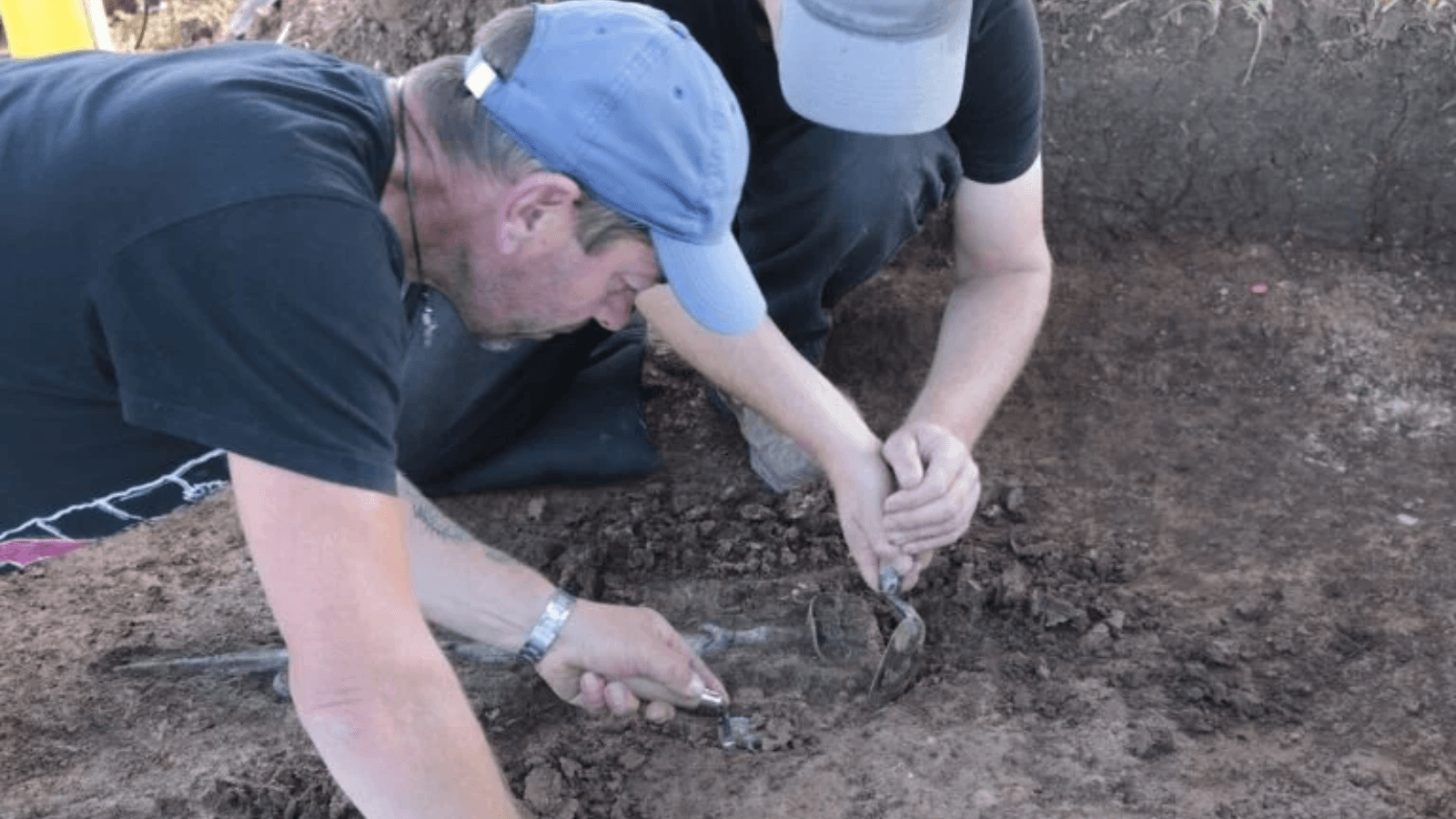
Archaeologists in central Germany have uncovered a rare Bronze Age sword, the remains of a man buried face down with an arrowhead still lodged in his chest, and a woman’s grave containing unusual bronze ornaments. The discoveries near Bothenheilingen, in the German state of Thuringia, provide evidence of prehistoric metalworking, burial customs, and violence. The sword, dating to approximately 880–800 BC, bears a striking resemblance to another weapon discovered nearby in 1931, raising the possibility that the same Bronze Age craftsman made both weapons.
The Thuringian State Office for Monument Preservation and Archaeology (TLDA) conducted excavations between July 2025 and November 2026 ahead of wind farm construction in the Unstrut-Hainich district. Archaeologists documented prehistoric settlements and burial grounds spanning several millennia.
Two Bronze Age Swords Discovered 95 Years Apart
One of the most significant discoveries came from a grave associated with the Unstrut cultural group, which occupied parts of central Germany between approximately 1300 and 750 BC. Alongside the deceased, archaeologists found a bronze sword, an arm ring, and a spearhead.
The weapon belongs to a distinctive category known as antenna-hilted swords, characterized by two projecting terminals on the pommel. Such weapons rarely appear in archaeological excavations in Thuringia, where historical grave looting has deprived researchers of much of the original material from Late Bronze Age burials.
In 1931, researchers discovered a hoard of six swords only a few hundred meters from the recently excavated grave. One of those weapons closely resembles the new discovery, leading archaeologists to consider whether the same craftsman produced both swords nearly 3,000 years ago.
The newly discovered weapon also preserves evidence of its life before burial. Archaeologist Volker Neubeck explained in a recent interview that the decorated sword bears damage consistent with combat and underwent repairs after breaking. These traces suggest that the weapon served a practical purpose rather than functioning exclusively as a symbol of status.
A Man Buried Face Down With an Arrowhead in His Chest
Elsewhere at the excavation site, archaeologists identified the remains of an ancient burial mound that prolonged agricultural activity had gradually flattened. Although the mound itself no longer survives, its surrounding circular ditch preserved the outline of the monument.
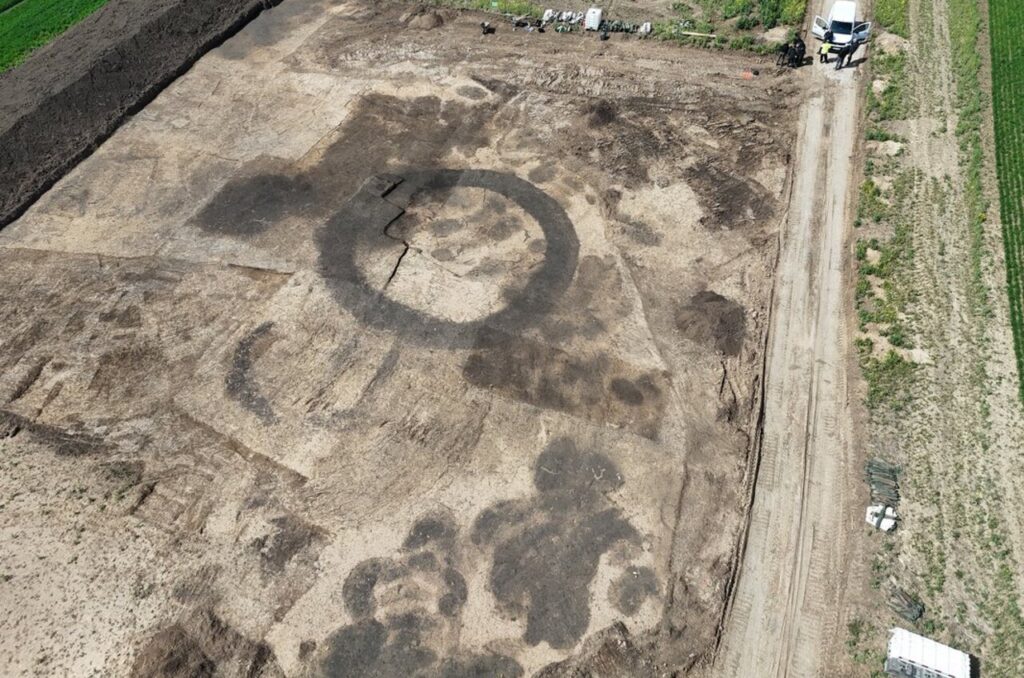
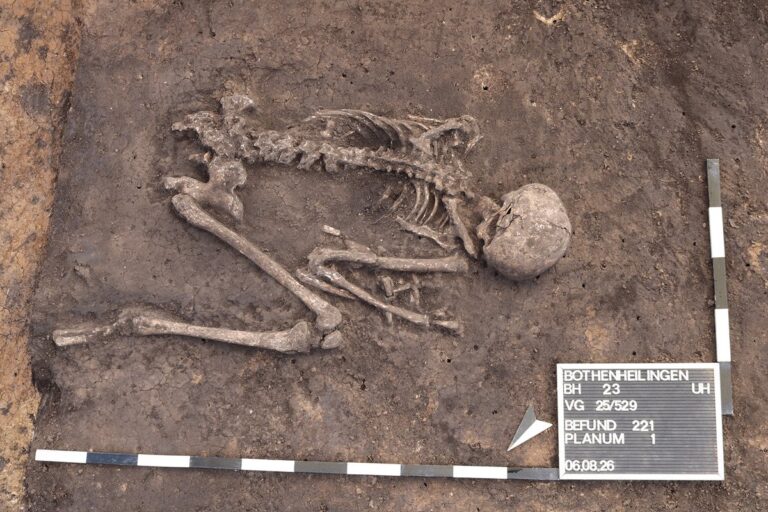
One of the graves associated with the monument contained the skeleton of a man lying face down. An arrowhead remained lodged in his chest, providing physical evidence of a violent encounter in the distant past.
The circumstances surrounding his death remain unknown. Archaeologists have yet to determine whether the injury resulted from armed conflict or an isolated act of violence. His unusual burial position raises additional questions about how prehistoric communities treated their dead under different circumstances.
Researchers have not yet established the precise date of the man’s burial or the original construction date of the mound. Agricultural activity destroyed the central graves, which could have provided important chronological evidence.
A Bronze Age Woman’s Unusual Burial Ornaments
Near the man’s grave, archaeologists uncovered the burial of a woman from the Middle Bronze Age. Her grave contained two bronze arm spirals and two wheel-shaped dress pins, offering evidence of prehistoric clothing and personal adornment.
The pins served both decorative and practical purposes, securing garments while displaying the craftsmanship of Bronze Age metalworkers. Archaeologists rarely encounter these distinctive ornaments in Thuringia, making the woman’s burial particularly valuable for understanding regional clothing traditions.
Because textiles rarely survive in prehistoric graves, metal accessories often provide the principal evidence for reconstructing ancient dress. Their position within a burial can also help researchers determine how people originally wore these objects.
A Landscape With More Than 6,000 Years of History
The excavations at Bothenheilingen revealed a much longer history of human activity. Archaeologists documented Neolithic settlement remains dating to approximately 4600–4450 BC, along with numerous burials associated with the Corded Ware culture, which spread across large parts of Europe between approximately 2800 and 2200 BC.
The latest discoveries add to a growing body of archaeological evidence concerning prehistoric metalworking in Germany. Recent research into a 3,400-year-old bronze sword from Nördlingen has also revealed unexpected details about Bronze Age weapon manufacturing techniques.
Specialists at the TLDA’s conservation workshops in Weimar are now examining and restoring the artifacts from Bothenheilingen. The institution plans to present the discoveries to the public following conservation.
A comparison between the newly discovered sword and its counterpart from the 1931 hoard could prove particularly informative. Nearly three millennia after their manufacture, the two weapons may help archaeologists identify the distinctive workmanship of an individual Bronze Age craftsman.
Cover Image: Archaeologists carefully uncover a rare Late Bronze Age sword during excavations near Bothenheilingen, Thuringia, Germany. Credit: K. Züffle / TLDA