
Inside a 3,200-year-old stone tower in Sardinia, archaeologists found a sealed well, shattered ceremonial vessels and a bronze sword that was never meant for battle.
The discovery at Nuraghe Barru, in south-central Sardinia, is now changing how researchers understand the afterlife of the island’s famous Bronze Age towers. These massive stone monuments, known as nuraghi, were not always abandoned when Sardinian society changed. In some cases, they were transformed into sacred places.
A new interdisciplinary study led by Dr. Silvia Amicone of the University of Tübingen shows that Nuraghe Barru remained active into the Early Iron Age, centuries after its original construction. The site appears to have become a place where ritual, memory and social power met.
A Bronze Age tower with a second life
Sardinia is often called the island of towers for a reason. Nearly 7,000 nuraghi still stand across the island, built mainly between about 1700 and 1100 BC. Their exact function remains debated. Some may have served as defensive structures, elite residences, territorial markers, ritual spaces or a mixture of several roles.
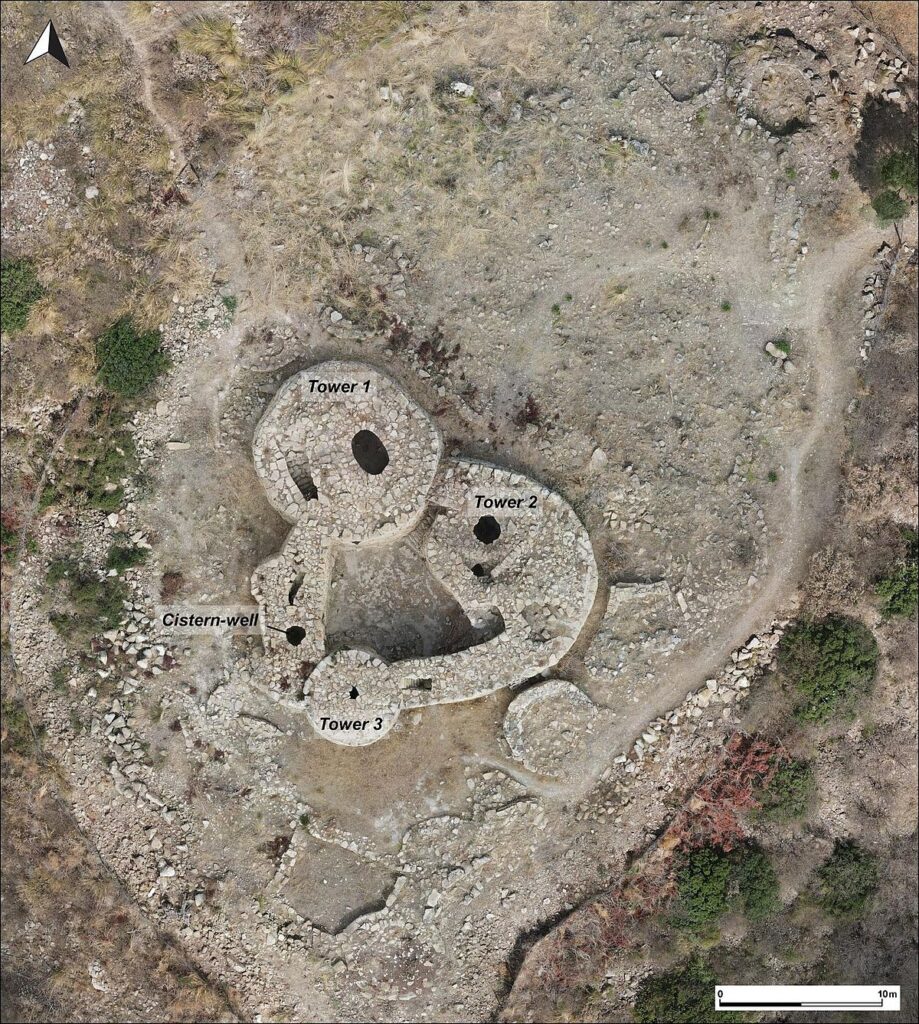
By the end of the Bronze Age and the beginning of the Iron Age, roughly between 1200 and 800 BC, Sardinia’s religious landscape was changing. Sacred wells and new cult places began to appear. That raised a central question: did the old towers lose their meaning, or did some communities reuse them in new ways?
Nuraghe Barru gives a clear answer. It was not treated as a dead monument. It was reactivated.
A sealed well filled with broken offerings
During excavations led by Dr. Chiara Pilo of the local Soprintendenza, archaeologists uncovered a carefully sealed cistern-well inside the tower complex. At the bottom were deliberately broken ceramic vessels, including jugs, a miniature amphora and a rare four-handled ceremonial vessel.
The deposit also contained animal and human remains. After these materials were placed inside, the well was closed with limestone slabs.
This was not ordinary rubbish. The placement of the objects, the breaking of the vessels and the deliberate sealing of the well all point to a structured ritual act. The well had become more than a water feature. It was turned into a ceremonial space.
A sword made for ritual, not war
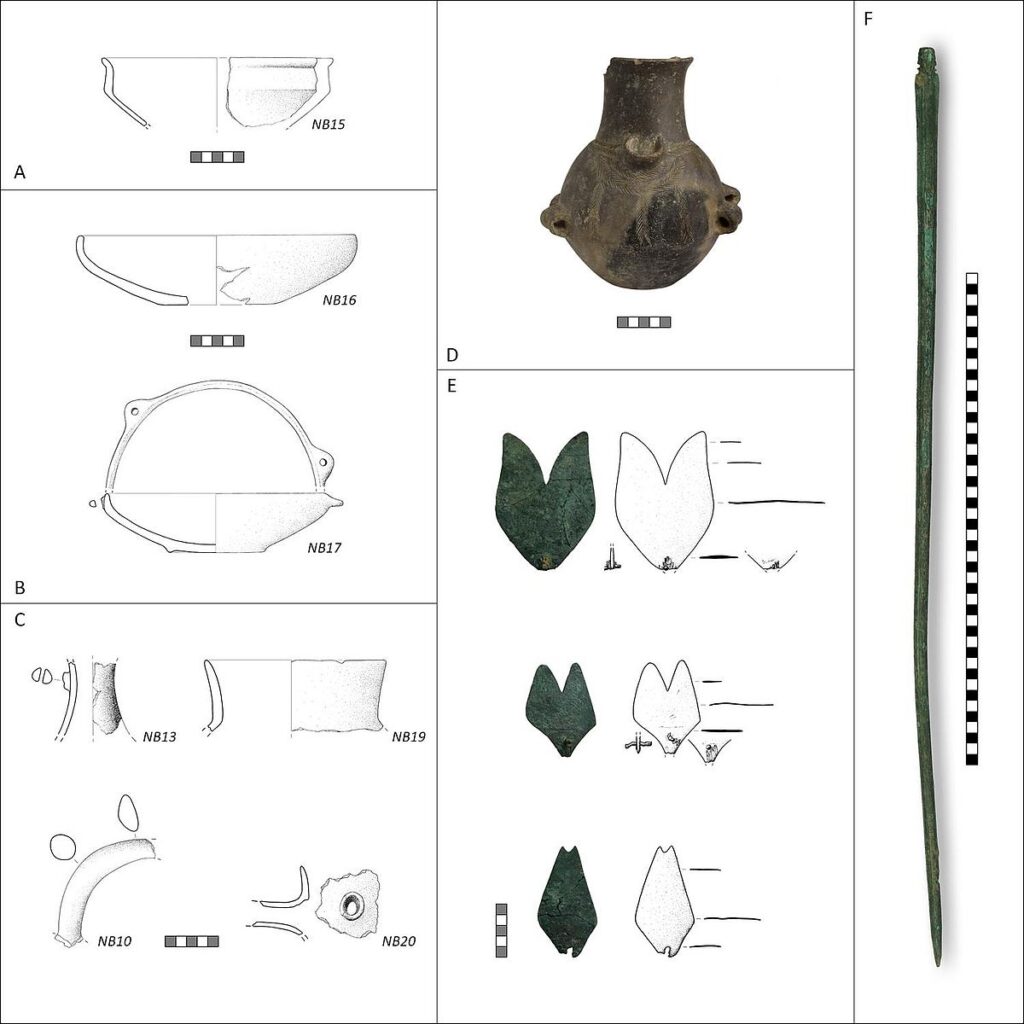
Near the sealed well, the team found another striking group of objects along a staircase. The deposit included a 94-centimeter bronze sword, three razor-like bronze objects and a lump of copper. Afterward, the staircase was blocked, cutting off access to the upper level of the monument.
The sword is the strongest visual symbol of the discovery. At first glance, it suggests warfare. But the metal analysis tells a different story. The sword and blade-like objects were made from bronze with a high copper content and low tin content. According to the researchers, this type of alloy is typical of Nuragic votive swords, objects created for symbolic or ritual purposes rather than combat.
The published study identifies the Barru sword as only the second intact votive sword known from inside a nuraghe. That makes the find unusually important for understanding how these towers were reused as sacred spaces.
The razor-like bronze objects add another layer. Their form resembles objects known from mainland Italy, yet their composition suggests local production rather than direct import. Barru was not isolated from wider Mediterranean influences, but those ideas were being adapted within Sardinia itself.
Objects traveled across Sardinia
The ceramics also revealed a larger story. Using thin-section petrography, a scientific method that identifies minerals inside pottery, the researchers found that most of the vessels were not made locally at Barru.
Some came from different geological regions of Sardinia, including areas more than 40 kilometers away. That matters because it suggests movement: people, materials, customs and ideas were circulating across the island.
Nuraghe Barru may have been one point in a wider network. Objects did not arrive there by accident. They were brought into a place that still held meaning.

Ritual, identity and power
The most important part of the discovery is not one object alone. It is the sequence.
Vessels were broken. Remains were placed in a well. The well was sealed. Metal offerings were deposited near a staircase. Access to part of the tower was blocked. The architecture itself was changed.
That pattern suggests a deliberate transformation of space. An old Bronze Age tower was being reshaped for Iron Age ritual life.
For the researchers, Nuraghe Barru shows that Sardinia’s ancient towers could remain socially powerful long after their original construction. As new sacred places appeared across the island, some communities did not simply abandon older monuments. They returned to them, altered them and used them to express identity in a period of change.
In that sense, the discovery is not just about a sword or a sealed well. It is about memory. Nuraghe Barru shows how a community reached back into the Bronze Age past and made it sacred again.
More than 3,000 years later, the tower still preserves that moment: a place where old stone, ritual objects and changing beliefs came together inside one of Sardinia’s most distinctive monuments.
Amicone, Silvia, Tiezzi, Valeria, Broisch-Höhner, Manuela, Freund, Kyle P., Heinze, Lars, Morandi, Lionello F., Salis, Gianfranca and Pilo, Chiara. “Ritual and Connectivity in Nuragic Sardinia: An Interdisciplinary Study of Ceramics and Metalwork from Nuraghe Barru” Open Archaeology, vol. 12, no. 1, 2026, pp. 20250078. https://doi.org/10.1515/opar-2025-0078
Cover Image Credit: Aerial view of the Nuraghe Barru archaeological site in south-central Sardinia. University of Tübingen