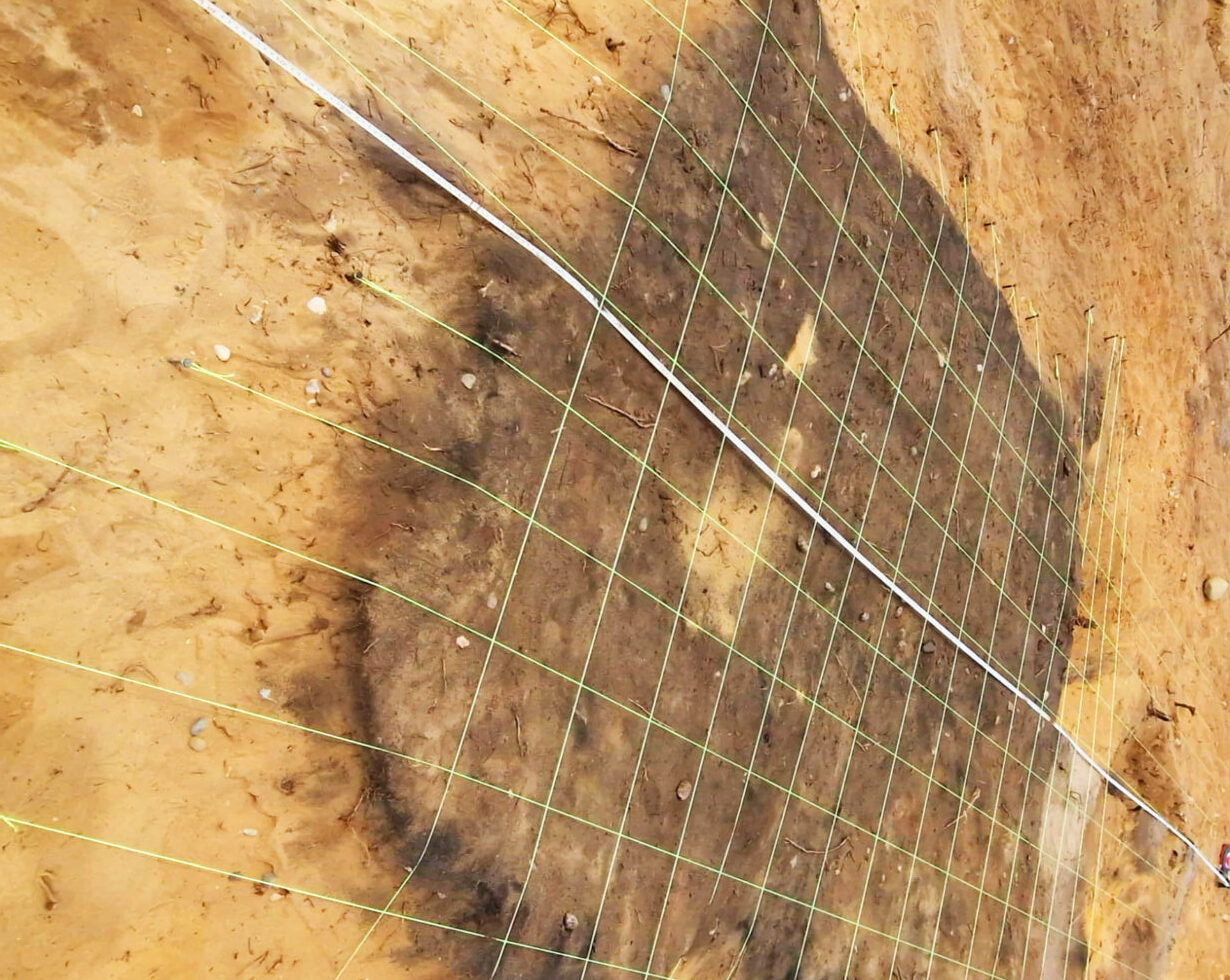
A rare funeral pyre at Sizewell C has revealed one of the most elusive stages of ancient burial practice: the moment when a body was placed on timber, set alight and transformed by fire.
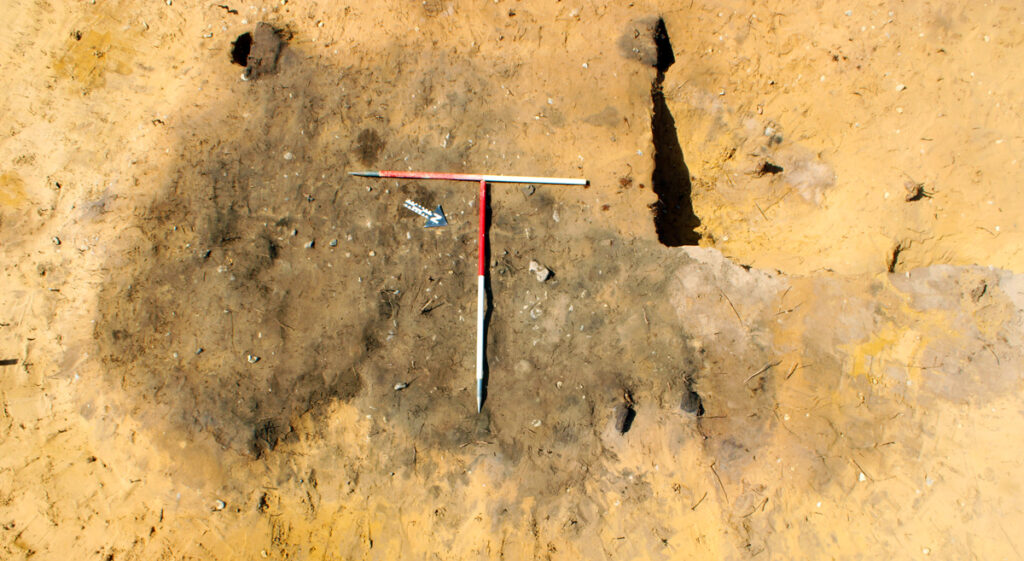
The discovery was made at Goose Hill, part of the archaeological investigations linked to the Sizewell C project on England’s Suffolk coast. What survived was not a grave filled with objects or a complete burial. It was a dark, rectangular stain in the soil, marked by charcoal, heat-reddened sand, scattered burnt bone and the postholes of a timber structure.
For archaeologists, that is enough to make the find significant. Funeral pyres were usually built above ground. After a cremation, the remaining bone could be collected and buried somewhere else, often in an urn. Farming, erosion and later activity normally erase the pyre itself.
At Goose Hill, however, part of the original cremation place appears to have survived.
A timber platform built for cremation
The pyre was probably built as a raised lattice of stacked wood, measuring about 3 metres by 2 metres. Archaeologists believe it may have stood up to 1.5 metres high, with kindling and heath scrub packed into the structure to help the fire burn.
The body of the deceased would have been placed on top of this platform before the pyre was lit.
Several postholes were recorded around the feature, suggesting that upright posts once supported or framed the structure. In places, the sand beneath had turned pink from the heat. Small fragments of burnt bone were recovered from the charcoal-rich soil.
Those fragments are now central to the next stage of research. Analysis may confirm whether the bone is human and, if preservation allows, provide information about the person’s age, biological sex, health and possible disease.
The missing remains may be part of the ritual
Only a small amount of burnt bone was found in the pyre deposit. That does not necessarily mean the cremation was incomplete or poorly preserved.
It may show what happened after the fire went out.
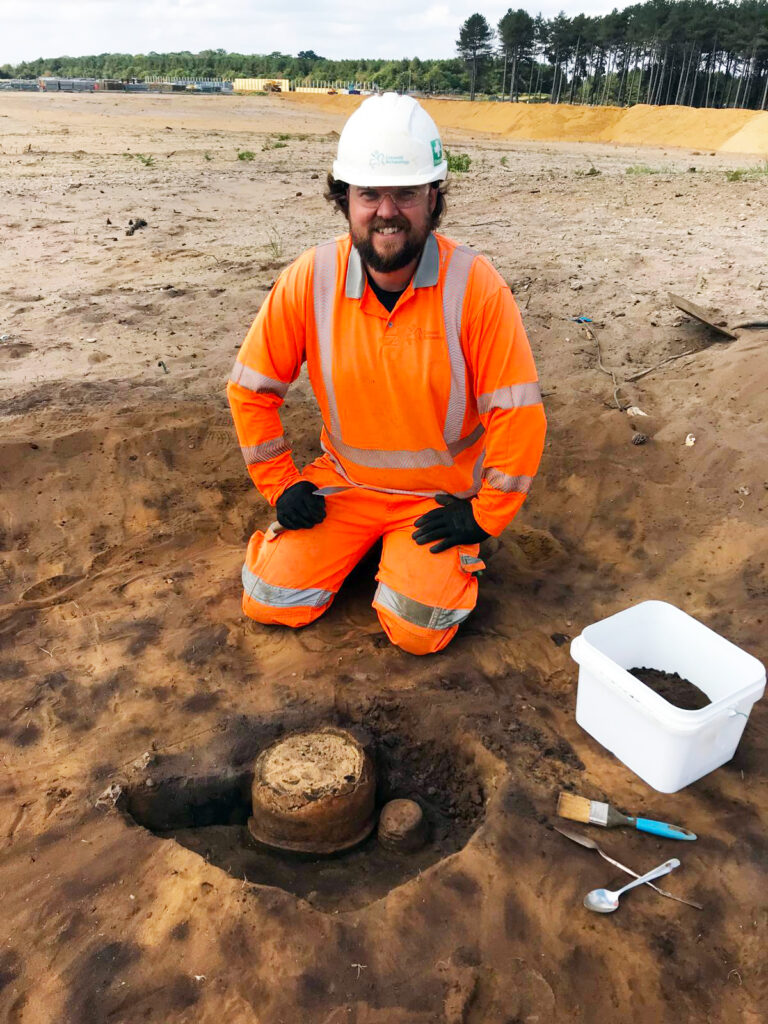
In many prehistoric cremation traditions, the burned remains were gathered from the pyre and placed in a separate burial. At Goose Hill, archaeologists have already identified a Bronze Age cremation burial in a Collared Urn, dated to around 1950–1600 BC, along with another possible urned cremation.
That makes the new pyre important. Archaeologists often find the final burial deposit, but far less often do they find the place where the cremation actually took place. The Goose Hill feature may preserve that missing stage between death and burial.
A ring ditch, a lost mound and an uncertain date
The pyre was found off-centre within a ring ditch, a type of circular feature often associated with prehistoric burial mounds or barrows. The mound itself has disappeared, most likely through ploughing, but it may once have covered and protected the pyre.
The relationship between the pyre and the ring ditch is still unclear. The cremation may have belonged to the original monument, or it may have been inserted later into the edge of an older barrow.
No central burial was found within the ring ditch. That absence is not conclusive. A later ditch cut through the centre of the mound area and may have destroyed earlier evidence.
The ring ditch must be older than the Iron Age, because an Iron Age pit cut into its already filled ditch. A polished flint axe from the Early Neolithic period was also recovered from a later ditch, though archaeologists believe it was residual, meaning it had been old long before it was finally buried there.
The pyre itself has not yet been securely dated. Radiocarbon testing of charcoal or burnt bone may eventually show whether it belongs to the Bronze Age, the Iron Age or another phase of prehistoric activity.
A rare survival on the Suffolk coast
The Suffolk coast has a long and layered archaeological record. Around Sizewell C, excavations have revealed evidence of Early Bronze Age farming, Roman salt production, medieval activity, World War II military features and early medieval burial practices.
Goose Hill now adds a more intimate kind of evidence to that landscape.
Its position on a slope, looking south toward the modern coastline, may have mattered. Burial places in prehistoric Britain were often placed with care. Visibility, elevation and proximity to familiar routes or natural features could all shape how communities marked death.
If the Goose Hill pyre proves prehistoric, it may help researchers understand not just how people were buried, but how funerals were performed. Cremation was not simply a practical way to dispose of a body. It was a public act, involving fuel, fire, movement and memory.
The person burned at Goose Hill remains unknown. Their name, status and life story are lost. But the pyre preserves a rare trace of the ceremony itself: the timber structure, the intense heat, the gathered remains and the final act before burial.
At Sizewell C, a faint stain in the Suffolk soil has become evidence of a human moment that archaeology rarely catches so directly.