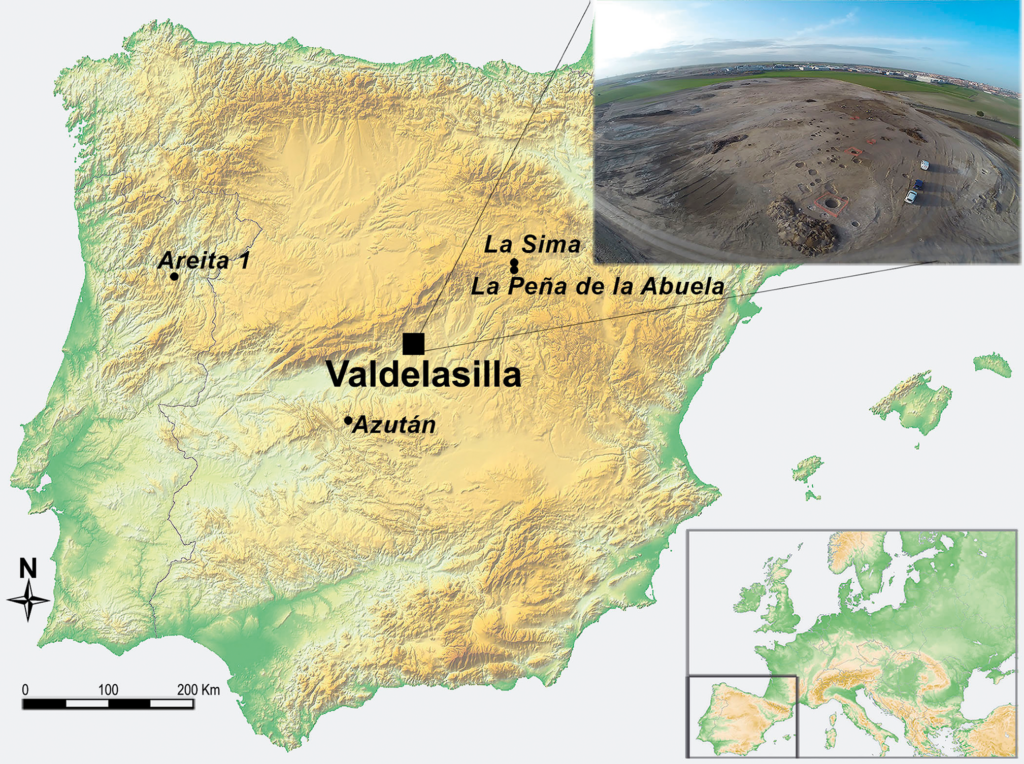
The Valdelasilla megalithic necropolis in Toledo is pushing one of Iberian archaeology’s major questions away from the coast and into the heart of central Spain.
Beneath a gently sloping field in Illescas, not far from the Tagus River basin, archaeologists have identified the oldest known monumental necropolis in the interior of the Iberian Peninsula. New radiocarbon dates place its first use in the late fifth millennium BC, around 6,000 years ago.
That date matters. For decades, many explanations of early European megalithism have focused on coastal routes, especially the Atlantic and Mediterranean worlds. Valdelasilla suggests that inland communities were not simply waiting for monumental burial traditions to arrive from elsewhere. They were already designing formal cemeteries, building durable tombs, and giving the dead a lasting place in the landscape.
The study, led by Rosa Barroso Bermejo of the University of Alcalá and published in the Cambridge Archaeological Journal, shows that Valdelasilla was not a loose group of graves. It was a planned funerary space, organized around a central tomb and used from the Late Neolithic into the Chalcolithic.
A central tomb shaped the whole cemetery
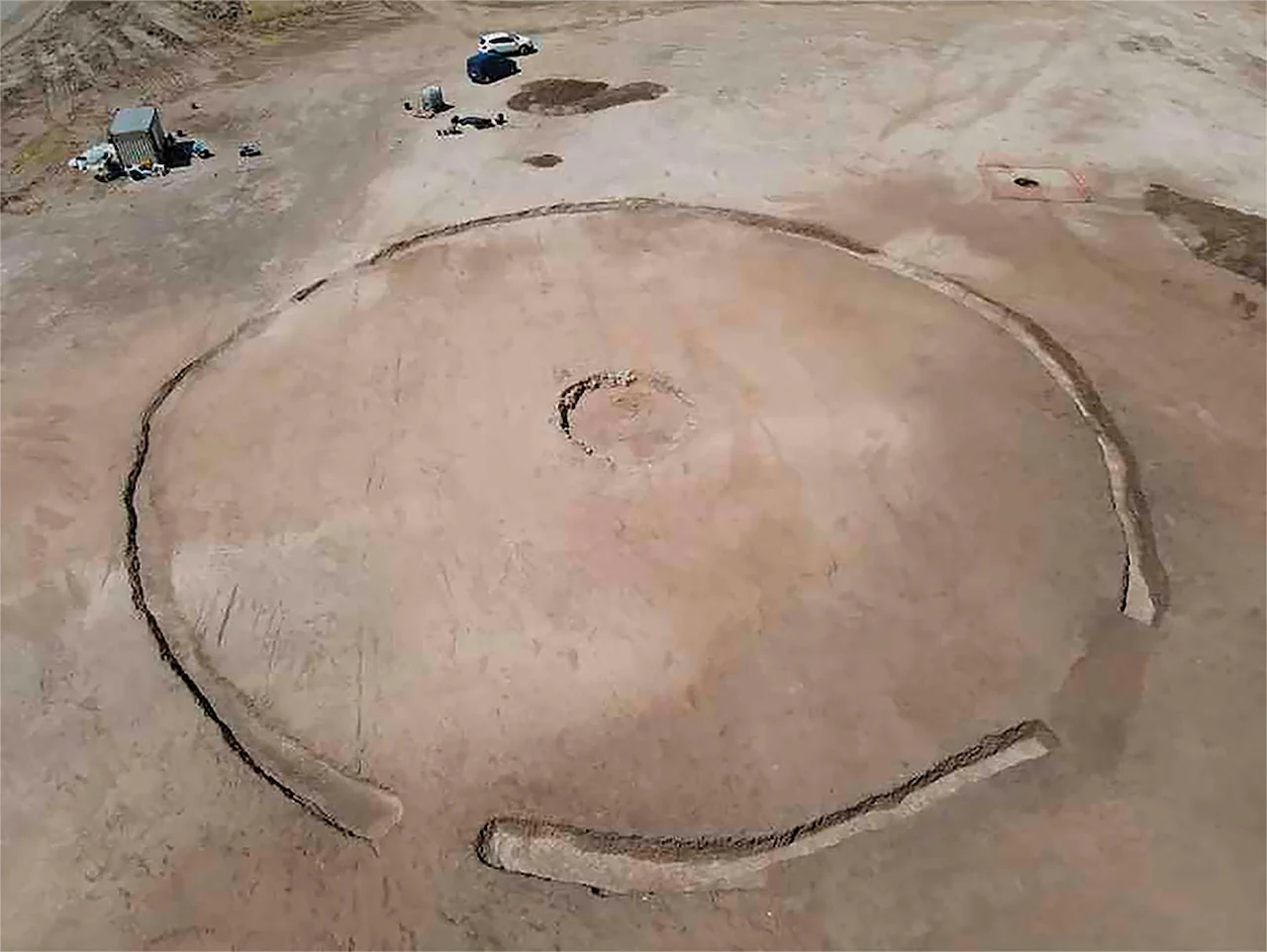
At the heart of Valdelasilla stood a circular funerary chamber known as VLD-T450. It originally measured about six meters across, although its usable space was later reduced when the walls were reinforced with compacted earth, clay, small stones, and timber.
Around the tomb, archaeologists identified a circular ditch with an internal diameter of about 36 meters. Its entrance faced southeast and appears to have been aligned with the central chamber.
No human bones were found in the ditch, and it could not be directly dated. But its position is difficult to treat as accidental. The enclosure and tomb seem to have belonged to the same architectural idea: a monument built to organize movement, ritual, and memory around the dead.
The ditch contained stones, pottery fragments, stone tools, and burned animal remains. These finds point to repeated activity around the monument, possibly connected with funerary ceremonies or gatherings held near the tomb.
The first burials reveal careful ritual choices
Inside VLD-T450, the earliest burial layer preserved a striking scene.
An adult woman had been placed on her right side in a flexed position. Beneath her head were bone hairpins and an awl. Nearby, archaeologists found the disarticulated remains of another adult woman, stained with red pigment and accompanied by ornaments, including stone beads, pendants, and marine shells.
The chamber was later reopened. After the first burial level had been sealed, new remains were placed inside, including an adult man and the mixed bones of several other individuals.
This was not a simple grave used once and abandoned. It was a structure returned to over time, where bodies could be buried, rearranged, sealed, and remembered.
Monumental does not always mean giant stone
Valdelasilla complicates the familiar image of megalithic monuments as huge stone structures standing above the ground.
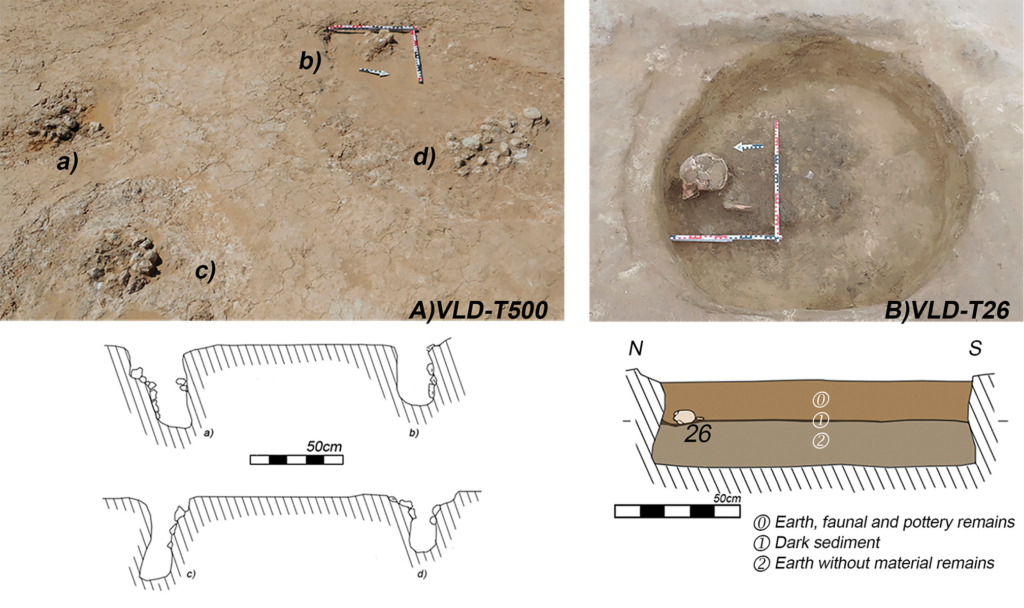
The tombs here were built with wood, clay, compacted earth, small stones, and timber supports. They may not have resembled the great stone dolmens of Atlantic Europe, but their purpose was comparable. They marked the dead through durable construction and made burial a visible part of the community’s world.
Other tombs around the central enclosure show the same concern for placement and ritual.
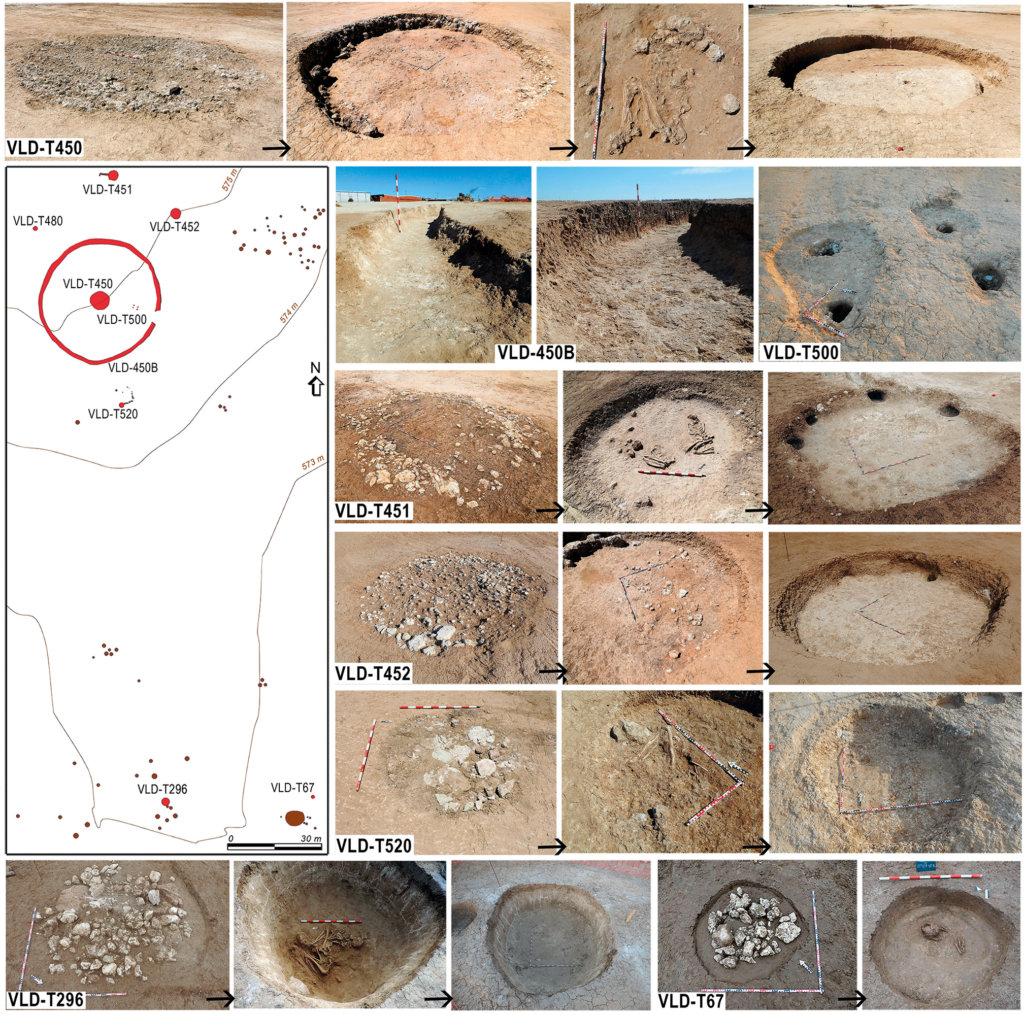
In VLD-T451, archaeologists found two adult men. One had been placed in primary burial position, with bone hairpins beneath the skull. VLD-T452 held at least three individuals, with red pigment on bones and charcoal deposits that may represent the remains of a wooden roof. Farther from the main enclosure, VLD-T296 contained a double burial of an adult man and woman, both placed in flexed positions and marked with traces of red ochre.
The cemetery also included a child burial, VLD-T67, placed in a small oval cavity surrounded by stones. No grave goods were found with the child, a detail that may point to differences in funerary treatment based on age, identity, or social role.
Marine shells show inland communities were not isolated
The objects placed with the dead reveal a community connected to more than its immediate surroundings.
Bone tools, hairpins, polished stone objects, flint blades, beads, and pendants were recovered from the tombs. In the central chamber alone, archaeologists found more than a hundred marine shells of the Antalis genus.
For a cemetery deep in the Iberian interior, that detail is important. The shells had travelled from the coast or through exchange networks that carried coastal materials inland. At Valdelasilla, they were not ordinary objects. They became part of burial ritual.
Red pigment was another repeated element. Identified as iron oxide, it appeared on bones and sediments in several tombs. In Neolithic and Chalcolithic funerary contexts, such pigment is often associated with body treatment, transformation, or the ritual marking of the dead.
At Valdelasilla, ochre, shells, bone tools, and burial positions suggest a community with shared ideas about death, identity, and remembrance.
Radiocarbon dates change the timeline
The strength of the Valdelasilla study lies in its chronology.
Researchers obtained 21 radiocarbon dates, mostly from human bones, and used Bayesian modeling to reconstruct the cemetery’s development. The earliest phase began roughly between 4336 and 4062 BC, placing Valdelasilla in the late fifth millennium BC.
That makes the site unusually early for the Iberian interior.
The dates suggest that the first tombs may have been built within a relatively short period, perhaps even within the same generation. Yet the cemetery remained meaningful for centuries.
In the third millennium BC, another chamber, VLD-T272, was used as an ossuary containing the remains of 17 individuals. Ten skulls had been deliberately arranged around the edge of the chamber.
That final arrangement is one of the clearest signs that Valdelasilla was not forgotten. Its meaning changed over time, but people continued to return to it.
The Iberian interior was not a latecomer
Valdelasilla does not erase the importance of Atlantic and Mediterranean routes in the spread of megalithic traditions. But it does weaken the idea that inland Iberia was merely a late recipient of coastal influence.
The cemetery points to a more complex picture. Communities in the Meseta were building their own monumental funerary landscapes very early, using local materials and their own architectural choices.
They did not need towering stone slabs to create monumentality. They used earth, timber, clay, stone, shells, pigment, and repeated acts of burial.
Six thousand years ago, in the interior of the Iberian Peninsula, a Neolithic community gave the dead a permanent place in the landscape. Valdelasilla now shows that some of Europe’s earliest monumental cemeteries were not only a coastal story.
Barroso Bermejo R, Bueno-Ramírez P, Cerrillo-Cuenca E, et al. New Dates for the Emergence of the Megalithic Phenomenon on the Iberian Plateau: The Funerary Practices of Valdelasilla, Toledo (Spain). Cambridge Archaeological Journal. Published online 2026:1-19. doi:10.1017/S0959774326100559
Cover Image Credit: R. Barroso Bermejo et al. 2026, Cambridge Archaeological Journal