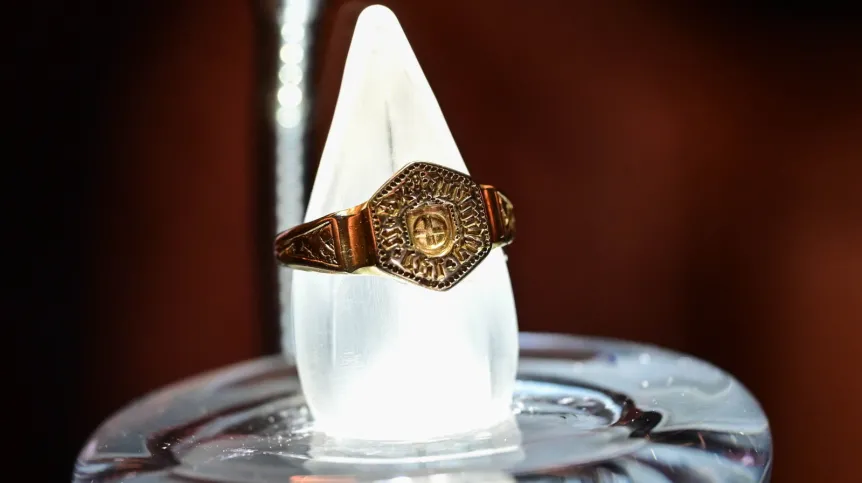
A rare gold bishop’s signet ring linked to Mikołaj Bock von Schippenbeil, a late medieval churchman and diplomat connected with the Teutonic Order, has entered the collection of the Museum of the History of the Kamień Land in Kamień Pomorski, northwestern Poland.
The museum dates the ring to the turn of the 14th and 15th centuries and describes it as an exceptional object. According to the institution, no direct European parallel for this type of gold episcopal signet ring is currently known in published literature or museum collections.
The ring was handed over by a private individual who has chosen to remain anonymous. In recognition of the donation, the person is expected to receive a financial award from Poland’s Minister of Culture and National Heritage.
A Private Seal in Solid Gold
The object was more than an item of personal adornment. It served as the bishop’s private seal, used to authenticate documents by pressing the engraved surface into wax. In medieval administration, such a ring was both practical and symbolic: it carried the identity, office and authority of its owner.
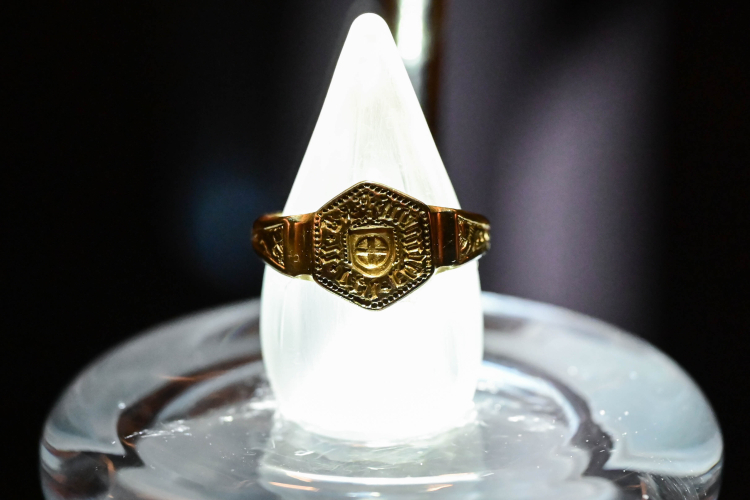
Made of solid gold, the ring measures 25 mm across its outer diameter and 22 mm inside. It weighs 10.43 grams. The hoop widens toward the top and ends in a hexagonal seal matrix measuring 12 by 13 mm. The matrix is engraved in intaglio, allowing it to produce a raised impression when used as a seal.
At the center of the seal is a heraldic shield with a cross set inside a circle. The museum identifies the motif as the coat of arms of the Chełmno diocese. Around the shield runs a Gothic minuscule inscription: “s + n + epi + colmens.” Expanded, it reads “sigillum nicolai episcopi colmensis,” meaning “the seal of Nicholas, bishop of Chełmno.”
Lions, Panthers, and Episcopal Power
The edge of the seal field is decorated with a beaded border, a detail associated with high-quality late medieval goldsmithing. The hoop is also decorated on both sides of the seal matrix with predatory animals, probably lions or panthers, shown in motion with their heads turned in different directions.
The museum suggests that the animal imagery may have referred to the dual nature of episcopal power: the bishop as guardian of spiritual order, but also as an active figure in politics and administration. That interpretation fits the career of Mikołaj Bock von Schippenbeil, whose life moved between church office, diplomacy and the political world of the Teutonic Order.
A Bishop Between Rome and the Teutonic Order
Mikołaj probably came from a German burgher family from Sępopol, then known as Schippenbeil, within the territory of the Teutonic Order. He appears in written sources from 1388, when he served as the Order’s general procurator in Rome, representing its interests before the papal curia.
In 1390, after the death of Bishop Reinhard von Sayn, he was elected bishop of Chełmno. His rise was not straightforward. During a journey through Bohemia, he was abducted and imprisoned in České Budějovice. He was released in spring 1391 after the intervention of Konrad Wallenrod, a senior official of the Teutonic Order.
In 1398, Pope Boniface IX transferred him to the bishopric of Kamień. There, Mikołaj held not only ecclesiastical authority but also secular power over a large episcopal territory that included lands around Kołobrzeg, Koszalin, Karlino and Bobolice.
He also remained closely involved in papal politics. In 1407, during the pontificate of Gregory XII, he served as castellan of Castel Sant’Angelo in Rome, one of the most important papal fortresses. He later took part in events connected with the Western Schism, remaining loyal to the Roman pope.
Mikołaj died after July 4, 1410. His last known document was issued in Myślibórz, where he was probably buried.
For the museum in Kamień Pomorski, the arrival of the ring is significant not only because of its material value, but because it gives the region a rare surviving object connected to one of its most politically active medieval bishops.
Cover Image: The gold episcopal signet ring of Mikołaj Bock von Schippenbeil, presented at the Museum of the History of the Kamień Land in Kamień Pomorski. Dating to the turn of the 14th and 15th centuries, the ring belonged to one of the most important churchmen and diplomats associated with the Teutonic Order. Credit: PAP/Marcin Bielecki