

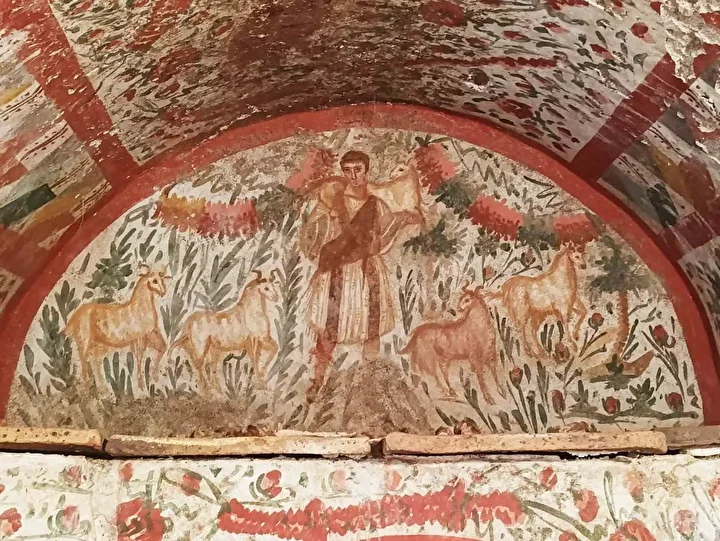
Long before modern pilgrims and popes found their way to its ancient streets, İznik—known worldwide by its classical name, Nicaea—was a meeting point of religions and empires. Now, the city has offered a new insight into its Christian past: archaeologists have uncovered an exceptionally rare Good Shepherd depiction inside a painted hypogeum tomb, a motif so uncommon in Anatolia that this example may be the only one ever identified.
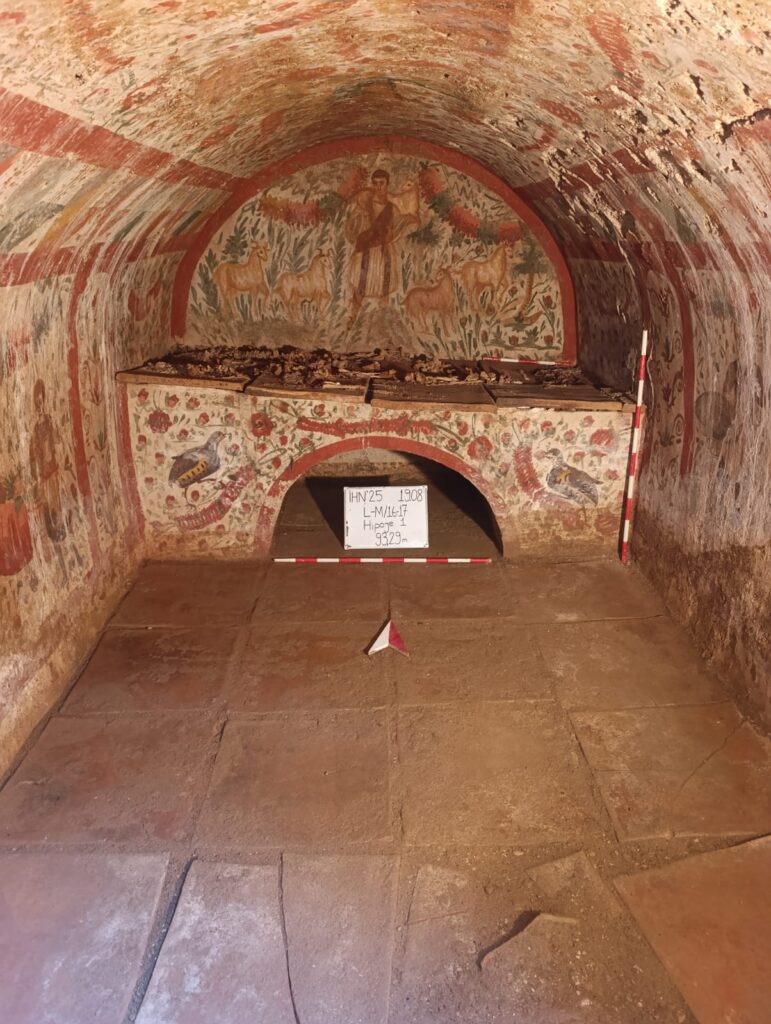
The discovery was made in Hisardere Necropolis during the 2025 excavation season, where a sealed subterranean chamber revealed vivid frescoes untouched for nearly eighteen centuries.
A Painted Chamber Reveals a Unique Image of Jesus
The excavation operates under the Turkish Ministry of Culture and Tourism, directed by İznik Museum Director Tolga Koparal, with scientific guidance from Prof. Dr. Aygün Ekin Meriç of Dokuz Eylül University and contributions from Dr. Gülşen Kutbay.
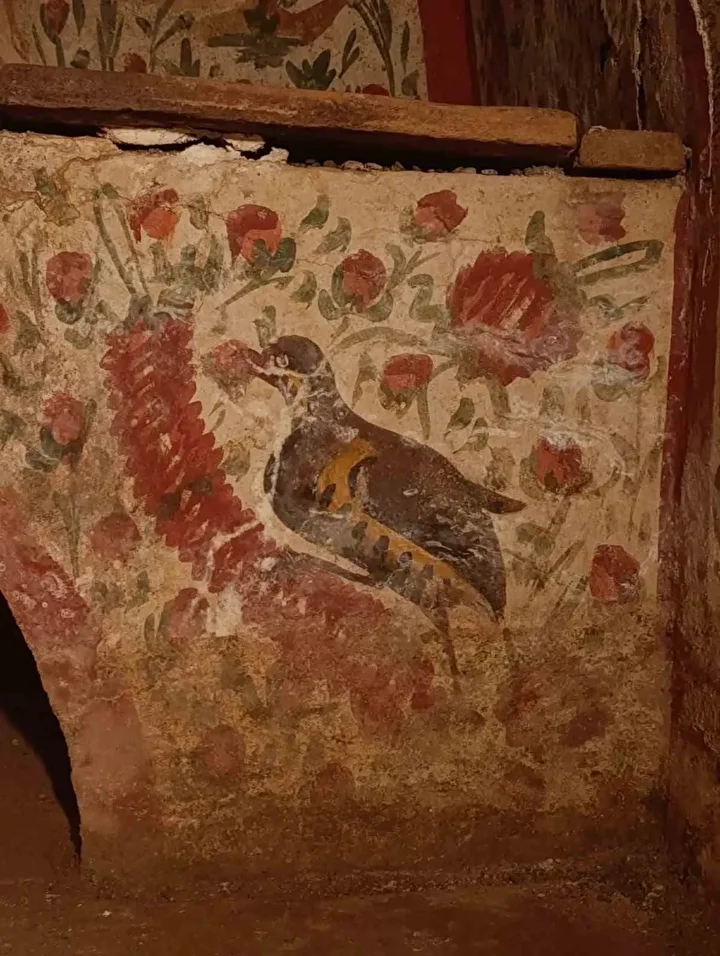
Hisardere Necropolis has long been recognized as a burial ground used by both affluent families and working communities between the 2nd and 5th centuries CE. Yet few tombs match the artistic richness of the chamber opened this season. Its southern wall has collapsed, but the eastern, western, and northern walls retain nearly all their painted plaster.
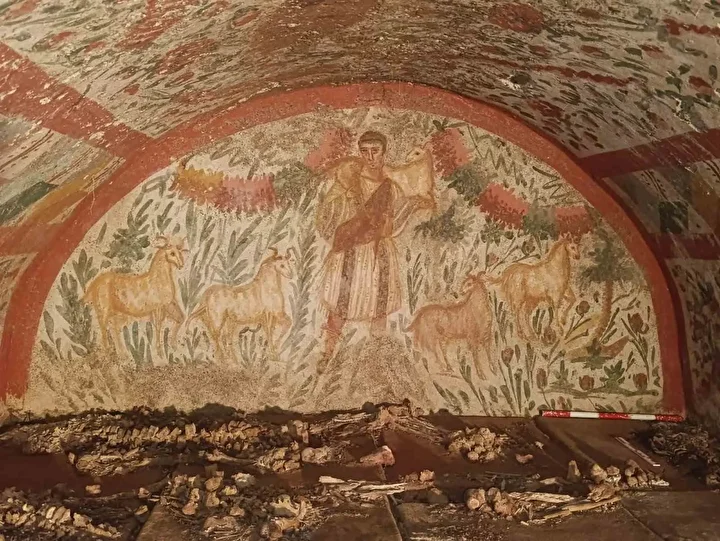
A klinē lined with terracotta squares stands along the northern side—the resting place of the deceased. Above it, archaeologists uncovered the fresco now capturing worldwide attention: a youthful, clean-shaven Jesus in a simple Roman tunic, carrying a horned goat across his shoulders. Two goats flank him in symmetrical posture, forming a pastoral composition at once gentle and symbolically powerful.
Specialists emphasize that depictions of Jesus in distinctly Roman visual language, especially in provincial Anatolia, are exceedingly rare. For this reason, the İznik fresco provides a valuable window into the earliest phases of Christian imagery outside metropolitan centers.
Dating the Tomb and the Broader Significance of İznik
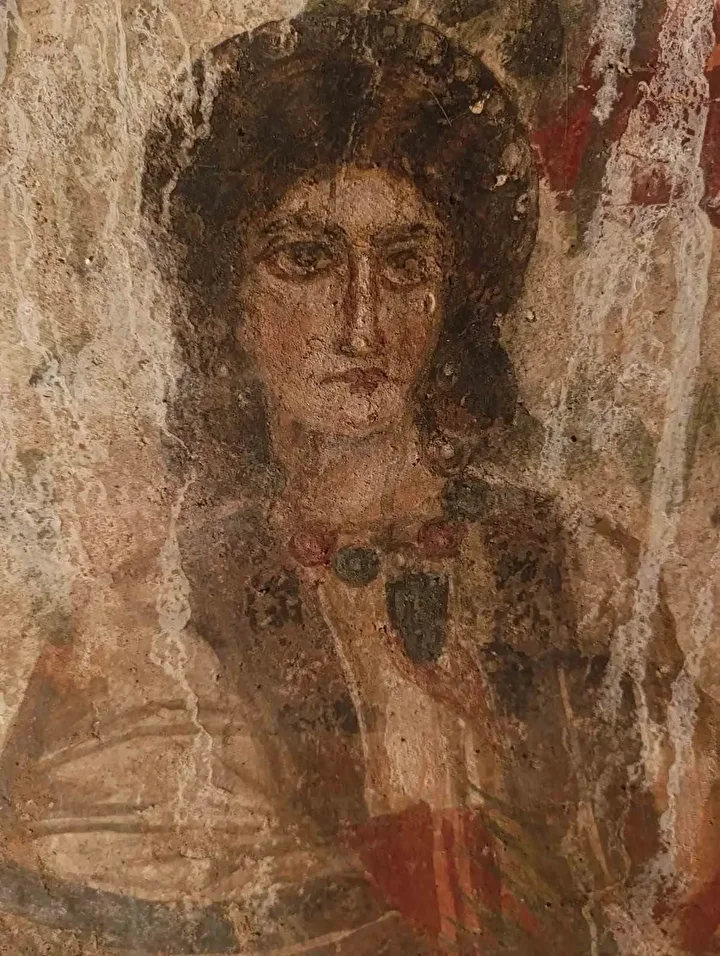
Although no coins or datable objects were found inside the chamber, the tomb’s architecture matches nearby structures securely dated to the 3rd century CE. If this dating holds, the İznik Good Shepherd stands among the earliest Christian-themed funerary paintings known in western Anatolia.
The location amplifies the significance. İznik/Nicaea is a foundational city in Christian history—host of the First Council of Nicaea in 325 CE, a site visited by multiple popes across centuries, and a place where theological debates once shaped global belief. Within this deep historical landscape, the emergence of a Good Shepherd fresco adds a striking new page to the city’s archaeological record.
This is also the first depiction of Jesus ever discovered in Hisardere Necropolis, an extraordinary milestone for a region already layered with religious narrative.
The fresco’s survival—unexpected, vivid, and unmistakably expressive—offers scholars a rare glimpse into how Christian symbolism traveled through Anatolia during its formative centuries, adapting to local traditions while carrying its universal message of guidance and protection.
This report, covering the discovery of the Good Shepherd depiction in İznik, is an exclusive story by Arkeolojihaber. All photographs used in this article were provided by IHA and Arkeolojihaber.