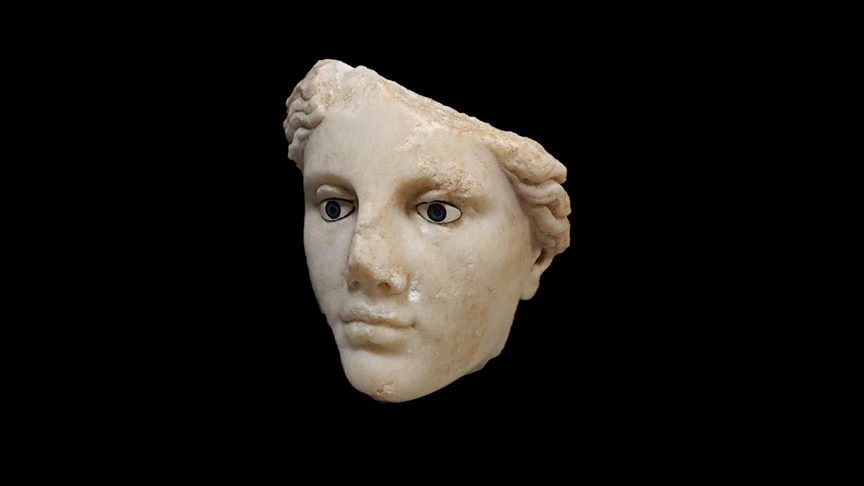
The late afternoon light often falls gently across the slopes of Izmir’s Torbalı district, but this season it illuminated something far rarer: the finely carved head of a Hellenistic-period goddess emerging from the soil of ancient Metropolis. The discovery, made inside a structure identified as a commercial building, is already being described as one of the most striking finds of the current excavation season.
The marble head carries the unmistakable hallmarks of high-level Hellenistic craftsmanship. Flowing hair strands cut with confidence, balanced facial proportions, and a subtle but powerful expression suggest that the original statue must have been monumental in scale. For a city long known as the “City of the Mother Goddess,” the find resonates deeply with Metropolis’s ritual and political identity.
Excavations at Metropolis are conducted under the direction of Prof. Dr. Serdar Aybek of Dokuz Eylül University, supported by Türkiye’s Ministry of Culture and Tourism within the “Heritage to the Future” program and by the Sabancı Foundation. While the city’s origins stretch back to the Neolithic period, it was the Hellenistic centuries that endowed Metropolis with its distinct urban character—its theatre, bouleuterion, bath complexes, and now, increasingly, its sculptural heritage.
Traces of Color, Technique, and Ancient Vision

Conservation work carried out by restorer Didem Taner revealed a detail rarely preserved so clearly: the eye area had been intentionally hollowed to receive inlaid stones. This technique, known from high-status sculptures in Greece, would have given the statue a lifelike, radiant presence when first installed more than two millennia ago.
Another technical clue emerged from the join marks. The head had been carved in two separate blocks and later locked together with a precision characteristic of Hellenistic workshops. According to the excavation team, this modular approach allowed sculptors to work on large statues more efficiently while maintaining exceptionally fine detail.
Prof. Aybek notes that “the scale, craftsmanship, and structural design indicate a monumental original. The piece provides highly significant evidence for understanding Metropolis’s sculptural production during the Hellenistic period.”
Could the Sculpture Represent Hestia?
One hypothesis is gaining traction: the newfound head may belong to Hestia, the goddess of the hearth, household, and civic unity. This interpretation stems from its proportional compatibility with a previously discovered torso found years earlier in Metropolis’s Council House—a structure where Hestia traditionally held symbolic importance.
Restorer Taner Özgür recently carried out a “gaze reconstruction” study, digitally simulating how the statue would have appeared with its original inlaid eyes. The experiment transformed the fragment from a silent archaeological find into a vivid reminder of Metropolis’s religious and political life.
If confirmed, the match between torso and head would restore one of the most impressive Hellenistic goddess statues discovered in western Türkiye in recent decades.
Why This Discovery Matters
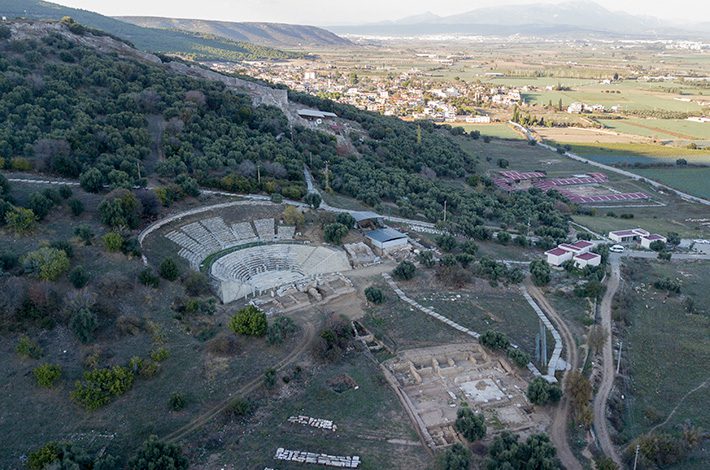
Metropolis sits within a cultural landscape where Anatolian traditions blended with Greek artistic ideals. Finds from the site regularly shed light on ritual life, civic identity, and the shifting power structures of the Hellenistic world. Yet large-scale sculptures attributed to specific deities are exceedingly rare.
The newly uncovered head does more than fill a gap in the site’s sculpture record—it strengthens the argument that Metropolis operated its own advanced workshop or maintained strong artistic connections with major centers across the Aegean.
For scholars, the statue offers a new anchor point for studying public art in western Anatolia; for visitors, it promises to become one of Metropolis’s most emblematic pieces once restoration and display preparations are complete.