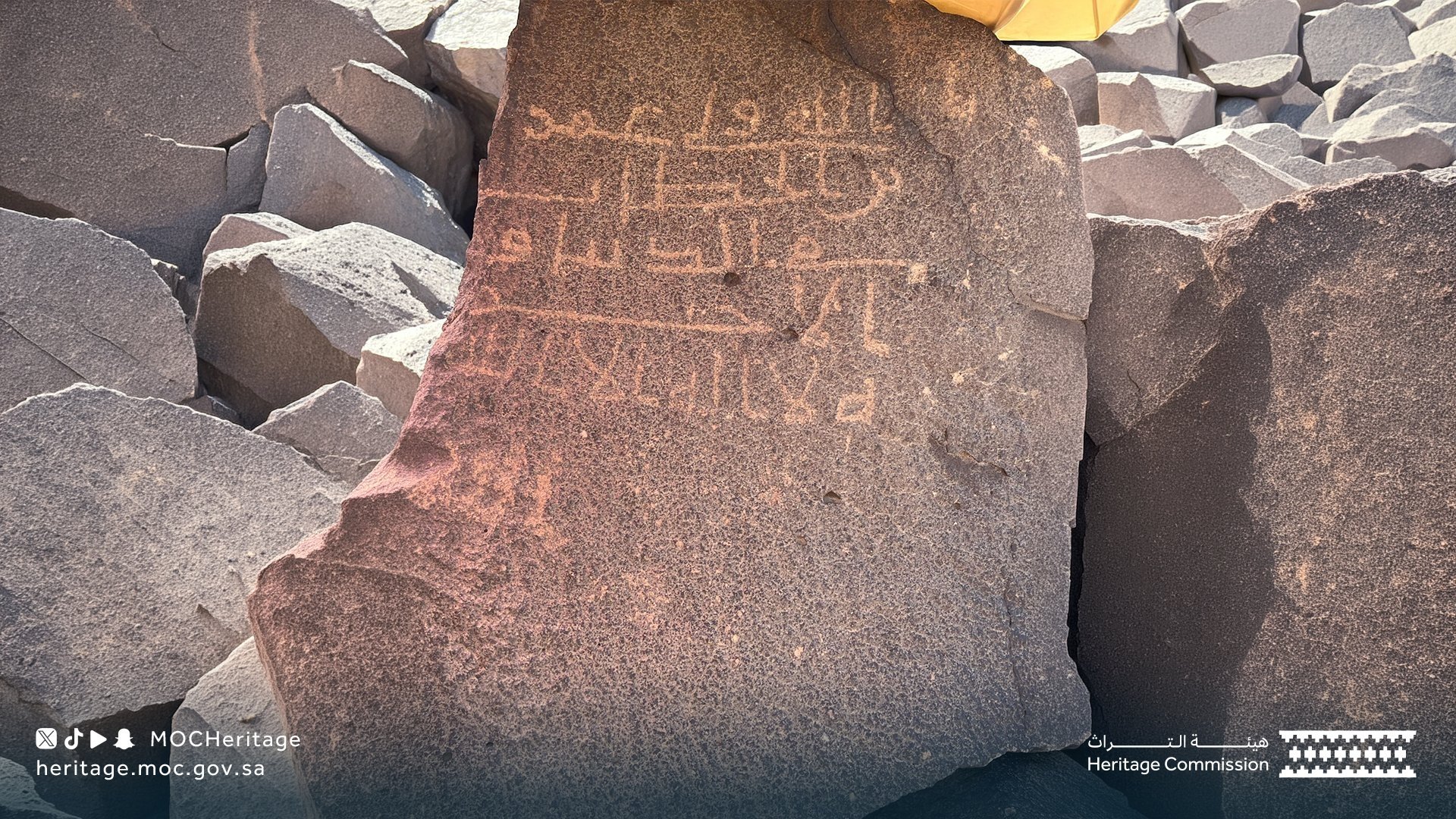
Rock inscriptions bearing the name of Caliph Umar ibn al-Khattab have been documented in Saudi Arabia’s Medina region, in a discovery that adds a rare early Islamic reference to the kingdom’s archaeological record.
The inscriptions were found during a large-scale survey in Al Mahd Governorate, where Saudi Arabia’s Heritage Commission recorded 1,774 archaeological finds across the first two field seasons. The survey covered Al-Suwayriqiyah, Al-Muwayhiyah, and Hadhah, three areas now emerging as important parts of the region’s historical landscape.
Caliph Umar’s name on the rocks
The most significant finds are the rock inscriptions that bear the name of Umar ibn al-Khattab, the second caliph of Islam. Umar ruled from 634 to 644 CE and remains one of the most important figures in early Islamic history.
The commission has not said that the inscriptions were written by Umar himself. The importance of the discovery lies in the appearance of his name within a wider group of rock inscriptions from the Medina region.
That detail matters. Inscriptions are often short, direct records, but they can preserve names, beliefs, routes, and memories that do not always survive in formal historical texts.
A wider archaeological survey
The Heritage Commission said the survey documented 156 previously unknown archaeological sites. The finds include 461 Islamic inscriptions, 34 Thamudic inscriptions, 1,259 rock art panels, 11 stone structures, three historical palaces or buildings, two caravan-route milestones, and four wells.
The variety of finds suggests that Al Mahd Governorate was used across different periods. Rock art, inscriptions, wells, route markers, and buildings point to a landscape connected with movement, settlement, and written culture.
Ancient Arabic poems were also recorded on rock surfaces, adding another layer to the region’s inscriptional heritage.
Early Islamic heritage in western Arabia
The discovery comes as Saudi Arabia continues to expand archaeological surveys across the kingdom. These projects have brought renewed attention to rock art sites, ancient inscriptions, caravan roads, and early Islamic remains.
For now, the inscriptions bearing Caliph Umar’s name are the clearest headline from the Al Mahd survey. Further study may help clarify their date, script style, and relationship to other early Islamic inscriptions in Arabia.