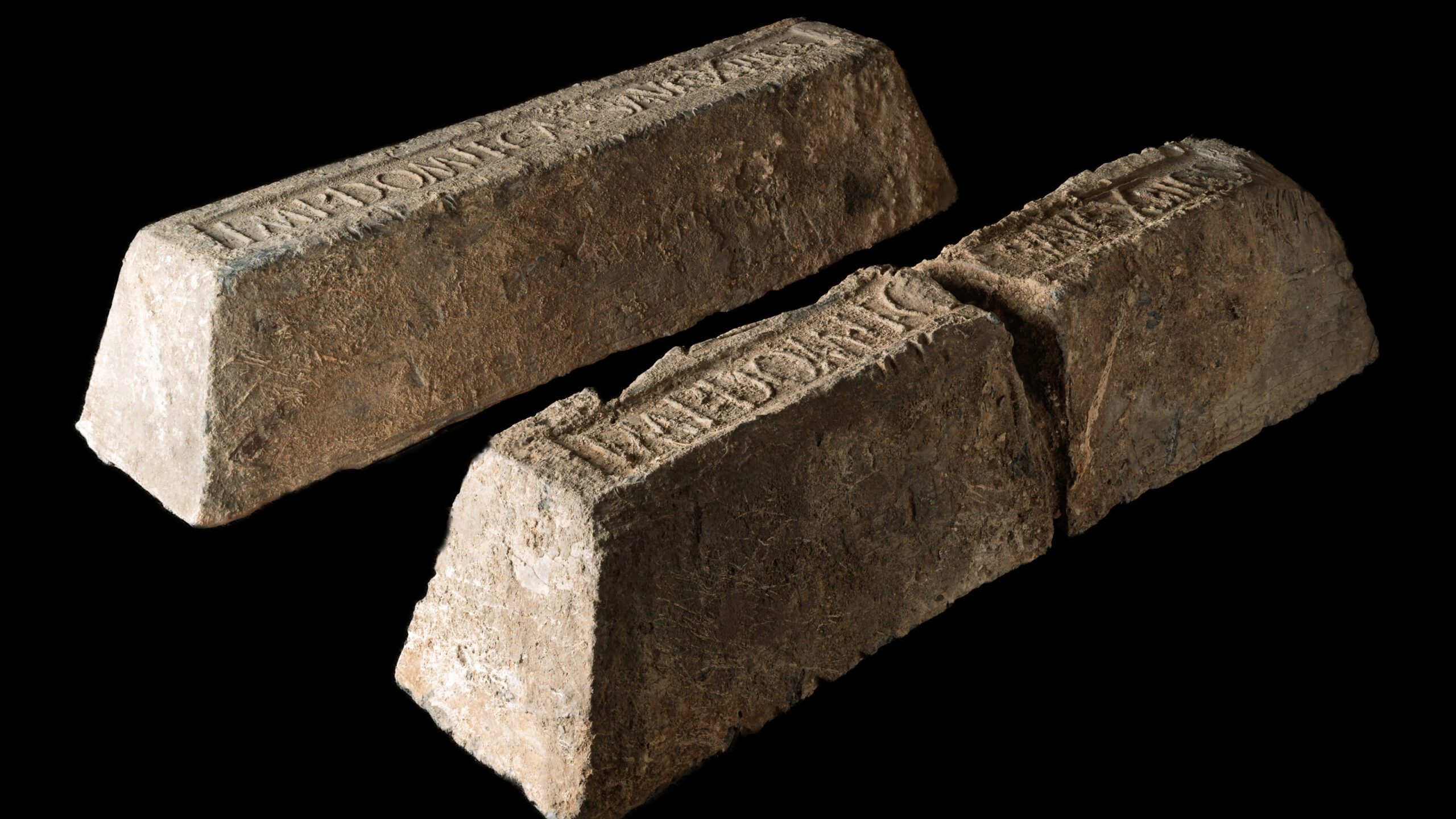
Two rare Roman lead ingots unearthed in western Wales have been formally recognized as treasure, marking the first discovery of their kind in the region and shedding new light on the imperial administration of Britain’s mineral wealth.
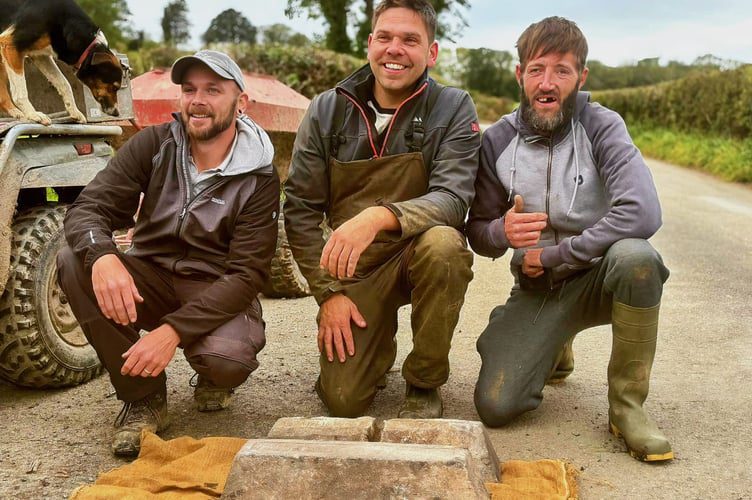
The artifacts were found by metal detectorists Nick Yallope and Peter Nicolas in pastureland near Llangynfelyn in Ceredigion county. Buried roughly half a meter beneath the surface and several meters apart, the heavy metal blocks lay undisturbed for nearly two millennia. A coroner’s inquest in January confirmed their status as official treasure under UK heritage law, initiating the process that could see them enter a public museum collection.
Imperial Markings Fix the Date to 87 CE
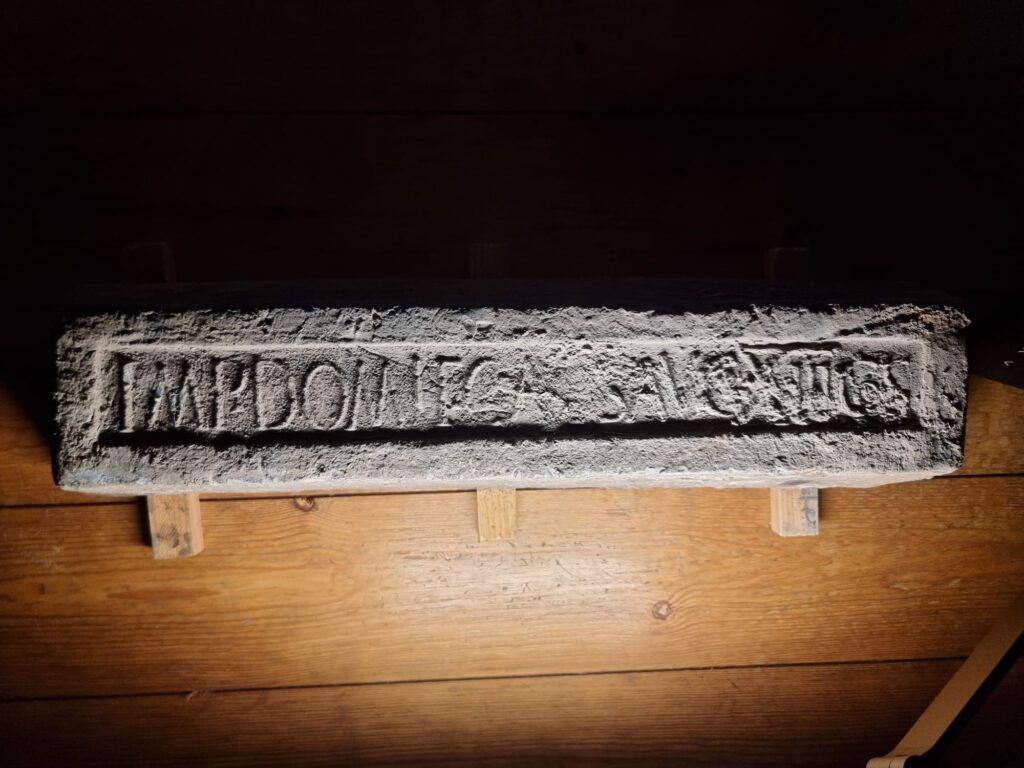
The ingots were cast in elongated trapezoidal forms with rectangular bases, a standardized Roman industrial design intended to simplify transport and storage. Each flat upper surface carries a clear Latin inscription: IMP DOMIT CAE AUG XIII COS — “Imperator Domitianus Caesar Augustus, consul for the thirteenth time.”
This formula provides a precise date. The thirteenth consulship of Domitian corresponds to 87 CE, placing the casting of the ingots six years into the emperor’s reign. Such stamped lead blocks, commonly known as “pigs,” were produced in molds where inscriptions were impressed before the metal cooled, serving both administrative and logistical purposes across the empire.
Industrial Evidence of Rome’s Mining Economy
Lead pigs rank among the most important archaeological indicators of Roman mining and state resource management in Britain. Intact Roman mine workings are extremely rare, making transport-ready ingots vital evidence for reconstructing extraction networks and imperial oversight.
Roughly one hundred examples are known from Roman Britain, and fewer than half survive today. Their standardized mass and dimensions—often reaching around 60 kilograms—made them efficient to stack and difficult to steal. Lead itself was indispensable to Roman engineering, widely used in plumbing systems, roofing, construction alloys, and military infrastructure.
The presence of dated inscriptions also reveals how rapidly Rome mobilized local resources after territorial consolidation. The earliest known inscribed pigs, discovered in the Mendip Hills of southwest England, date to 49 CE and carry legionary markings, signaling direct military involvement in early extraction.
Wales Under Imperial Control
Roman conquest advanced gradually westward, with Wales fully subdued by 78 CE. The Ceredigion ingots were therefore produced less than a decade after the region came under Roman authority, offering rare chronological evidence of how swiftly imperial administration extended into newly controlled territories.
Unlike older provinces where mining rights increasingly shifted to private contractors, the stamps on these ingots indicate continued centralized control. The lead industry in this part of Wales appears to have remained under direct imperial supervision during Domitian’s reign, reflecting the strategic value of local mineral deposits.
This resource-driven expansion traces back to the invasion of Britain ordered by Claudius in 43 CE, when access to metals—especially lead, silver, and tin—was a primary economic objective.
Path to Museum Display
A valuation committee will now determine the ingots’ market value. Once assessed, a local institution will be offered the opportunity to acquire them, with the purchase sum divided equally between the finders and the landowner.
The likely home is Ceredigion Museum, which has expressed strong interest. Curator Carrie Canham emphasized the regional significance of the discovery, noting that Ceredigion’s mineral wealth was a central motive behind Roman expansion into the area. Lead extracted from these landscapes once circulated across imperial trade routes, embedding west Wales into the economic fabric of Rome.
The museum plans to feature the ingots in a new archaeology gallery scheduled to open in 2027, aligning public display with renewed scholarly and community interest in the region’s deep past.