
For generations, gold shimmered quietly in the sands of the Segre River. Ancient texts hinted at its value. Archaeologists suspected Roman hands had worked these deposits. But until now, there was no firm scientific proof.
A new interdisciplinary study has confirmed that Roman alluvial gold mining operated in the Eastern Pyrenees between the 1st and 4th centuries AD, providing the first conclusive evidence of imperial extraction in this mountainous region of Hispania.
The research was conducted by scholars from the Universitat Autònoma de Barcelona and the Universidade da Coruña, combining archaeological excavation with advanced geological dating techniques.
Gold from the Segre: A Resource Long Known, Now Proven
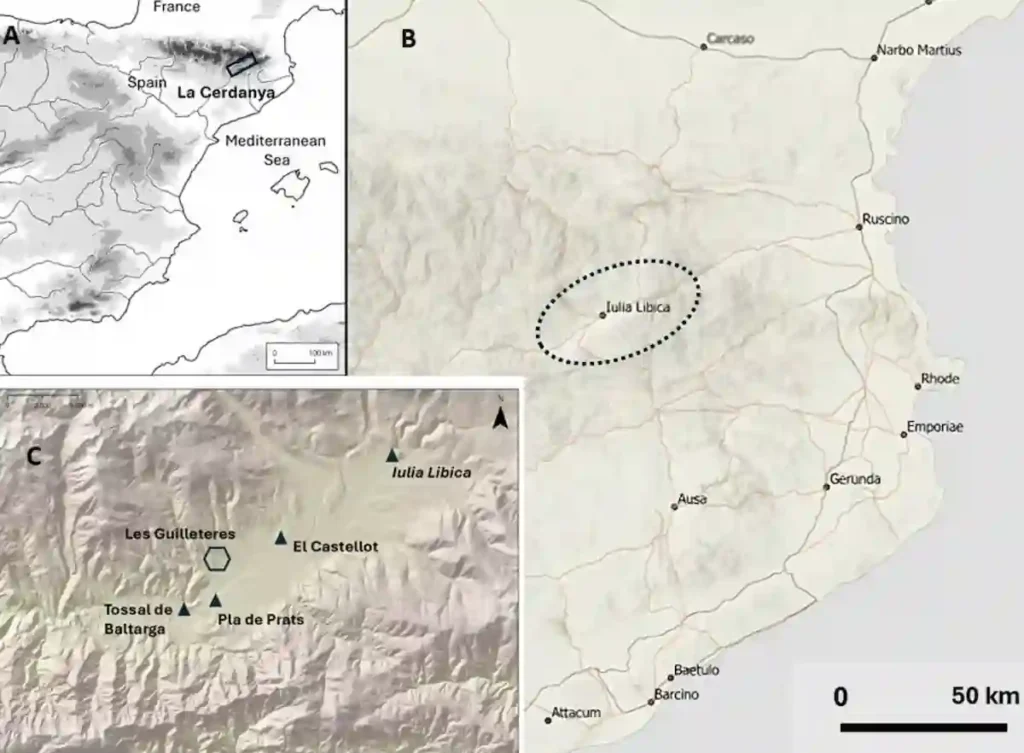
The presence of gold in the alluvial deposits of the Segre River has long been documented. These secondary gold particles originate from Miocene geological formations in the axial Pyrenees. Over thousands of years, erosion carried them downstream, depositing them across river terraces from Cerdanya to the plains of Lleida.
Medieval Islamic sources even praised the high quality of Segre gold for coin production. Yet archaeological confirmation of Roman-era mining remained uncertain.
Earlier investigations uncovered compelling clues. At Castellot de Bolvir, dating to the 2nd–1st centuries BC, researchers identified a workshop where gold, silver, and cinnabar were processed. Meanwhile, the site of Guilleteres d’All revealed extensive erosive formations carved into Miocene terraces — structures strongly suggestive of hydraulic mining.
But there was one problem: the installations lacked organic materials necessary for radiocarbon dating.
OSL Dating Provides the Breakthrough
To resolve the chronological uncertainty, researchers turned to Optically Stimulated Luminescence (OSL) — a method capable of dating mineral sediments directly.
Unlike radiocarbon (C14), OSL does not require organic matter. Instead, it measures the radiation accumulated in quartz grains after burial. When stimulated in laboratory conditions, these grains release stored energy, allowing scientists to calculate when the sediments were last exposed to sunlight.
Two samples were collected from the silting levels of a large hydraulic reservoir at Guilleteres d’All. Although OSL dating provides a broader chronological range than C14, both samples independently converged on the 1st–4th centuries AD.
Crucially, these dates correspond to the period when the hydraulic structure had already been abandoned and was undergoing natural infilling. This means the mining system itself must have been operational during the Roman imperial period.
For the first time, the Roman origin of these Pyrenean gold mines has been scientifically confirmed.
Roman Engineering in the Pyrenees
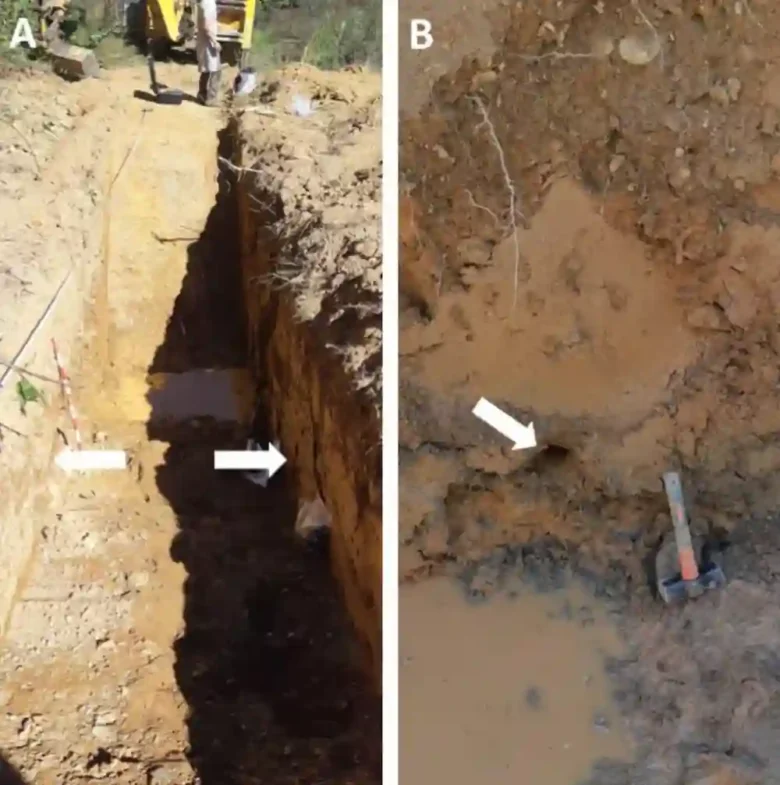
Roman alluvial gold extraction relied on sophisticated water management. Techniques ranged from simple channeling systems to large-scale reservoirs and controlled erosion using pressurized water.
The hydraulic complex at Guilleteres d’All demonstrates organized infrastructure rather than small-scale prospecting. Its scale suggests coordinated operations, likely supported by administrative oversight.
The mines are located only about 10 kilometers from Iulia Livica — modern Llívia — the only documented Roman city in the Pyrenees. Its proximity strongly indicates that this urban center played a role in organizing, managing, or taxing the gold extraction activities.
The discovery reinforces the view that the Pyrenees were not merely a frontier landscape, but an integrated economic zone within the Roman imperial system.
A Frontier of Wealth, Not Isolation
This confirmation reshapes our understanding of Roman resource exploitation in northeastern Hispania. Gold from the Segre basin was not an incidental find — it was part of a structured extraction network connected to imperial infrastructure.
Equally significant is the methodological breakthrough. By combining archaeology and sedimentary geology, the team resolved a debate that had persisted for years. In regions where organic material is scarce, OSL offers a powerful tool for dating ancient engineering works.
The sands of the Segre have long concealed traces of Roman ambition. Now, science has brought them fully into the light.
Autonomous University of Barcelona
Sanjurjo-Sánchez, Jorge, Jordi Morera Camprubí, and Oriol Olesti Vila. 2025. First Evidence of Roman Gold Mining Obtained by Luminescence Dating of Sediments in Les Guilleteres D’All (Cerdanya, Girona, Eastern Pyrenees) Land 14, no. 9: 1912. doi.org/10.3390/land14091912
Cover Image: Excavated dam structure documented between 2010 and 2012, showing several of the large stone blocks that formed part of the hydraulic system. Credit: J. Sanjurjo-Sánchez et al., 2025.