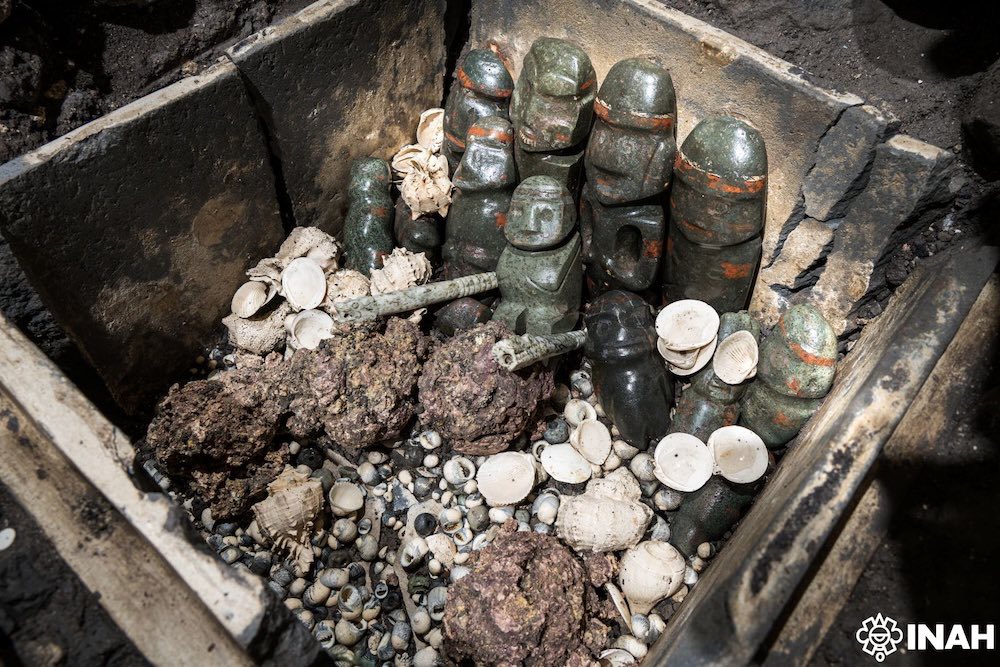
Archaeologists working under the Templo Mayor Project (PTM) have revealed what may represent the largest single ceremonial offering ever documented at the Mexica capital during the reign of Motecuhzoma Ilhuicamina. The discovery adds a new dimension to our understanding of ritual power at the sacred heart of Tenochtitlan.
The findings come from ongoing excavations at Templo Mayor in modern Mexico City. Researchers recently identified three newly excavated ritual deposits—Offerings 186, 187, and 189—that align chronologically and materially with Offerings 18, 19, and 97, uncovered in previous decades.
Together, the six deposits appear to have been interred simultaneously between 1440 and 1469, during a single, large-scale ceremony.
A Ritual on an Imperial Scale
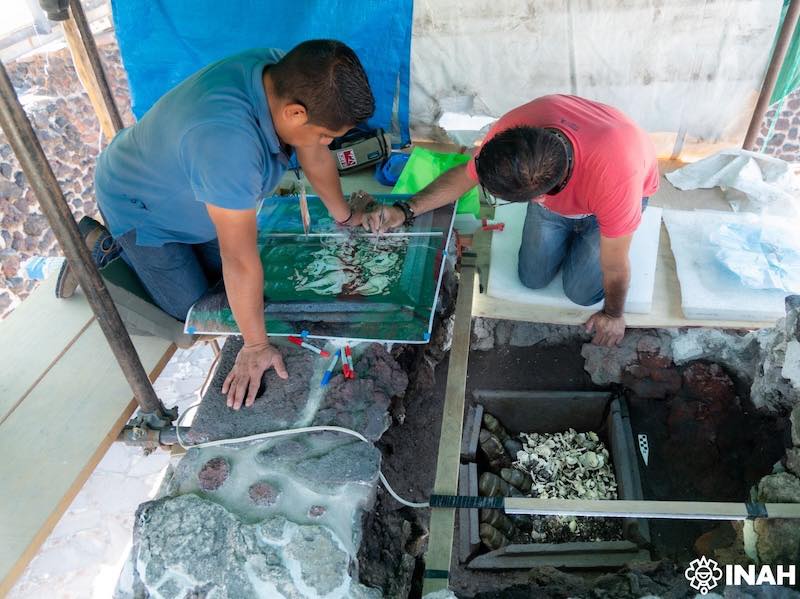
Leonardo López Luján, director of the PTM and researcher at National Institute of Anthropology and History, described the event as a spectacular state ritual. Priests and thousands of participants are believed to have gathered around the Huei Teocalli—the Main Temple—at the symbolic center of the island city.
The synchronized placement of six ritual deposits marks an unprecedented archaeological confirmation of a coordinated ceremonial act tied to a specific construction stage of the temple. For the first time, researchers have effectively “closed the circle” of offerings associated with a single architectural phase.
War Booty Transformed into Sacred Power
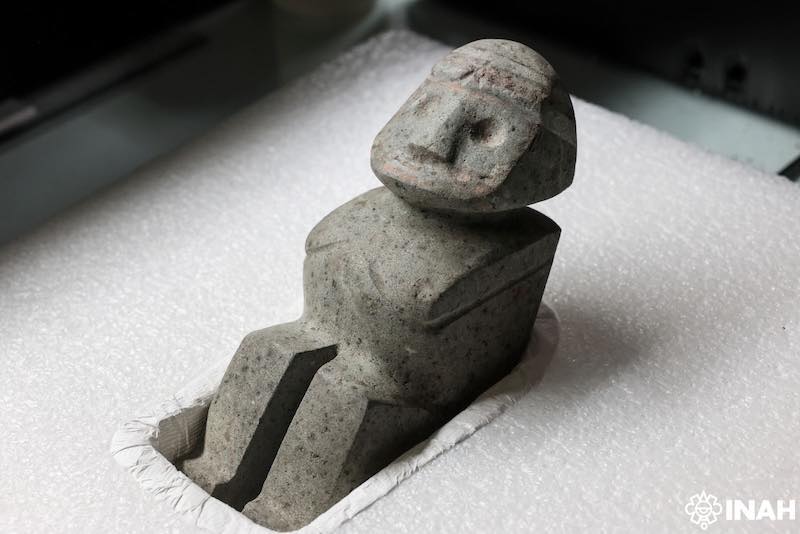
Inside the six stone chests—known as tepetlacalli—archaeologists recovered 83 greenstone figurines carved in the distinctive Mezcala style. These abstract anthropomorphic sculptures are believed to have originated in territories of present-day Guerrero, conquered during Motecuhzoma Ilhuicamina’s military campaigns beyond the Valley of Mexico.
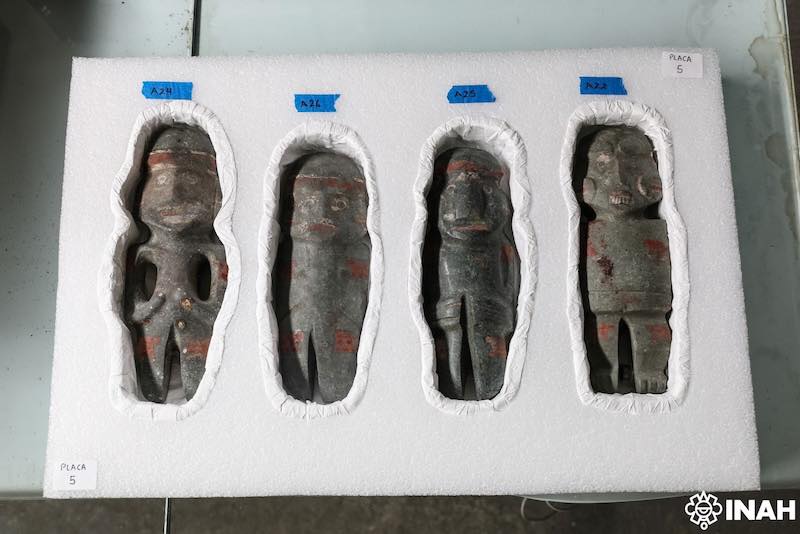
At no other point in the Templo Mayor’s long construction history do Mezcala figurines appear in such concentration.
Their presence suggests more than aesthetic choice. They likely represent war trophies ritually transformed into offerings, embedding imperial conquest into the sacred architecture of the Mexica state. The temple thus functioned not only as a religious center but also as a material statement of political domination.
Construction Phase IVa: Closing the Sacred Geometry
Field directors Alejandra Aguirre Molina and Antonio Marín Calvo determined that the deposits date to Construction Phase IVa of the Templo Mayor. This phase preserves the platform surrounding the pyramidal base, famously adorned with sculpted serpent heads and ritual braziers.
The symmetrical arrangement of the six offerings around the structure is especially significant. Such spatial precision suggests deliberate cosmological symbolism—perhaps evoking directional sacred geography or reinforcing the temple’s role as the axis mundi of Mexica cosmology.
Archaeologically, this configuration is remarkable: rarely can scholars attribute multiple deposits to a single ceremonial episode with such clarity.
Thousands of Marine Treasures
Conservation teams face complex challenges. The three newly excavated chests alone yielded 43 sculptures and more than 4,000 marine elements. Among them were Atlantic coast snails such as Nerita scabricosta and Hexaplex brassica.
Some shells preserved organic residues, indicating they may have been transported alive in saltwater containers to the Mexica capital. This detail reveals the logistical sophistication of imperial networks linking distant coastal environments to the highland metropolis.
Marine offerings symbolized primordial waters and fertility in Mexica cosmology. Their presence alongside war trophies creates a powerful ritual juxtaposition—conquest and creation intertwined.
A Future Exhibition of Imperial Ritual
Once conservation is complete, the offerings will be transferred to the Templo Mayor Museum. Plans are underway for an exhibition that will reunite all six deposits for the first time, allowing visitors to witness the scale and coherence of this extraordinary ceremony.
The discovery not only enriches our understanding of Mexica ritual practice but also demonstrates how imperial expansion, sacred architecture, and cosmological ideology converged at the apex of Tenochtitlan’s power.
In the shadow of the temple’s serpent-lined platform, archaeology continues to reveal how the Mexica embedded empire into stone—and into the sacred earth itself.
Cover Image Credit: INAH