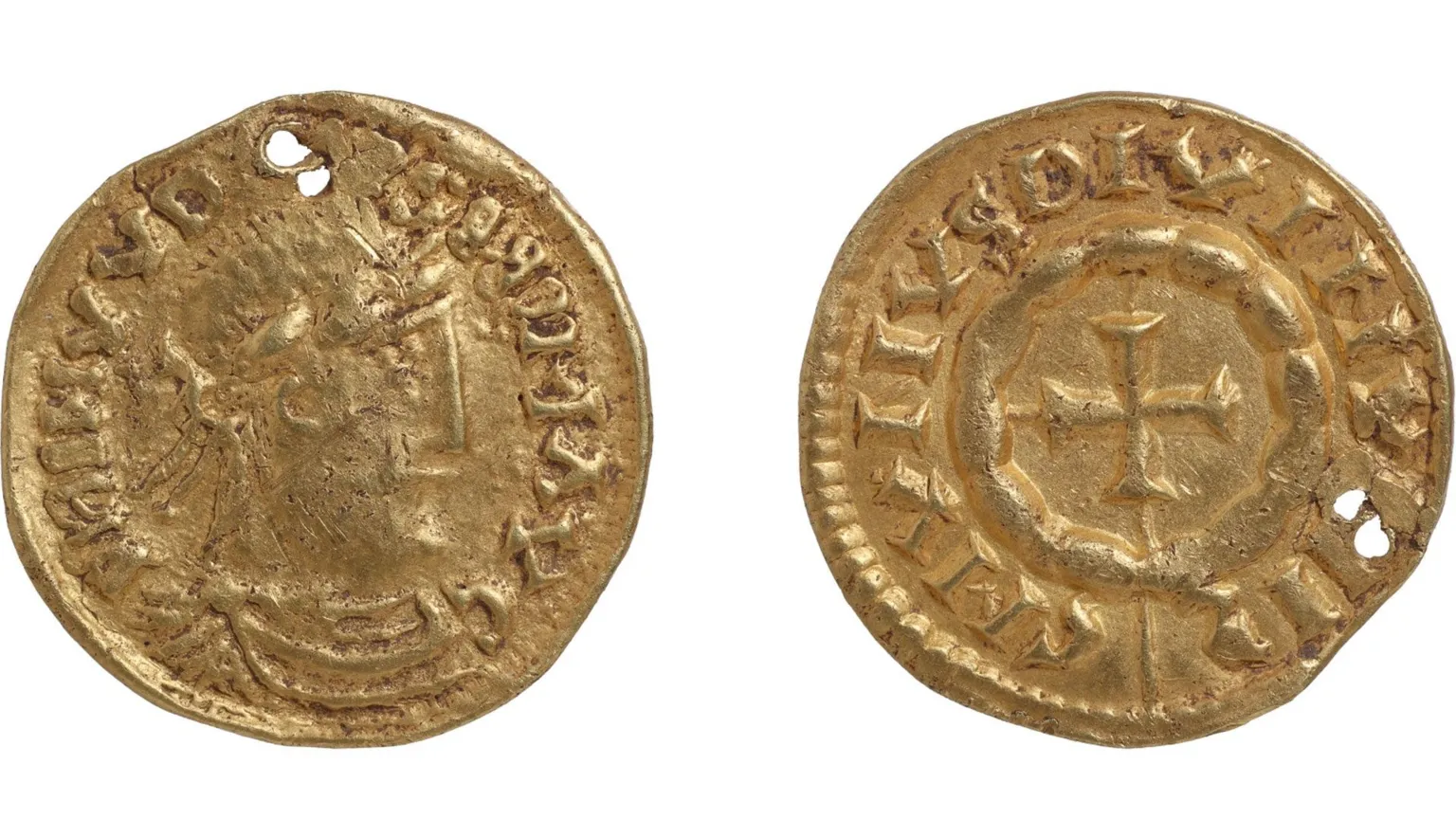
A thin disc of gold, buried for more than a thousand years in a Norfolk field, is now being linked to the advance of the Great Heathen Army — the Scandinavian force that reshaped early medieval England after landing in AD 865.
Discovered near Dereham in 2024, the object is an imitation of a gold solidus issued under Louis the Pious, son of Charlemagne. What appears at first glance to be a Carolingian coin is, in fact, something far more revealing.
An Imperial Portrait in Viking Hands
The original solidus type dates to around AD 816 and presents a Roman-style imperial bust, inspired by rulers such as Constantine I. The reverse carries the inscription MVNUS DIVINUM — “Divine Gift” — framing a cross.
The Norfolk example, however, is not one of the rare originals. Numismatic analysis suggests it was produced decades later in Frisia, in the modern Netherlands.
Only twenty-two similar imitations have been recorded in Britain. Their locations closely follow the known movements of the Viking Great Army.
That pattern matters.
From Currency to Status
Two deliberate piercings above the emperor’s head show the coin was converted into a pendant. It was meant to hang visibly — the portrait facing outward.
Gold coinage did not circulate in Scandinavia in the same way as in the Carolingian Empire. Instead, precious metal functioned as portable wealth, valued by weight and often transformed into jewelry.
For a Viking warrior, this was not imperial propaganda. It was status. It was mobility. It was gold.
A Material Trace of Conquest
After arriving in East Anglia in 865, the Great Heathen Army consolidated control over large parts of England within a generation. Archaeological finds recorded through the Portable Antiquities Scheme increasingly allow researchers to track that expansion.
The Norfolk pendant is only the second of its type found in the county, reinforcing evidence of sustained Viking presence in the region.
Now undergoing the UK’s Treasure process, the object is widely expected to be declared treasure. Norwich Castle Museum has expressed interest in acquiring it.
Small in scale — but continental in implication — this pendant captures a moment when Carolingian imagery, Frisian craftsmanship, and Viking ambition converged in gold.
Cover Image Credit: Andrew Williams/Norfolk County Council