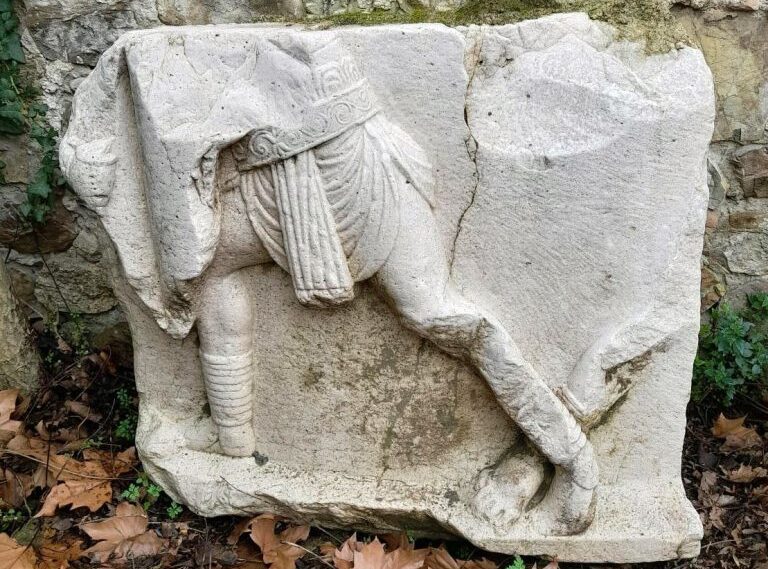
A Roman mausoleum decorated with scenes of gladiatorial combat has been discovered along the ancient Via Appia near Apollosa in southern Italy, revealing a striking connection between funerary architecture and the spectacle culture of the early Roman Empire.
The monumental tomb emerged unexpectedly after flooding from the nearby Serretelle stream exposed large limestone blocks in the mud. Local volunteer Marco Zamparelli noticed the unusual stones and alerted heritage authorities, prompting archaeologists from the Soprintendenza Archeologia, Belle Arti e Paesaggio for Caserta and Benevento to launch an investigation.
What initially appeared to be scattered architectural fragments soon proved far more significant. Excavations led by archaeologist Simone Foresta recovered around twenty massive limestone blocks and identified the entrance to an underground funerary chamber belonging to a previously unknown Roman mausoleum.
Early analysis suggests the monument dates to the early 1st century AD, likely during the reign of Emperor Augustus or shortly afterward—a period when monumental funerary architecture flourished across Roman Italy.
A Monument Built for Visibility
The architectural remains indicate that the tomb originally formed a circular mausoleum roughly twelve meters in diameter. Such structures were often designed to stand prominently along major roads, where they could be seen by travelers moving across the Roman landscape.
What distinguishes the Apollosa monument, however, is its sculptural decoration. Several recovered blocks display carved scenes of gladiators engaged in combat—an unusual motif in Roman funerary contexts.
The imagery suggests that the individual buried within the mausoleum was closely connected to the world of gladiatorial games. Rather than being a gladiator himself, the deceased was more likely a wealthy patron involved in organizing or sponsoring spectacles, possibly serving as a lanista (gladiator manager) or as an editor munerum, a sponsor responsible for staging public games.
In the early Roman Empire, gladiatorial contests were not merely popular entertainment. Financing such spectacles offered ambitious elites a powerful way to gain prestige and public recognition. By commemorating these associations in stone reliefs, the tomb’s owner may have been making a permanent statement about status, wealth, and influence.
The Role of the Via Appia
The mausoleum’s location is equally significant. The Via Appia, first constructed in 312 BC under the Roman censor Appius Claudius Caecus, became one of the most important roads of the Roman Republic and later the Empire.
Initially linking Rome with Capua before eventually extending to the Adriatic port of Brindisi, the route functioned as a vital corridor for military movement, trade, and communication across southern Italy.
Roman law prohibited burials within city limits, and as a result, major roads became lined with funerary monuments. Wealthy families often competed to build the most impressive tombs along these routes, ensuring their names and achievements would be remembered by generations of travelers.
The newly identified mausoleum appears to have stood along a strategic section of the Via Appia between the ancient settlements of Caudium and Montesarchio—an area that formed a key passage through the mountainous landscape of Campania.
In such a location, the tomb would have been highly visible to anyone traveling along the road, transforming the burial place into a public display of prestige.
Research and Reconstruction
Following their recovery, the architectural blocks were transferred to the Soprintendenza’s operational center in Benevento, where specialists are now studying the monument’s structure and decorative program in detail.
Researchers hope that further analysis will allow them to reconstruct the mausoleum’s original appearance and clarify the identity of the individual buried there. The preserved reliefs may also offer valuable clues about the organization of gladiatorial spectacles in the region during the early imperial period.
Local authorities in Apollosa are already exploring ways to integrate the discovery into cultural tourism initiatives connected to the historic Via Appia route. Among the proposals under discussion is a digital 3D reconstruction that would allow visitors to visualize the mausoleum as it stood nearly two millennia ago.
If the monument is confirmed to belong to a sponsor or organizer of gladiatorial games, it could provide rare archaeological evidence of the social networks behind one of the most iconic—and controversial—forms of entertainment in the Roman world.