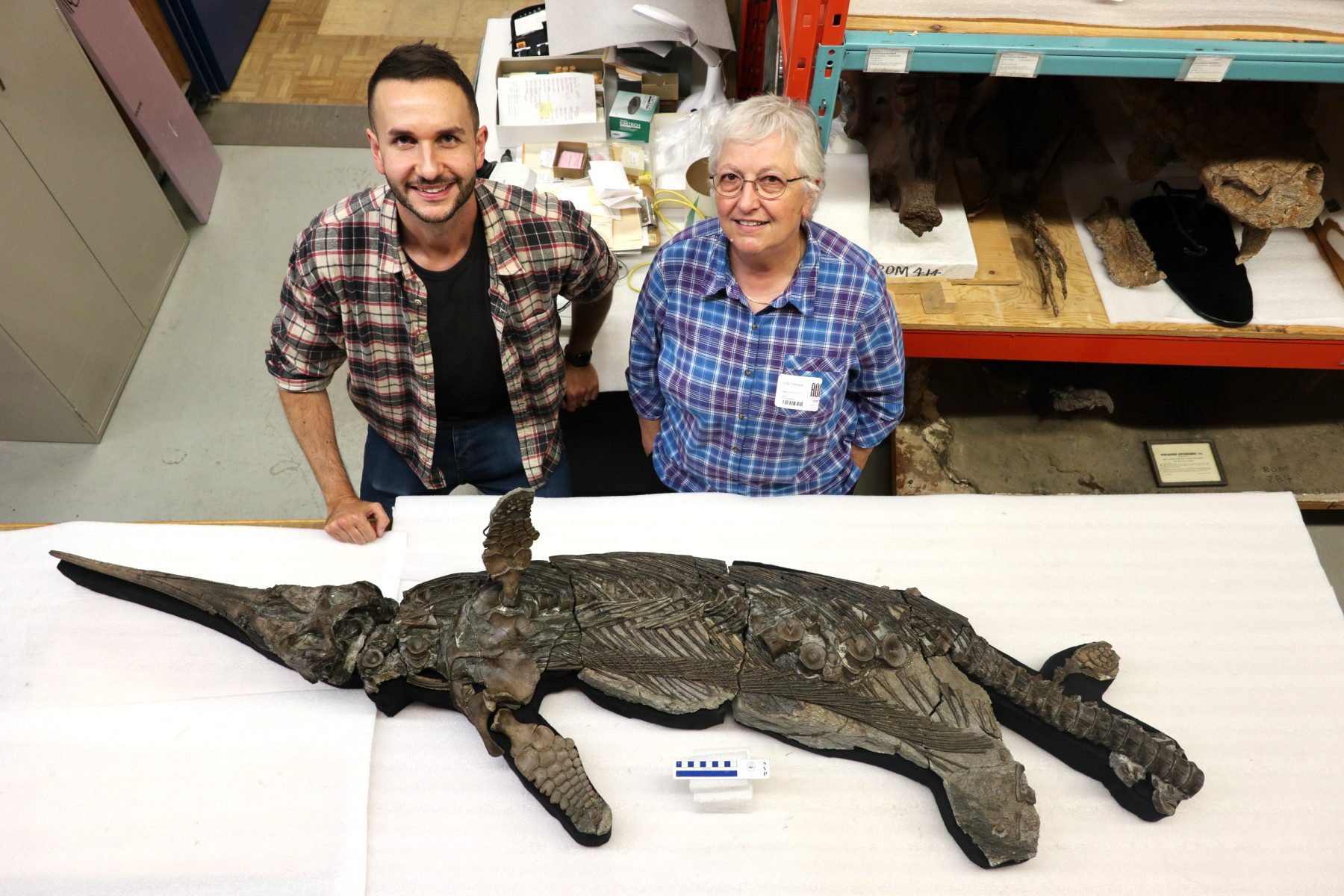
A near-complete marine reptile discovered on England’s famous Jurassic Coast has been identified as a new species of ichthyosaur, a dolphin-shaped predator that once dominated the ancient seas. Named Xiphodracon goldencapensis — the “Sword Dragon of Dorset” — the fossil is the first new Early Jurassic ichthyosaur genus described from the region in over a century, offering rare insight into a missing chapter of marine evolution.
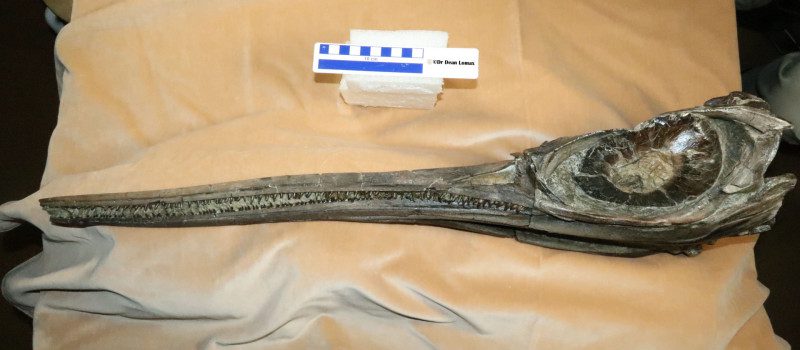
The stunning specimen was unearthed near Golden Cap, the highest cliff on the southern English coastline, by Dorset fossil collector Chris Moore in 2001. Preserved in remarkable three-dimensional detail, the fossil includes a complete skull with enormous eye sockets and a long, blade-like snout — features that inspired its name. Measuring around three meters in length, the animal likely hunted fish and squid in the Pliensbachian seas roughly 190 million years ago, and even retains traces of its last meal.
After two decades in the Royal Ontario Museum’s collection, the fossil was recently analyzed by an international team led by Dr. Dean Lomax of the University of Manchester and the University of Bristol. Their findings, published in Papers in Palaeontology, describe Xiphodracon as a critical “missing link” that bridges two distinct ichthyosaur faunas separated by a mysterious evolutionary turnover.
“When I first saw the skeleton in 2016, I knew it was unusual,” said Lomax. “It turned out to be the key to understanding when a major extinction and replacement of ichthyosaur families took place — earlier than we ever expected.”
Ichthyosaurs from the Pliensbachian epoch (193–184 million years ago) are extremely scarce, making Xiphodracon one of the most complete and scientifically valuable prehistoric reptiles ever found from this period. Co-author Prof. Judy Massare (State University of New York at Brockport) noted that while thousands of ichthyosaur skeletons are known from older and younger layers, Xiphodracon uniquely documents the faunal shift between them.
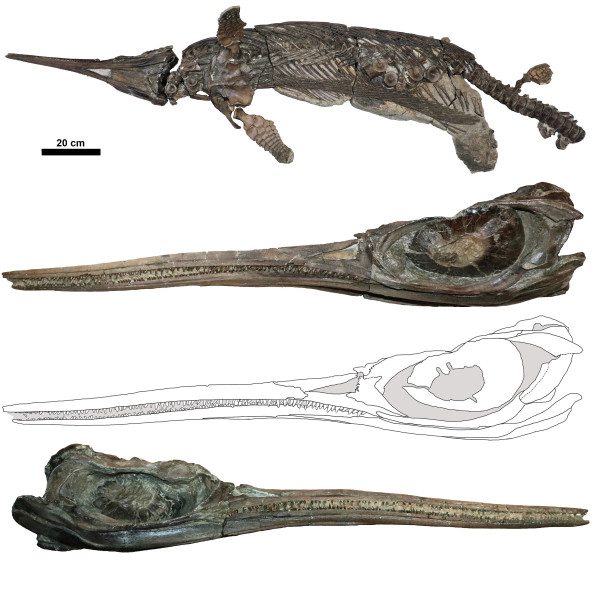
Adding a dramatic twist, Dr. Erin Maxwell of the State Museum of Natural History Stuttgart revealed that the creature’s skull bears bite marks from a larger predator — likely another ichthyosaur — and its bones show signs of disease or injury, painting a vivid picture of a perilous life in the Mesozoic seas.
Among its most distinctive features is a lacrimal bone with strange prong-like extensions, unseen in any known ichthyosaur. This peculiar anatomy, along with its evolutionary position, makes Xiphodracon goldencapensis not only unique but vital to reconstructing the ichthyosaur family tree.
“Xiphodracon combines beauty, mystery, and significance,” said Lomax, who also authored The Secret Lives of Dinosaurs. “And naming it after a sword and a dragon feels right — ichthyosaurs have been called ‘sea dragons’ for over 200 years.”
The fossil will soon be displayed at the Royal Ontario Museum in Toronto, where visitors can come face-to-face with the Sword Dragon that once ruled Britain’s Jurassic seas.
Cover Image: Dr Dean Lomax and Professor Judy Massare study the skeleton of the newly named sword dragon ichthyosaur, Xiphodracon goldencapensis, at the Royal Ontario Museum, Toronto, Canada. © Courtesy of Dr Dean Lomax.