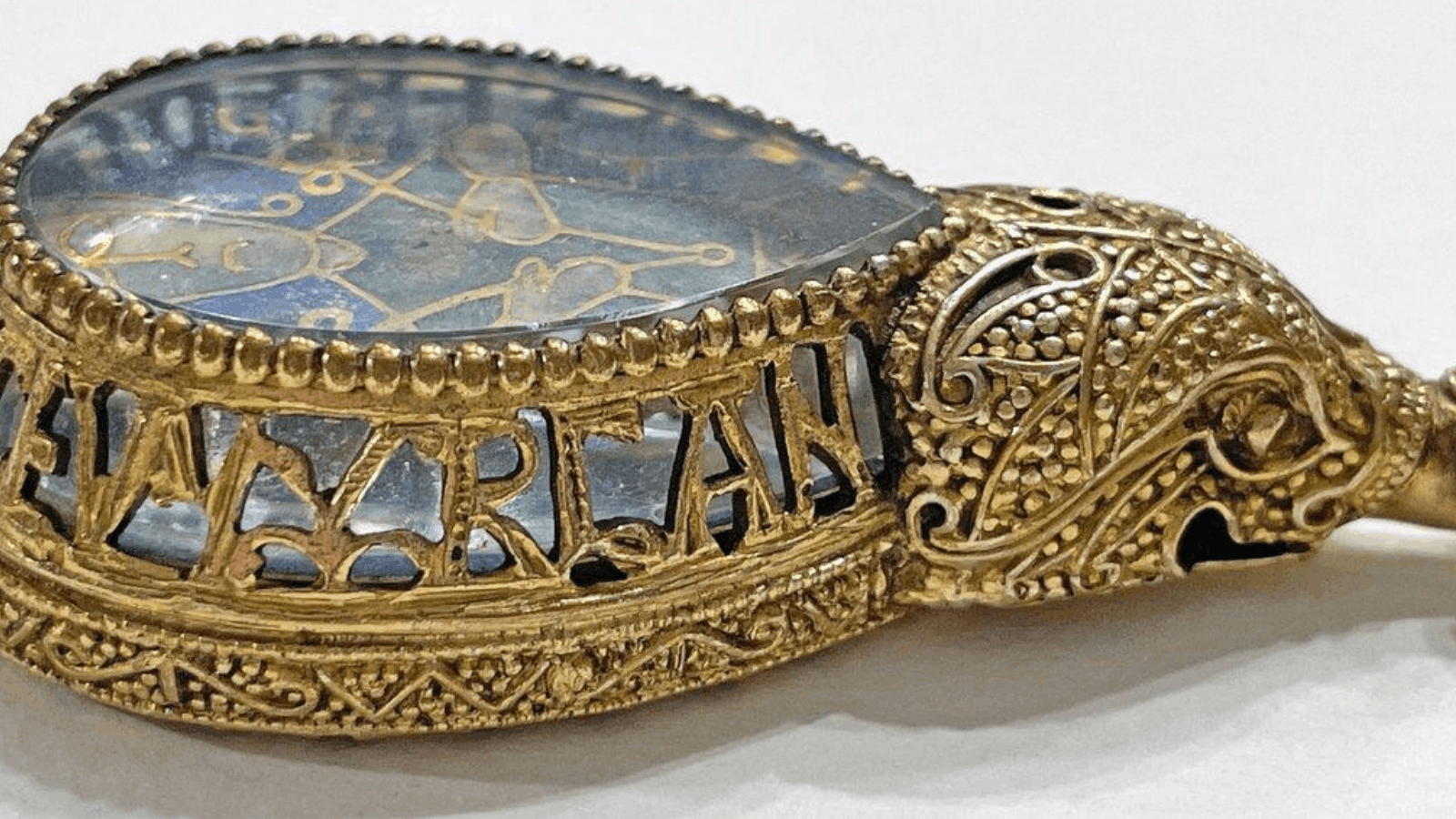
The Alfred Jewel, a 1,100-year-old Anglo-Saxon object associated with King Alfred the Great, may have been a manuscript reading pointer rather than simply an elaborate piece of royal goldwork. The small object carries an unusually direct statement of royal patronage: “Alfred ordered me to be made.”
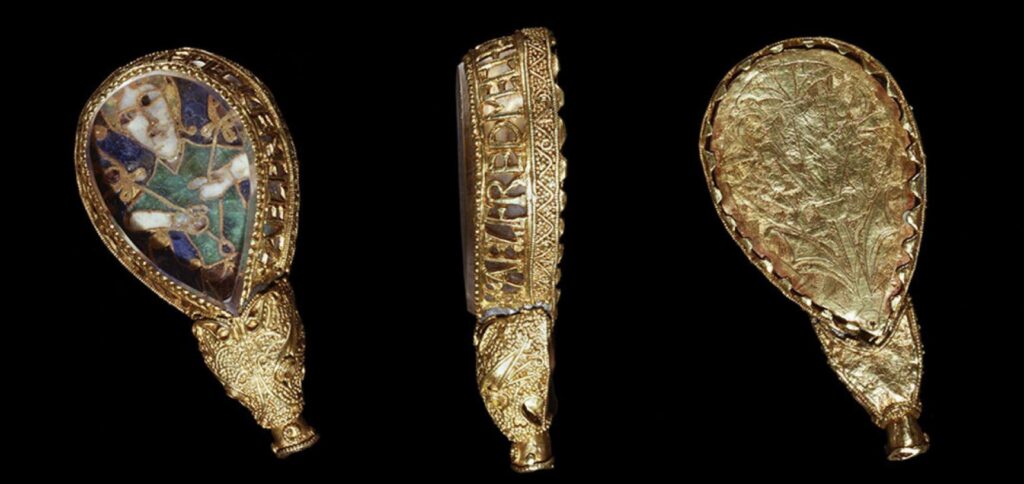
Dating to between AD 871 and 899, the reign of Alfred as king of Wessex, the Alfred Jewel is made from gold, cloisonné enamel and rock crystal. Measuring just 6.2 centimeters long, it is now held by the Ashmolean Museum in Oxford.
Its elaborate workmanship alone would make it an exceptional survival from the ninth century. But the inscription around its gold frame, together with an unusual socket at its base, has led to a more intriguing interpretation.
The Alfred Jewel may have been an æstel, a valuable pointer associated with Alfred’s effort to distribute books and promote learning across his kingdom.
An Anglo-Saxon jewel with Alfred’s name
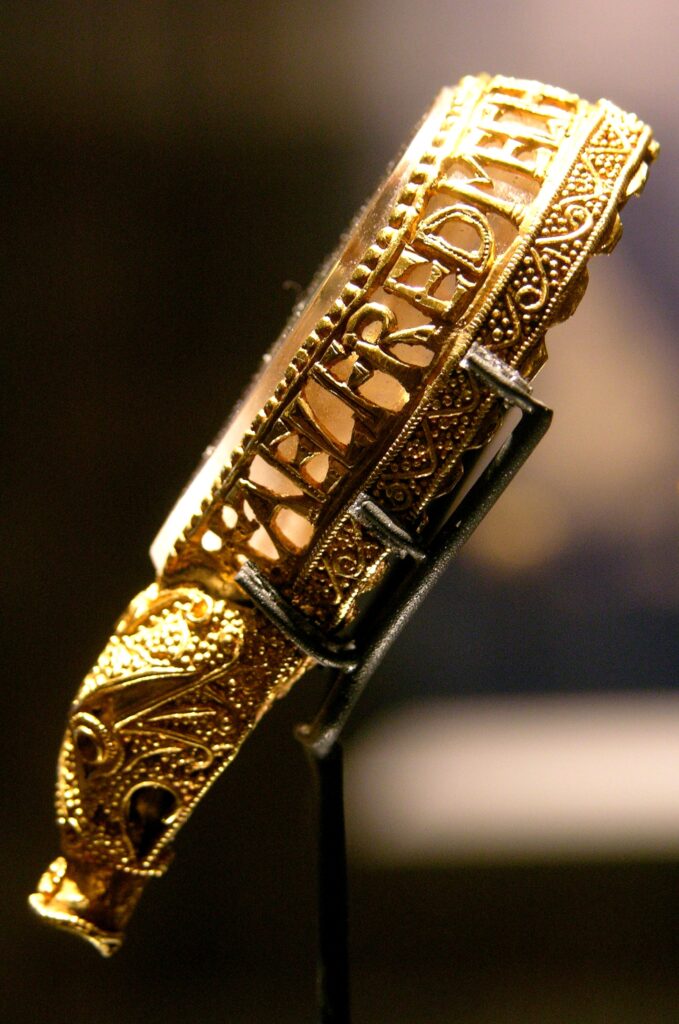
The inscription running around the object reads:
AELFRED MEC HEHT GEWYRCAN
It translates as “Alfred ordered me to be made.”
The Ashmolean identifies the Alfred named in the inscription as Alfred the Great and dates the object specifically to his reign.
The jewel was found in 1693 at North Petherton in Somerset. Its discovery location adds another layer to its association with the king: North Petherton lies only a few miles from Athelney, where Alfred established a stronghold during his conflict with Viking forces before his victory at Edington in AD 878.
Yet the jewel was almost certainly not simply an ornament.
At its lower end is a dragon-like animal head with an open mouth containing a cylindrical socket. The Ashmolean suggests that this socket once held a slender pointer, perhaps made of ivory, secured by a rivet.
That feature has helped connect the object with one of Alfred’s best-known initiatives: his campaign to encourage literacy and make important texts more accessible in English.
The clue in Alfred’s manuscript program
Alfred’s court was closely associated with the translation of important religious and philosophical works from Latin into Old English.
Among the works connected with this program was Pope Gregory the Great’s Pastoral Care. In the preface accompanying the Old English version, copies were to be distributed to bishops together with an object described as an æstel worth 50 mancuses.
Exactly what an æstel looked like has been debated, but it is generally interpreted in this context as a valuable pointer used while reading a manuscript.
The Alfred Jewel appears well suited to such a function.
A rod inserted into the socket at its base could have allowed a reader to follow lines of writing without placing a finger directly on the manuscript page. The Ashmolean now presents both the Alfred Jewel and the related Minster Lovell Jewel as objects that would have held pointers used to aid manuscript reading.
The imagery on the Alfred Jewel may also have been chosen with reading in mind.
Beneath the polished rock crystal is a cloisonné enamel figure with strikingly prominent eyes. Its identity remains uncertain, but the Ashmolean notes that the figure may represent the sense of Sight — an appropriate subject for an object intended to assist a reader.
Was it really an æstel?
The reading-pointer interpretation is persuasive, but it is not something that can be demonstrated with absolute certainty.
Other socketed Anglo-Saxon gold objects show why caution is necessary. The British Museum, for example, catalogs a late ninth-century gold fitting with a tubular socket as possibly either the handle of a pointer or a dress fitting. Similar construction alone therefore does not always reveal how such an object was used.
The Alfred Jewel, however, has evidence that goes beyond its shape.
It was made during Alfred’s reign. Its inscription explicitly states that Alfred ordered it to be made. Its base was designed to hold another component, and historical evidence records the distribution of valuable æstels as part of Alfred’s manuscript program.
Taken together, those details make the identification of the Alfred Jewel as a reading pointer particularly compelling.
If that interpretation is correct, the object was not simply a piece of royal Anglo-Saxon goldwork. It may have been part of a deliberate effort to place books, reading and learning at the center of Alfred’s kingdom — a small object made to accompany the written word more than 1,100 years ago.