
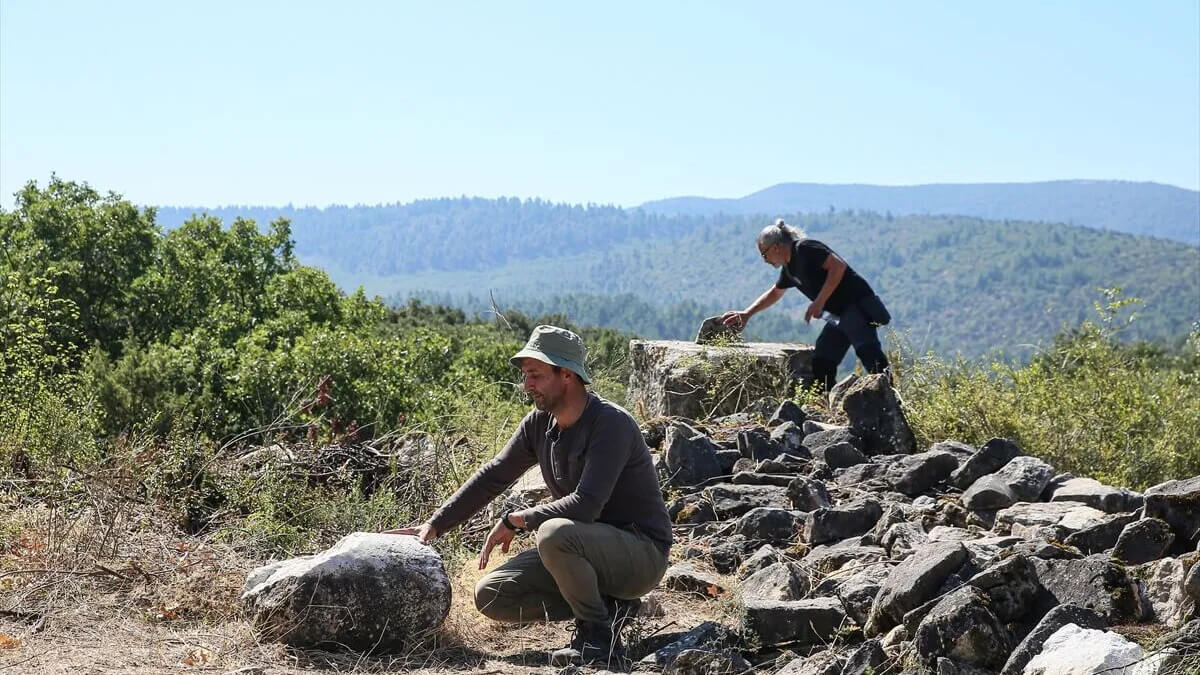
A monumental building has begun to emerge at Hadrianoi, a hidden Roman city on the southern slopes of Mount Uludağ in northwestern Türkiye. Archaeologists say the structure may have served as an agora or gymnasium, although its identity will remain uncertain until they reach the original floor.
The excavation is being conducted by the Bursa Museum Directorate with Professor Derya Şahin of Bursa Uludağ University serving as scientific adviser. Work is currently concentrated on an area of about 5,000 square metres in the Orhaneli district of Bursa, where substantial walls and architectural elements remain in their original positions.
Unlike many major Roman centers in western Anatolia, Hadrianoi has remained archaeologically elusive and has not yet been exposed as a coherent urban settlement. Its name was known from ancient records, inscriptions and scattered architectural remains, but its precise location, boundaries and urban plan have yet to be established.
An untouched monumental building
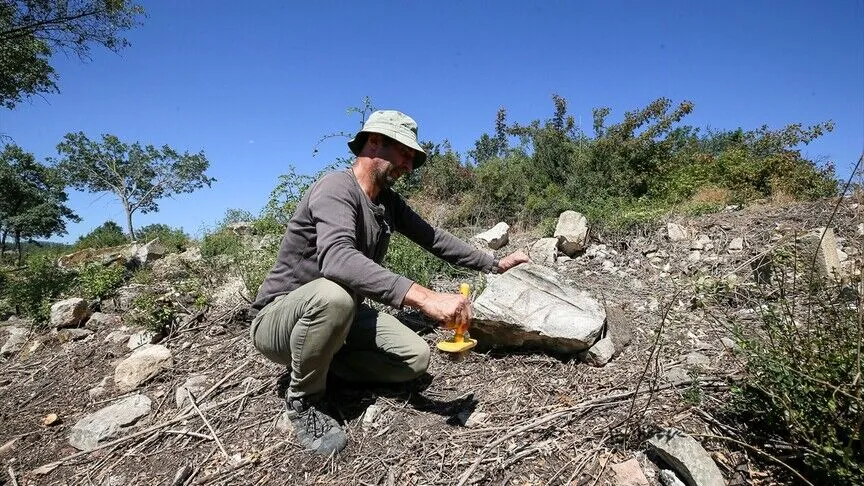
Bursa Museum Director Ahmet Türkmenoğlu told Anadolu Agency that the team initially had to clear dense vegetation before excavation could begin. What appeared beneath it was much larger than anticipated.
“We entered a landscape that had never been touched,” Türkmenoğlu said. “After completing the cleaning work, we suddenly realized that we were standing inside an enormous monumental structure. It may be an agora, or perhaps a gymnasium. We will only understand that as the excavation progresses.”
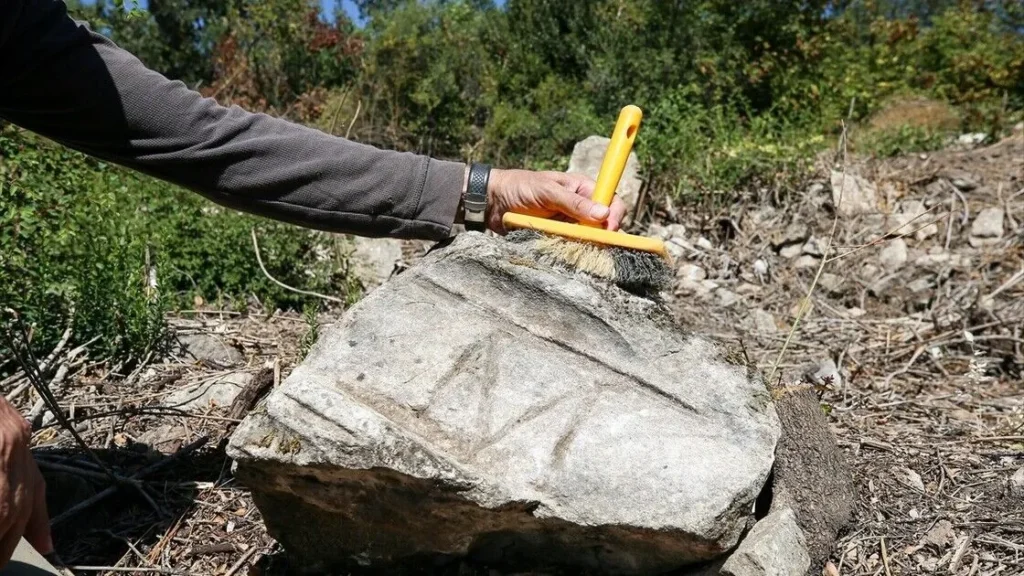
The five-person team is working close to what appears to be the entrance and principal wall of the building. Its immediate objective is to reach the ancient floor, where pottery, coins and other finds could help date the structure, establish how it was used and reveal whether it underwent later alterations.
Although parts of the exterior walls have collapsed, Türkmenoğlu said that considerable sections remain visible. Walls and architectural elements survive in situ, meaning they have remained in their original positions rather than being displaced or reused elsewhere.
“The data obtained from the floor will guide us and help reveal the building,” he explained. “Once we reach that level, we will also be able to establish its architectural character.”
No sculptures have yet been reported. Türkmenoğlu noted, however, that objects associated with the monumental building could survive around its floor level. Excavation, rather than expectation, will determine what remains inside.
A Roman city founded in Hadrian’s name
Known in antiquity as Hadrianoi pros Olympon, meaning “Hadrianoi near Olympus,” the city occupied the mountainous country south of Prusa, modern Bursa. The Olympus mentioned in its name was today’s Uludağ, a dominant landmark in the geography of ancient Mysia and Bithynia.
Hadrianoi is traditionally dated to AD 123 and is believed to have been founded or formally reorganized under Emperor Hadrian, who ruled the Roman Empire from AD 117 to 138. The distinction is important because the creation of a Roman city did not always involve building an entirely new settlement. An existing community could be granted urban status, renamed and provided with new civic institutions.
Hadrian travelled through the empire more extensively than almost any other Roman emperor. His journeys allowed him to inspect provincial cities, respond to natural disasters, supervise military frontiers and support major building programs.
According to information Türkmenoğlu provided to Anadolu Agency, the emperor passed through northwestern Anatolia while inspecting areas affected by an earthquake. His route took him through Nicomedia and Nicaea—modern İzmit and İznik—before he continued toward the southern slopes of Uludağ.
Türkmenoğlu suggested that the wooded landscape may also have appealed to Hadrian, who was known for his passion for hunting. Ancient accounts more directly connect the emperor’s hunting exploits with another Mysian foundation, Hadrianotherai, so hunting should be considered one possible factor rather than the sole explanation for Hadrianoi’s location.
Roads and thermal springs shaped the city
Hadrianoi occupied a position beside a route connecting the mountainous interior with Kütahya and Balıkesir. Türkmenoğlu noted that the same corridor, passing through Harmancık, remains active today, demonstrating the enduring importance of this passage across the region.
Nearby thermal springs may have added to the location’s appeal, although no Roman bath complex directly associated with them has yet been identified. Together with the road and the area’s natural resources, the springs may help explain why a city developed in this mountainous landscape. Across the Roman world, large bath complexes also functioned as important centers of social and civic life.
The excavation could eventually reveal whether Hadrianoi possessed the planned public center expected of a Roman city. If the structure now being investigated proves to be an agora, it would have served as a center of trade and civic life. If it was a gymnasium, it would have been associated with education, exercise and the social formation of the city’s young male citizens.
Inscriptions preserve the city’s inhabitants
Hadrianoi’s importance is already reflected in inscriptions and architectural remains recovered from Orhaneli and surrounding settlements. A study published in 2011 documented five inscribed stones, along with funerary and architectural objects collected from the area and placed under museum protection.
One inscription records the honoring of Emperor Antoninus Pius, Hadrian’s successor, by three officials known as strategoi. The text suggests that Hadrianoi possessed an organized civic administration during the second century.
Other inscriptions bring its inhabitants into view. A funerary poem commemorates a woman named Iulia Hagne, while another monument was erected by the children of Diostratos and Aphia. A later inscription belonged to Aurelius Agapetos, a Christian who prepared a tomb for himself, his child and his grandchildren.
A stone funerary chest, blocks associated with a church, an altar and a large vessel marked with a cross further indicate that life at Hadrianoi continued beyond the Roman imperial period. The city later became an episcopal center, showing that it retained regional importance during Late Antiquity.
Reaching the monumental building’s floor could now provide the dating evidence needed to identify the structure and begin reconstructing Hadrianoi’s urban plan. For the first time, the city may be understood not only through inscriptions and displaced stones, but through architecture preserved where the Romans built it.
Cover Image: Archaeologists examine architectural remains at Hadrianoi on the southern slopes of Mount Uludağ in Bursa, Türkiye. Credit: Saliha Nur Köksal / Anadolu Agency