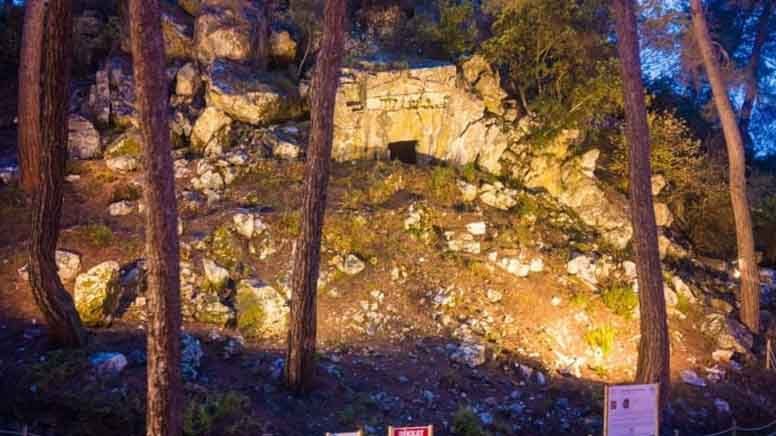
Carved directly into the limestone above Marmaris, a coastal town on Turkey’s southwestern Aegean shoreline, a 2,500-year-old rock-cut tomb is drawing renewed scholarly attention as conservation measures secure its long-term survival. Known as the Yeşilbelde Rock Tomb, the monument has been placed under strict protection—not as a result of a new discovery, but because its architectural rarity and structural vulnerability demand a preservation-first approach.
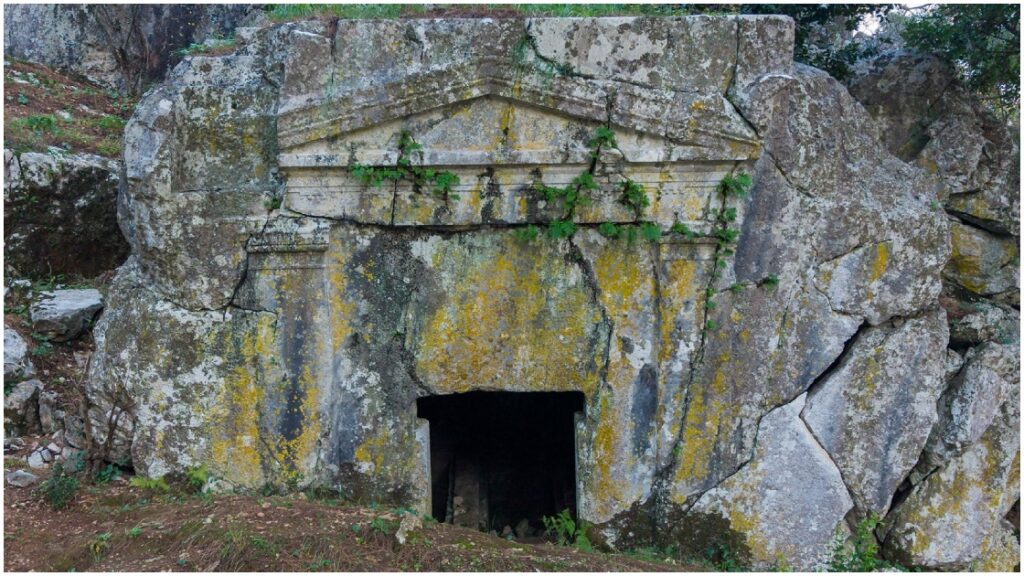
The tomb stands out within the funerary landscape of ancient Caria, where temple-fronted rock-cut tombs are well known but overwhelmingly Ionic in character. By contrast, the Yeşilbelde monument presents a Doric façade, an uncommon choice in Carian funerary architecture and one that immediately complicates assumptions about stylistic uniformity in the region.
Caria’s selective use of architectural forms
During the Classical period, Caria occupied a complex cultural position at the crossroads of Anatolian traditions, the Aegean world, and the Persian administrative sphere. Funerary architecture became a key arena in which local elites articulated identity, status, and memory. Rather than replicating Greek architectural models wholesale, Carian communities selected, adapted, and occasionally subverted them.
Rock-cut tombs with temple façades exemplify this process. While their overall form echoes Greek temple architecture, details such as column order, proportions, and façade treatment often diverge from canonical models. The Doric order employed at Yeşilbelde is best understood within this context—as a deliberate architectural statement, not an anomaly or error.
Tentatively dated to the 4th–5th centuries BCE, the single-chambered tomb belongs to a period when Caria was undergoing political transformation under Persian satrapal rule. Monuments from this era are widely interpreted by scholars as markers of local authority and territorial presence, embedded permanently into the landscape rather than designed for ritual use alone.
Conservation over access
Recent preservation work was carried out with the support of the Marmaris Chamber of Commerce, under the academic consultancy of Mehmet Gürbüzer, and the supervision of the Marmaris Museum Directorate.
The intervention focused on stabilization rather than presentation. Invasive vegetation was removed, the immediate surroundings were reorganized, and a secure perimeter was established. Lighting, surveillance cameras, and informational signage were installed to allow continuous monitoring while minimizing human impact.
Plans that initially considered limited public access were revised after geological assessments revealed weaknesses in the bedrock floor. Physical indicators associated with the 1957 Fethiye earthquake further reinforced concerns about structural integrity. As a result, authorities chose to prioritize long-term conservation over short-term visitation.
Why this tomb matters
Although the Yeşilbelde Rock Tomb will remain closed to visitors for the foreseeable future, its significance extends beyond its immediate setting. It is the only known temple-fronted rock-cut tomb in Marmaris and one of the very few Doric examples securely attributed to Caria. As such, it provides a rare point of reference for understanding how architectural choices functioned within local power structures during the Classical period.
More broadly, the monument highlights a recurring pattern in Anatolian archaeology: some of the most revealing evidence comes not from spectacular new excavations, but from re-evaluating known monuments through careful preservation and contextual analysis.
Preserving meaning by limiting exposure
Speaking on behalf of the supporting institutions, Marmaris Chamber of Commerce President Mutlu Ayhan emphasized that safeguarding cultural heritage is a responsibility that extends beyond tourism. Protecting such monuments, he noted, ensures that they can be transmitted to future generations without compromising their physical or historical integrity.