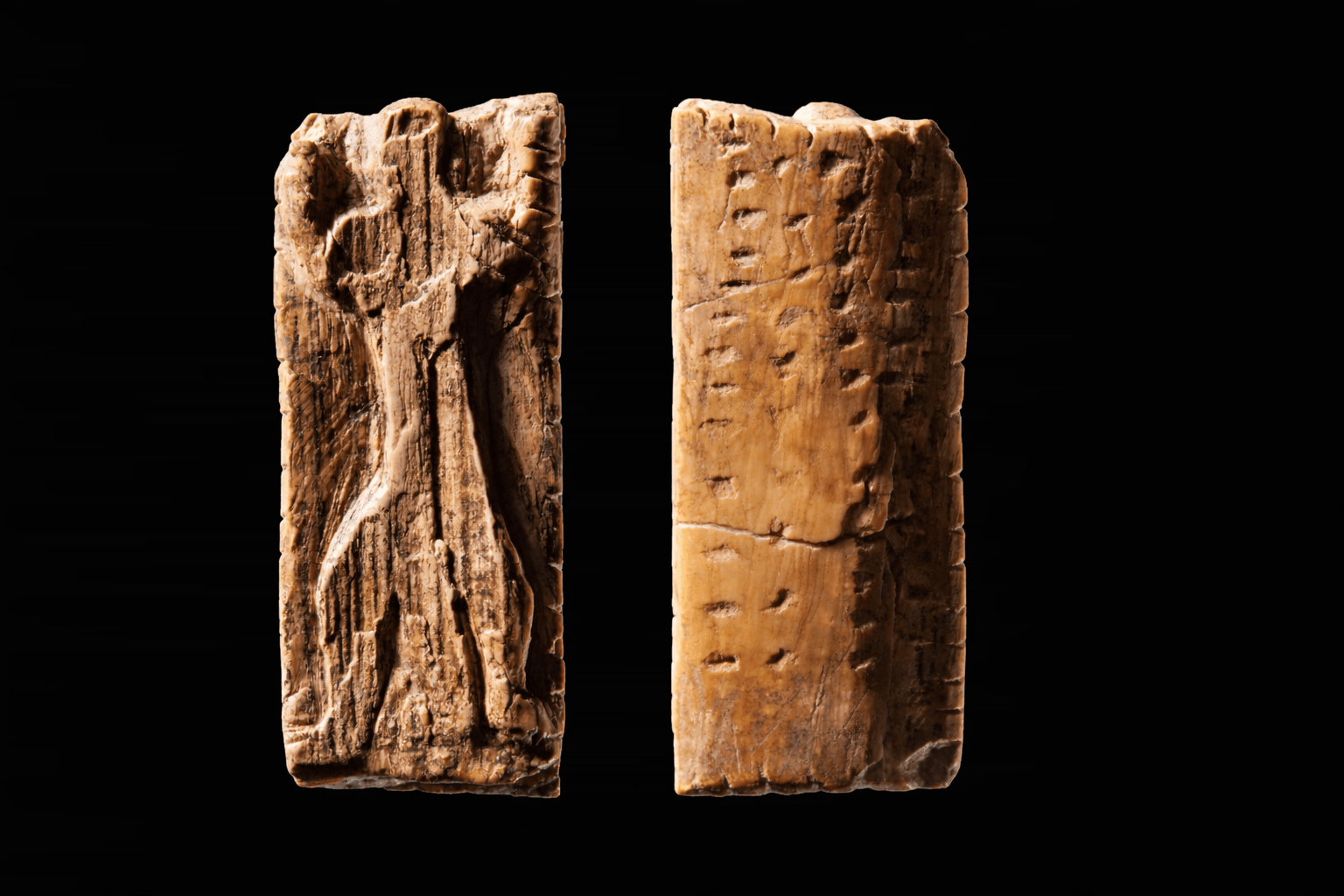
Before clay tablets and urban bureaucracies, before agriculture reshaped human life, Ice Age hands were carving deliberate patterns into ivory.
Rows of dots. Repeated crosses. Carefully spaced notches.
For decades, archaeologists described these markings as symbolic or decorative. A new computational study now argues something more radical: these 40,000-year-old signs may represent one of the earliest structured systems for encoding information in human history.
The research, led by linguist Christian Bentz of Saarland University and archaeologist Ewa Dutkiewicz of Berlin’s Museum für Vor- und Frühgeschichte, applies quantitative linguistic tools to more than 3,000 Paleolithic signs carved onto 260 objects. The findings will appear in the Proceedings of the National Academy of Sciences.
And the statistical results were not what the team expected.
Ice Age Symbols That Follow Structure
Many of the artifacts analyzed come from caves in the Swabian Jura in southwestern Germany — a region already known for some of Europe’s earliest figurative art.
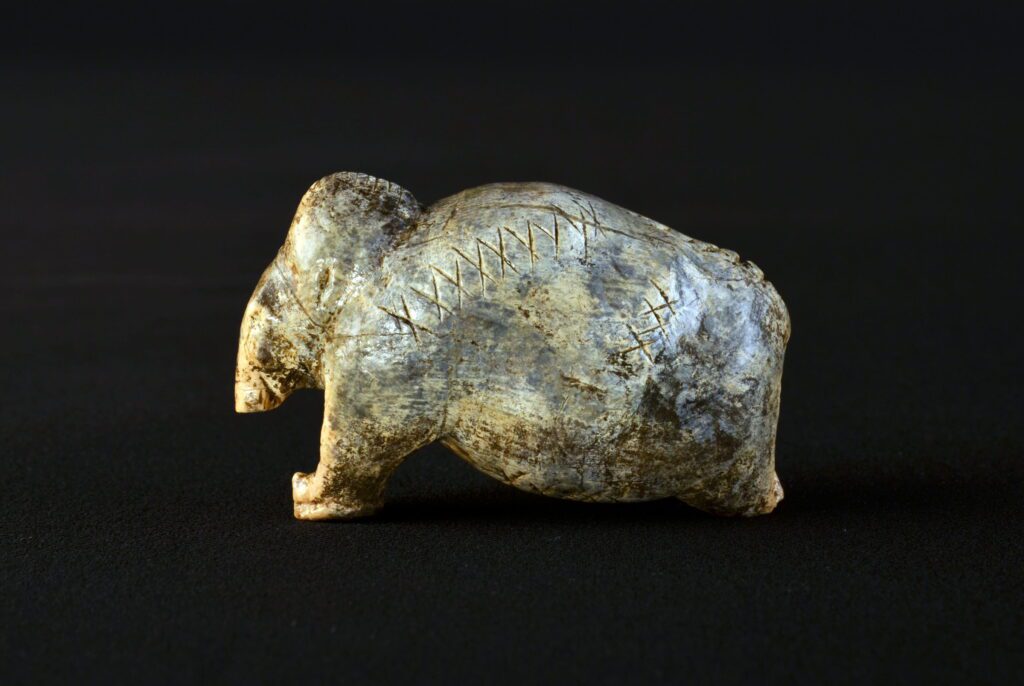
Among them is the so-called Adorant figurine from Geißenklösterle Cave: a small mammoth ivory plate bearing an anthropomorphic figure. Both sides carry orderly rows of dots and notches. Similar repeated markings appear on a mammoth sculpture from Vogelherd Cave, and even on the arm of the iconic Lion Human from Hohlenstein-Stadel Cave, where notches were placed at regular intervals.
The key detail is not the imagery — but the repetition.
“Our research is helping us uncover the statistical fingerprint of these sign systems,” explains Professor Christian Bentz. “They represent an early predecessor to writing.”
That phrase — statistical fingerprint — is central to the study.
Entropy and Information Density
Rather than attempting to decipher what the signs meant, the researchers measured how they functioned as systems.
Using statistical modeling, frequency analysis, and machine learning classification, they calculated entropy — a measure from information theory that captures how much information a sequence can encode. High entropy generally means greater unpredictability and informational richness; low entropy suggests repetition and predictability.
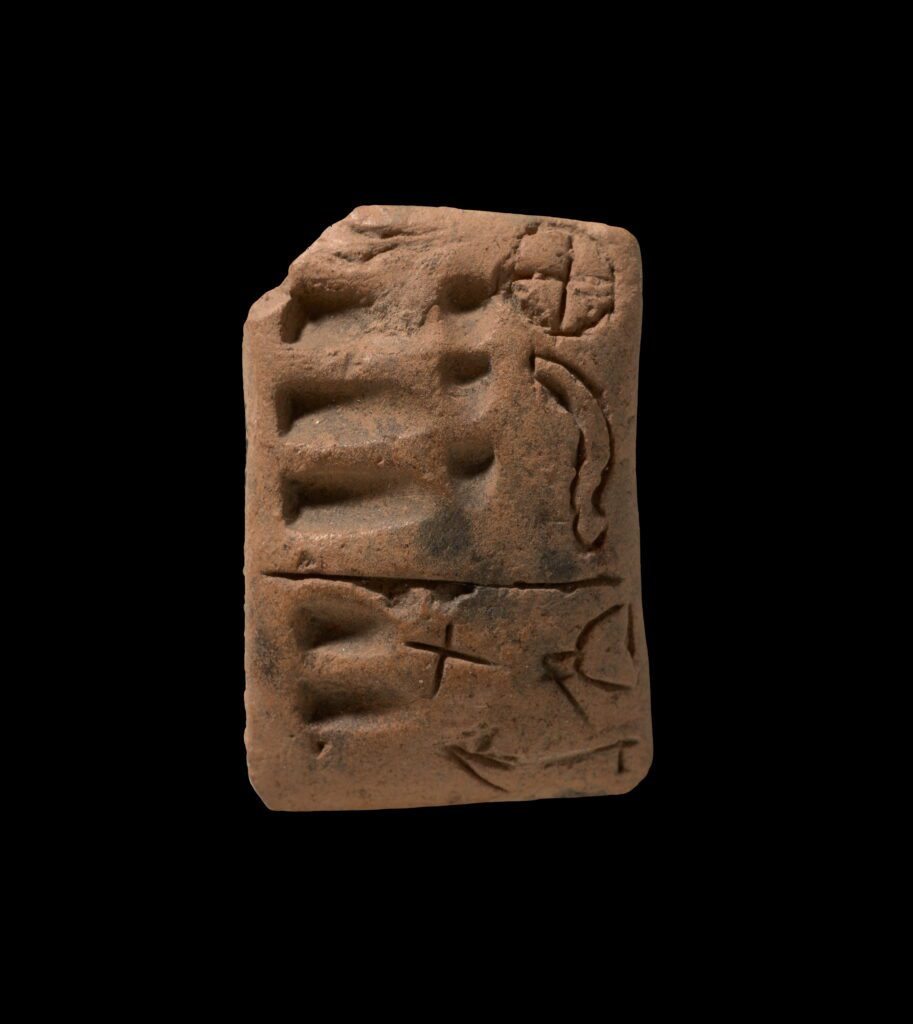
The Paleolithic sequences show strong repetition: cross, cross, cross; line, line, line. This pattern is unlike modern writing systems, which encode spoken language and typically display high informational diversity.
Yet here is the surprise.
When compared to early proto-cuneiform tablets from ancient Mesopotamia — administrative clay tablets used around 3000 BCE to record goods, livestock, and labor — the overall information density is statistically comparable.
“In terms of complexity, the sign sequences are comparable,” Bentz notes. “Early proto-cuneiform is actually much closer to these Paleolithic systems than to modern writing.”
That finding complicates a long-standing assumption: that early writing would resemble contemporary scripts more than ancient engravings. Instead, proto-cuneiform appears structurally similar to much older symbolic systems.
Only around 5,000 years ago did a fundamentally new system emerge — one that directly represented spoken language and produced the statistical characteristics of modern writing.
Challenging the “Decoration” Hypothesis
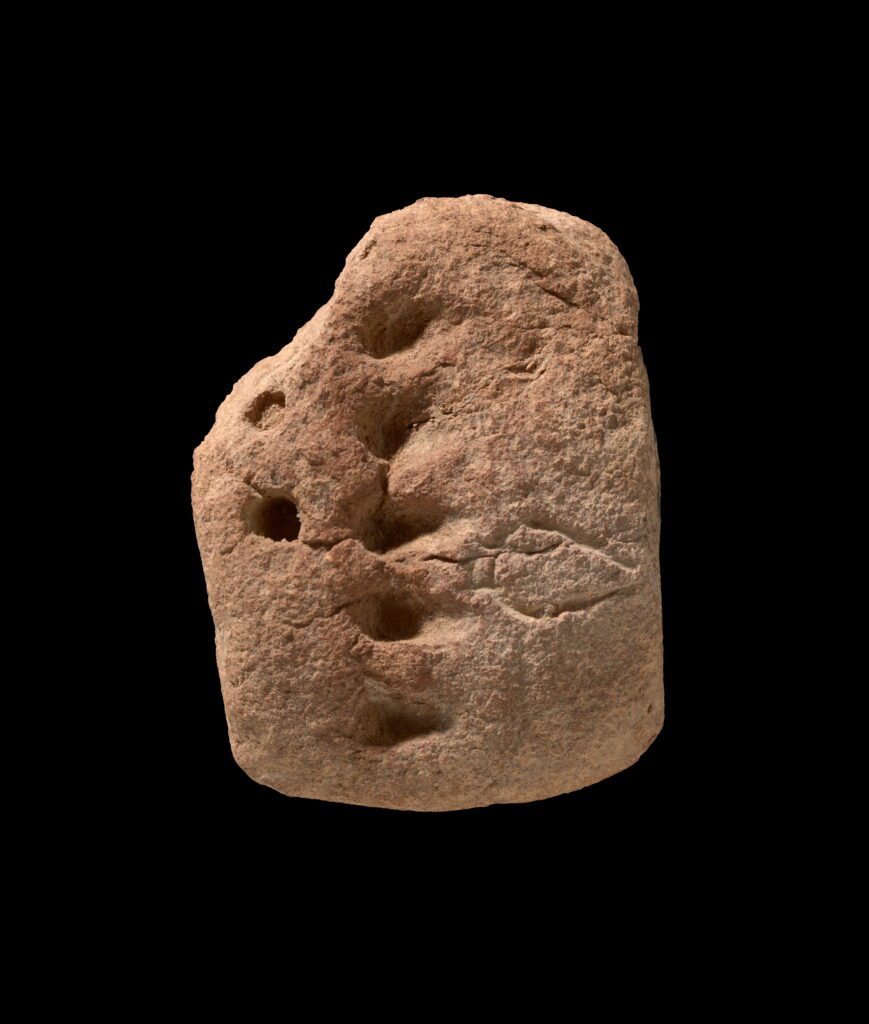
For much of the twentieth century, Paleolithic marks were interpreted as decorative embellishments or ritual symbolism without systematic structure. Some scholars proposed tally marks; others suggested clan identifiers or magical motifs.
What has been largely missing, Bentz argues, is empirical measurement.
“There have been many theories,” he explains, “but very little quantitative work on the measurable characteristics of these signs.”
By analyzing repetition rates and predictability, the team demonstrated that the marks are not random. They follow internal structural rules. Figurines, interestingly, exhibit higher informational density than tools — suggesting variation in function.
This does not mean the signs encode language. The researchers are careful on that point.
But they do encode information.
A Deep History of Encoding
The implications extend beyond archaeology.
“Writing is only one specific form in a long series of sign systems,” Bentz says. “The human ability to encode information developed over many thousands of years.”
Encoding depends on predictability and patterned sequences — the same principles underlying modern computing and artificial intelligence. In that sense, these Ice Age engravings represent early experiments in structured abstraction.
Archaeologist Ewa Dutkiewicz emphasizes another overlooked detail: portability.
“They carried the objects with them,” she notes. Many artifacts fit in the palm of a hand — much like early clay tablets thousands of years later.
In Ice Age Europe, where survival required coordination, memory, and planning, external information storage could have offered real advantages.
What We Still Don’t Know
The study does not decode the content of the signs. They remain undeciphered. Were they seasonal records? Resource counts? Social signals?
Those answers remain out of reach.
But one conclusion becomes harder to dismiss: anatomically and cognitively, Homo sapiens 40,000 years ago were capable of structured symbolic encoding at a level statistically comparable to early writing systems.
Long before cities and bureaucracies, before scribes and alphabets, humans were already thinking in systems.
And carving those systems into stone and ivory.
Cover Image: The approximately 40,000-year-old Adorant figurine from Geißenklösterle Cave is a small ivory plaque bearing an anthropomorphic figure and multiple sequences of notches and dots. Credit: © Landesmuseum Württemberg / Hendrik Zwietasch, CC BY 4.0