
A television prop initially identified as an Ottoman-era menzil stone has sparked debate in Turkey after it was officially registered as a cultural asset and transferred to a museum—before later being revealed as a modern production piece.
According to a report published in Cumhuriyet, the object was created in 2019 for the TRT 1 children’s series Tozkoparan İskender. Despite its recent origin, it was later interpreted by two researchers as a historical artifact linked to Ottoman archery traditions.
From Set Design to Cultural Asset
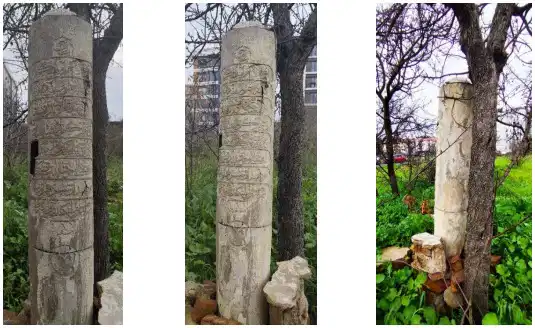
The object was reportedly found in Istanbul’s Tuzla district and assessed as a menzil stone, a type of monument historically used to commemorate long-distance archery achievements in the Ottoman Empire.
On February 26, 2025, the Istanbul Regional Conservation Council formally registered the piece as a protected cultural asset. It was subsequently transferred to the Turkish and Islamic Arts Museum, where conservation procedures were initiated.
An academic article supported this identification, suggesting that the object could represent a previously unknown menzil stone associated with the famed Ottoman archer Tozkoparan İskender.
A Claim That Drew Attention
In their published study, the researchers described the object as a unique example of an Ottoman archery marker.
They noted that it was made of wood, stood upright with structural support, and was not embedded in the ground—features presented as distinctive rather than problematic.
The claim attracted attention for its potential contribution to the understanding of Ottoman sports culture.
A Rebuttal from Within the Production Team
The interpretation was later challenged by Dr. Şükrü Seçkin Anık of Kırşehir Ahi Evran University, who had been part of the series’ art team.
In a formal response published in the same academic journal, Anık stated that the object was not historical, but a prop produced for the television series in 2019. He further clarified that the Ottoman-style inscriptions on the object had been written by him specifically for the production.
Why Material Matters
Anık also pointed to a key methodological issue: historically documented menzil stones are made of durable materials such as marble.
The identification of a wooden object as a centuries-old artifact, he argued, raises questions not only about material analysis but also about long-term preservation assumptions. The survival of clearly legible inscriptions on untreated wood over several centuries would be highly unlikely.
A Wider Discussion on Heritage Verification
Beyond the individual case, the incident has prompted broader discussion about how cultural assets are evaluated and registered.
It underscores the importance of interdisciplinary verification—combining historical expertise, material science, and contextual analysis—before formal classification decisions are made.