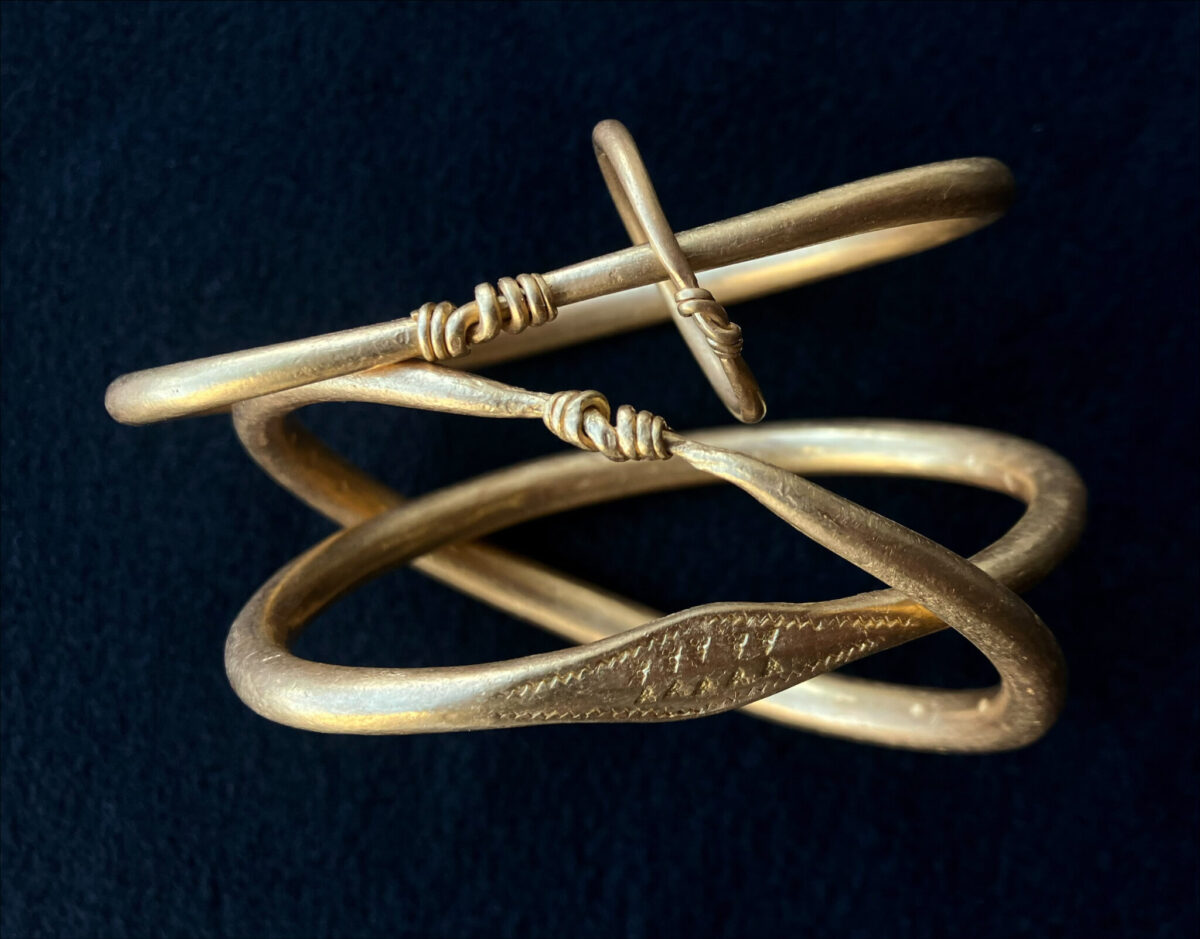
A faint flash of Viking gold beside a forest track in northern Denmark has led archaeologists to six rare gold arm rings, now identified as one of the country’s largest Viking-age hoards.
The discovery, now known as the Rold Hoard, consists of six intact gold arm rings weighing a total of 762.5 grams. According to Nordjyske Museer, it is the third-largest Viking-age gold hoard ever recorded in Denmark, surpassed only by the Tissø ring from West Zealand and the Fæsted Hoard near Ribe.
Gold uncovered near Rold
The first two rings were spotted near Rold in Himmerland by a local man, who noticed part of the gold visible in the soil beside a field road in a wooded area. He handed the objects to Nordjyske Museer on April 22 for danefæ assessment, Denmark’s official process for evaluating treasure finds of national importance.
Museum archaeologists quickly realized that the heavy objects were solid gold arm rings from the Viking Age.
“It is a completely exceptional find. We have simply never experienced anything like it before here at the museum,” said Torben Sarauw, head of cultural heritage and archaeologist at Nordjyske Museer.
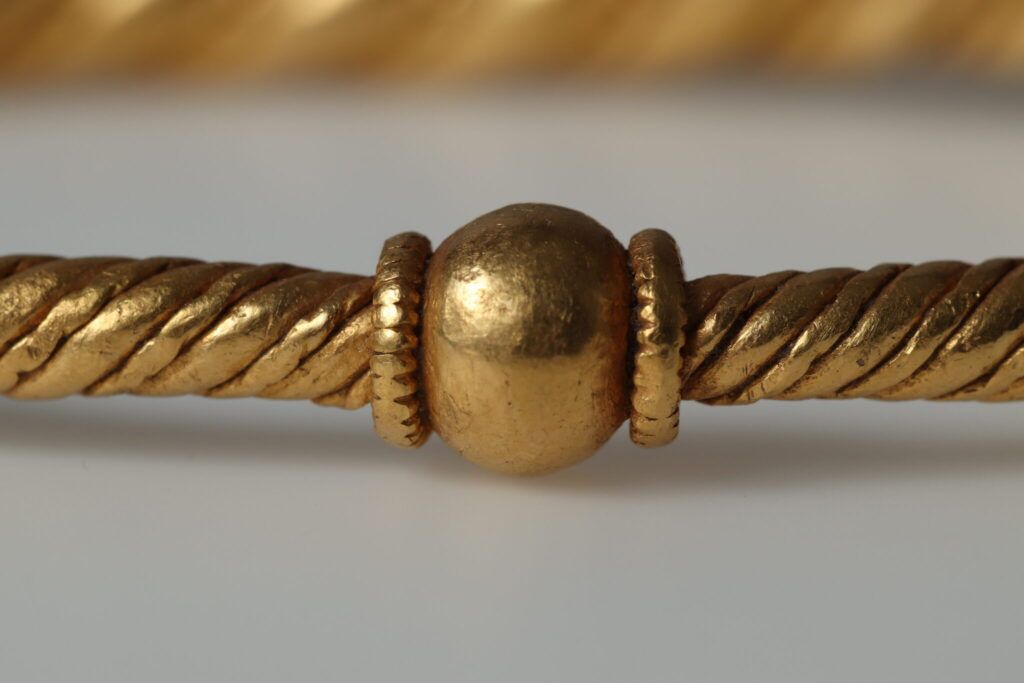
After the first discovery, archaeologists carried out a systematic metal-detecting survey of the area. A third twisted gold arm ring was found close to the original spot. Around 15 meters away, three more gold arm rings were uncovered lying together.
Their position may be significant. Because the final three rings were found stacked on top of one another, archaeologists believe that part of the hoard may still have been resting where it was deliberately buried more than a thousand years ago.
A treasure from Denmark’s late Viking Age
The Rold Hoard dates to around A.D. 900 to 1000, a period when Denmark was undergoing major political and religious change. Royal power was becoming more visible, elite networks were expanding, and Christianity was beginning to reshape parts of Scandinavian society.
This was also the age of Harald Bluetooth, who famously declared on the Jelling Stone that he had won Denmark and Norway and made the Danes Christian. The Rold gold rings belong to that same world of shifting authority, wealth and allegiance.
In Viking society, gold was far rarer than silver and largely connected with the highest levels of power. Arm rings were not simply ornaments. They could be worn as signs of rank, exchanged as elite gifts, or used to mark loyalty between leaders and followers.
Complete gold rings, not broken bullion
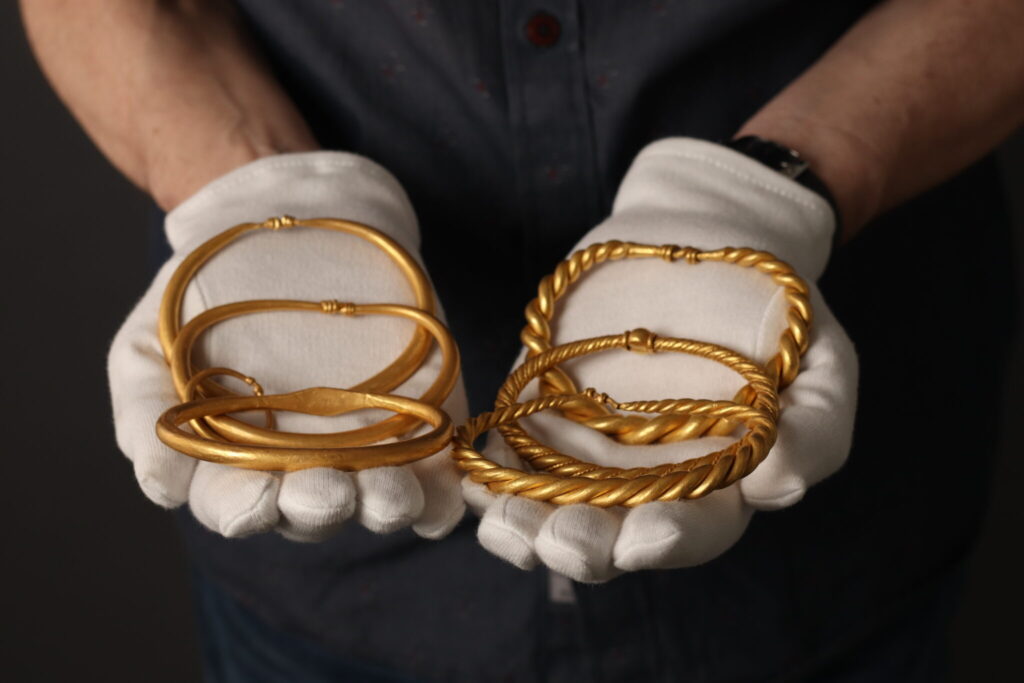
The condition of the Rold Hoard makes it especially important. Viking-age precious metal is often found cut, weighed or broken into pieces for use as bullion. These six rings survived intact.
That suggests they were valued not only for their metal, but also as finished prestige objects. Their form, weight and craftsmanship would have made them visible symbols of status in life. Their burial may point either to hidden wealth in a time of uncertainty or to a deliberate ritual deposit whose full meaning is now lost.
The craftsmanship is also striking. Three of the rings were twisted from two gold rods, including one with thin gold wire decoration and a knob-shaped fastening. Others were made from smooth rods or wire. Several have wrapped closures known as running knots. One ring carries a smaller ring of the same type, while another has flat-hammered ends decorated with zigzags and triangular patterns.
Together, the six objects offer a rare look at the work of highly skilled Viking-age goldsmiths and the elite culture that valued such objects.
The Rold Hoard will undergo further analysis
The find area lies on private land and has no public access. Both the finder and the landowner have chosen to remain anonymous.
Archaeological work at the site has now been completed, and all six rings have been submitted as danefæ. They will undergo further analysis before being transferred to the National Museum of Denmark.
Nordjyske Museer hopes the arm rings can be displayed at Aalborg Historical Museum before the summer holiday, giving the public a chance to see one of Denmark’s most remarkable Viking gold finds close to the landscape where it lay hidden for more than a millennium.
Cover Image Credit: Three of the Viking gold arm rings are smooth, while one stands out with zigzag and triangular decoration. Another ring contains a smaller ring of the same type. Nordjyske Museer