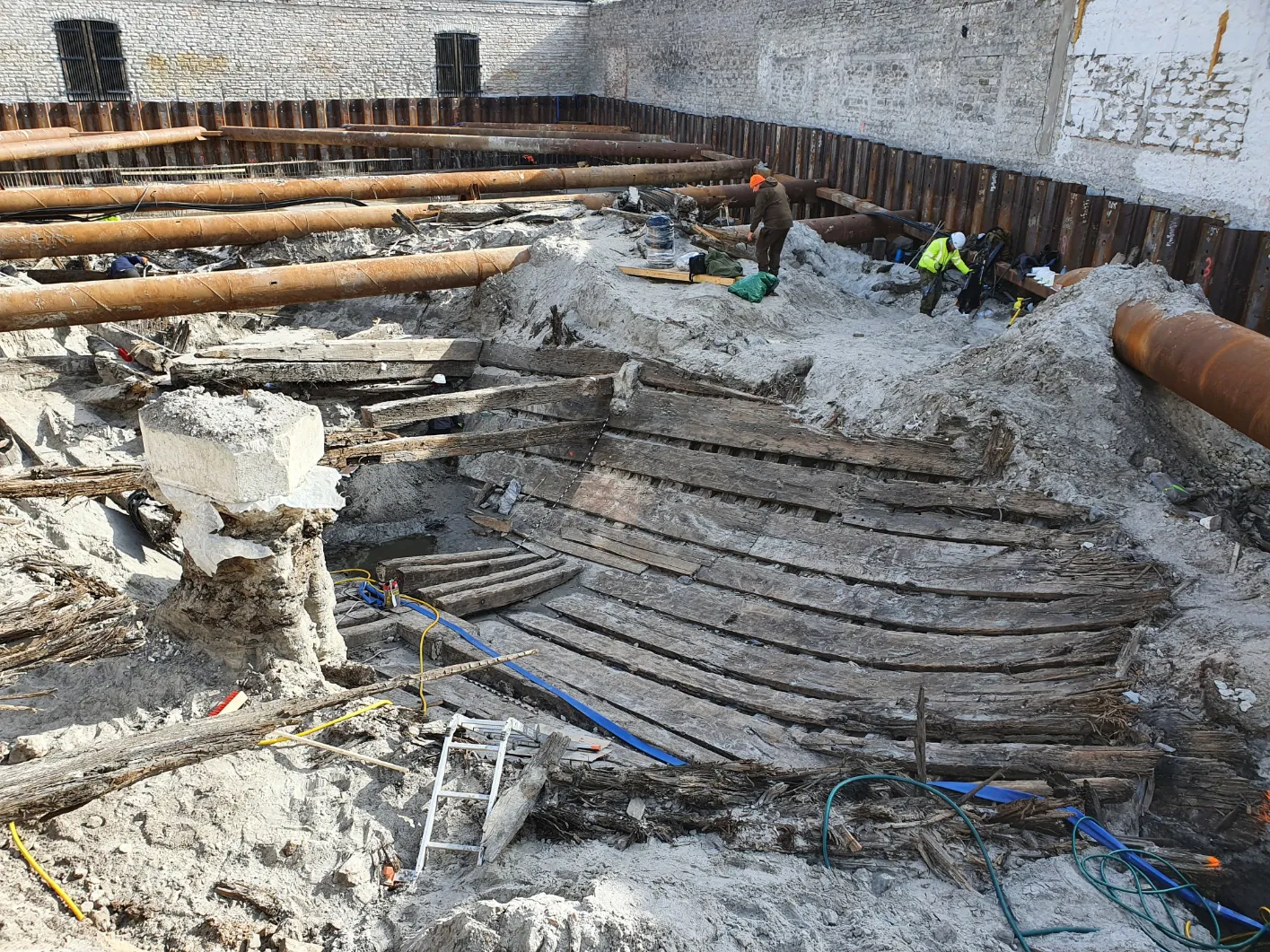
A 14th-century ship uncovered beneath a construction site in Tallinn has turned an ordinary office project into one of northern Europe’s most revealing medieval maritime discoveries.
The find was made at Lootsi Street 8, near Tallinn’s old harbor area, when workers digging foundations struck wooden remains about 1.5 meters below the surface. Archaeological monitoring stopped the work almost immediately. What first looked like buried timber soon proved to be the remains of a large medieval merchant vessel, now known as the Lootsi 8 cog.
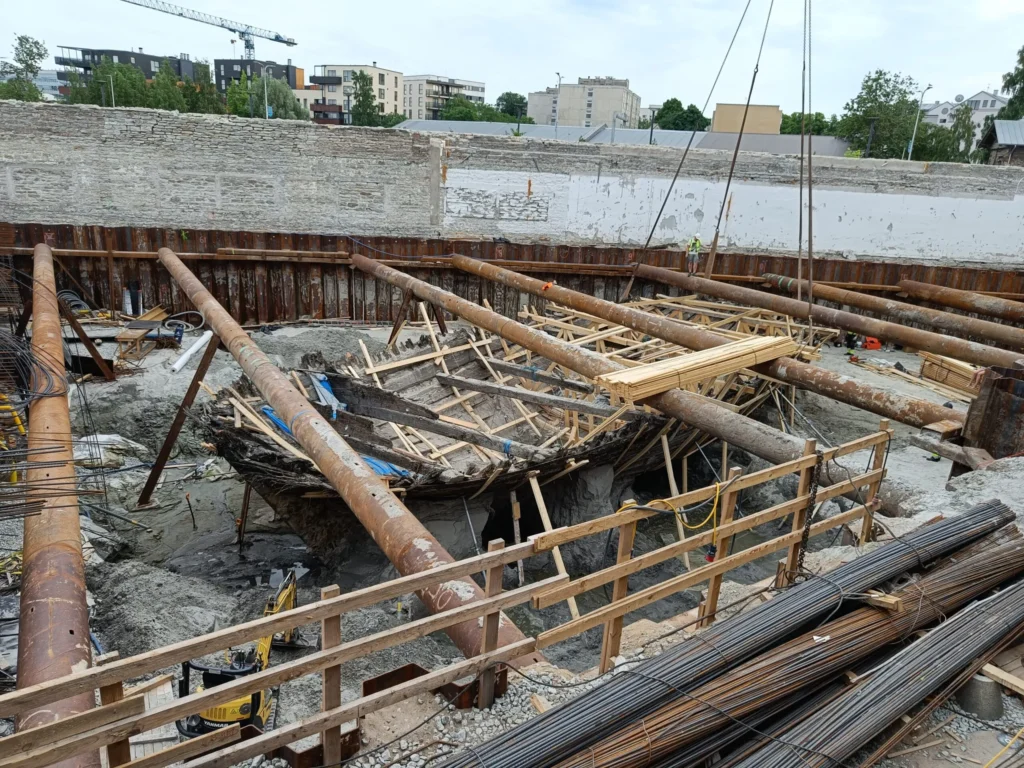
Measuring about 24.5 meters long and 8.6 meters wide, the ship is considered one of the best-preserved medieval wrecks ever found in Europe. Its condition was both remarkable and fragile. Specialists had to lift the vessel in four major sections before transferring it to the Estonian Maritime Museum, where conservation and research could continue under controlled conditions.
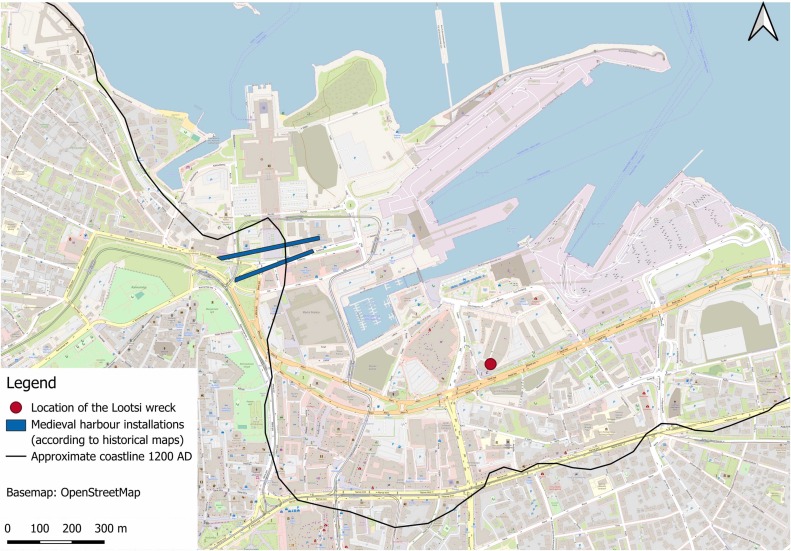
A medieval ship beneath modern Tallinn
The place where the ship was found no longer resembles a shoreline. Today, it sits inside urban Tallinn, surrounded by the layers of a modern city. In the Middle Ages, however, this area lay near shallow coastal waters close to the delta of the Harjapea River.
Over the centuries, the coastline shifted. Marshy ground was reclaimed, filled and built over. Warehouses, railway infrastructure, parking areas and later construction projects covered what had once been part of Tallinn’s maritime landscape.
Beneath that transformed surface, the Lootsi cog remained sealed in wet marine sediments. That is why the discovery is so valuable. The wreck preserved not only a large section of the hull, but also traces of the people who once moved across its deck.
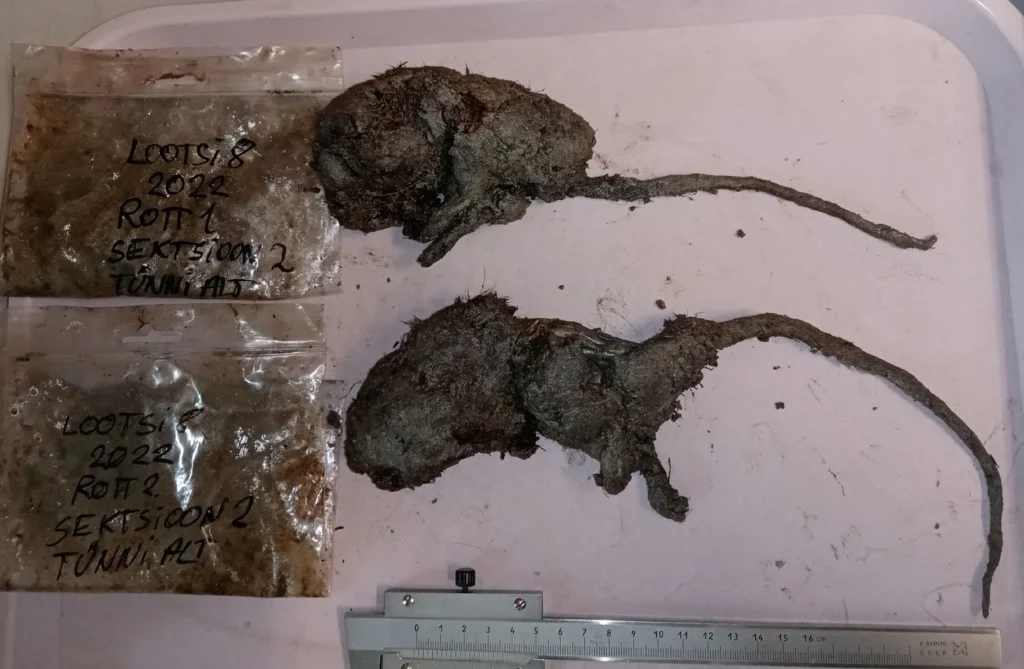
Archaeologists recovered tools, weapons, leather shoes and the remains of two ship rats trapped in spilled tar. Some of the shoes had been worn and repaired. These small details matter. They show that this was not a symbolic or ceremonial vessel, but a working ship used by sailors, merchants and craftsmen.
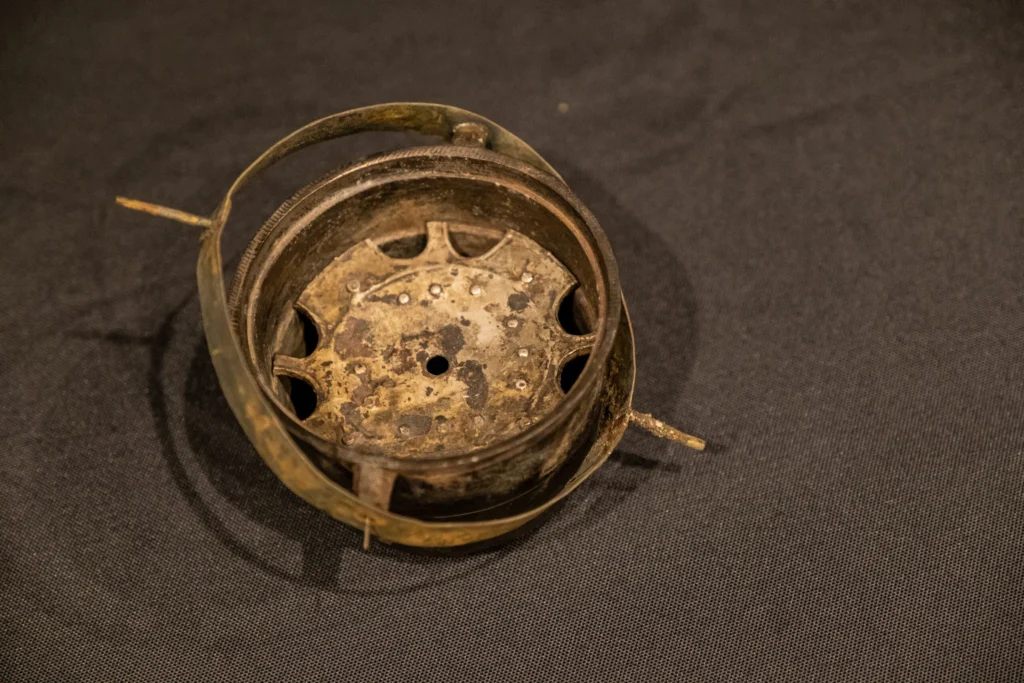
A rare compass from the age of Baltic trade
The most striking object recovered from the wreck is a dry compass, reported in Estonia as possibly the oldest surviving example of its kind in Europe. If that identification is confirmed, the Lootsi 8 find would become a key piece of evidence for the history of medieval navigation.
The compass gives the ship a wider meaning. This was not simply a wooden cargo vessel lost near shore. It belonged to a commercial world that required planning, technical skill and knowledge of dangerous waters.
Baltic merchants moved through a sea shaped by wind, fog, coastlines, currents and seasonal risk. They relied on experience, memory and landmarks, but by the 14th century, navigational instruments were becoming increasingly important. A compass aboard the Lootsi cog suggests a ship operating within that changing maritime culture.
The scattered condition of the finds has also raised a human question. Archaeologists have suggested that the ship may have been abandoned or lost suddenly, leaving everyday objects behind. Why such a large and valuable vessel ended its journey so close to Tallinn remains one of the central mysteries of the wreck.
Tree rings date the vessel to the early 1370s
A new scientific study has given the ship an unusually precise date. Researchers analyzed 97 wood samples from the wreck, including planks, beams, frames and reinforcing timbers. Of these, 87 were successfully dated through dendrochronology, the study of tree rings.
The results show that much of the vessel was built from oak trees felled in the winters of 1370–71 and 1371–72. Other timbers, possibly linked to a galley or pantry structure, came from trees felled in winter 1373–74.
That places the construction of the Lootsi cog in the early 1370s with rare precision. The ship was not simply “medieval” in a general sense. Its timber preserves the rhythm of a specific building process, from forest to shipyard.
The study also found little evidence of major repair. Only smaller interventions, such as caulked cracks, were recorded. That suggests the vessel may have been relatively new when it was lost.
Baltic forests built into a Tallinn wreck
The timber tells a second story. Many of the oaks used in the ship likely came from coastal Lithuania, while other groups of wood may be linked to nearby Baltic regions and Estonia.
In other words, the Lootsi cog was not only a ship that moved through trade routes. It was made by them. Its wood may have been cut in one region, transported across the Baltic, shaped by skilled builders and fitted for service near Tallinn.
The vessel belongs to the broad cog tradition, a medieval ship type associated with cargo transport across northern Europe. Yet the Lootsi 8 ship does not fit a simple textbook model. Its construction shows local choices, adaptations and practical solutions.
One detail makes that craftsmanship especially clear. Several oak planks contained “moon rings,” pale bands formed when a tree is damaged during growth. The builders appear to have recognized these weaknesses and strengthened affected areas with long internal reinforcing planks.
That is where the wreck becomes more than a preserved object. It reveals judgment. Medieval shipwrights were reading the wood, noticing its flaws and correcting them with experience earned long before modern engineering.
The Lootsi 8 cog began as an obstacle in a construction pit. It has become a rare window into medieval Tallinn, Baltic trade and the technical knowledge of sailors nearly 650 years ago. Beneath a modern city street, one of Europe’s best-preserved medieval ships had been waiting in silence, carrying with it a compass, a cargo world and the unfinished story of its last voyage.
Daly, A., Sohar, K., Läänelaid, A., Lätti, P., & Reinvars, L. (2026). Timber for a medieval cog: Wood studies of the Lootsi 8 wreck, Tallinn. Dendrochronologia, 97, Article 126519. https://doi.org/10.1016/j.dendro.2026.126519
Cover Image Credit: Estonian Maritime Museum (Eesti Meremuuseum)