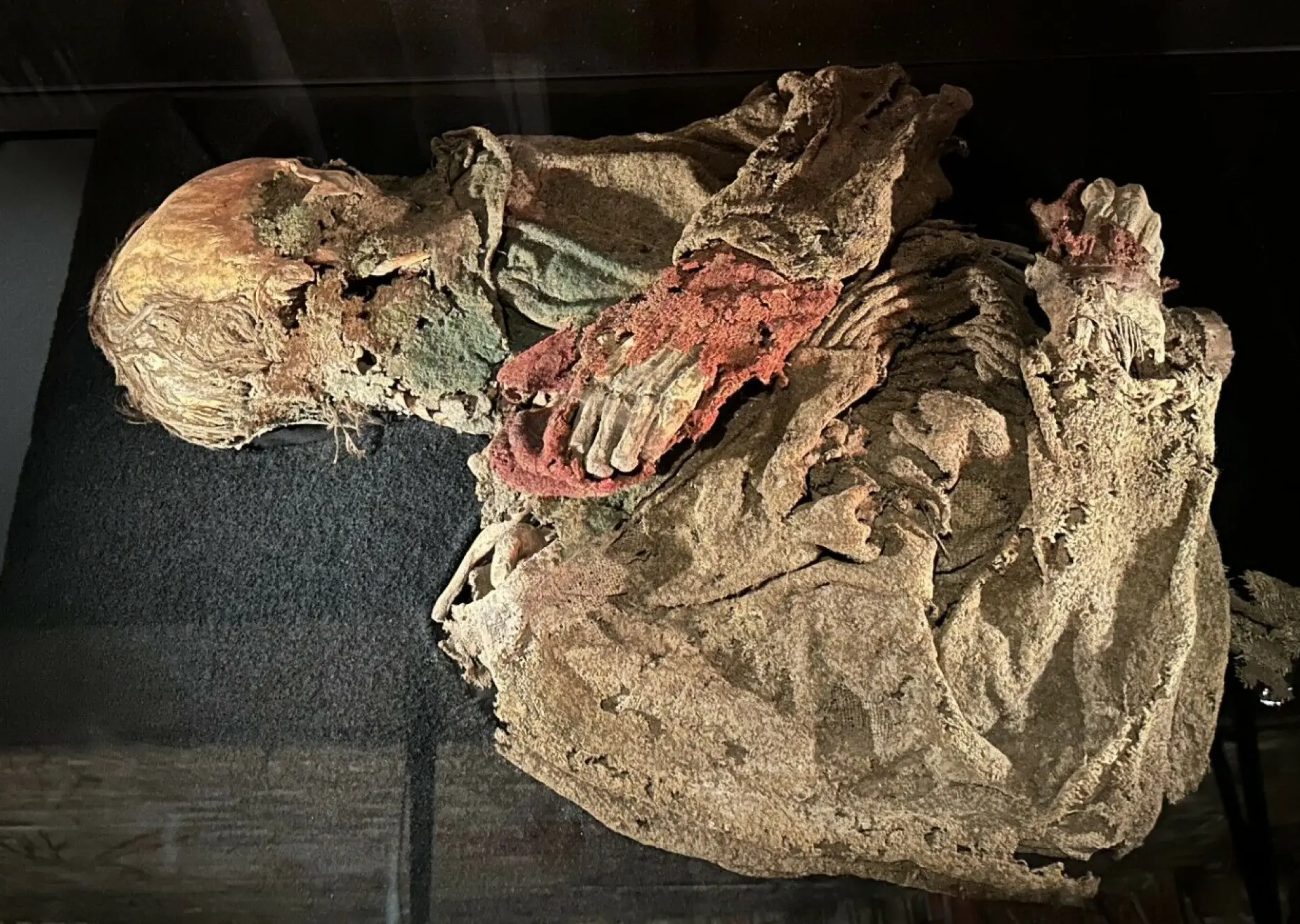
Two children and two teenage girls were laid together in a shallow grave beneath the floor of Uvdal Stave Church in Norway. Their faces, hands and feet were covered, while red woollen mittens had been sewn onto their sleeves.
No written record identifies them or explains why all four received the same unusual burial treatment.
Although the grave was excavated in 1978, it has returned to attention after archaeologist Marianne Vedeler received permission to conduct DNA analysis. If the project secures funding, the tests may reveal whether the girls were sisters or other close relatives.
A Burial Preserved Beneath the Church
Uvdal Stave Church stands in Norway’s Numedal valley and dates to the late 12th century. Its medieval core survives despite repeated alterations and extensions made over the following centuries.
When archaeologists investigated beneath the church floor in 1978, they uncovered several layers of burials. Some of the dead rested on pillows filled with flowers. One shallow grave contained four young people placed directly on the ground, without surviving coffins.
The dry conditions beneath the wooden floor had slowed decomposition. Parts of their hair, skin, fingernails and clothing remained intact after more than six centuries.
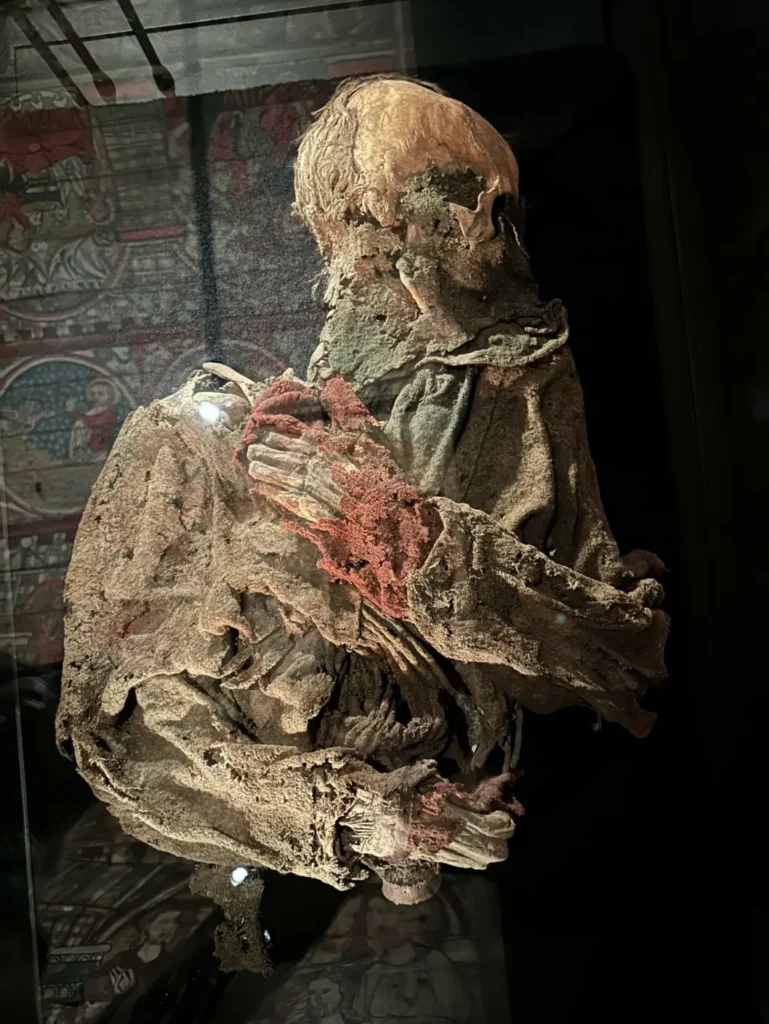
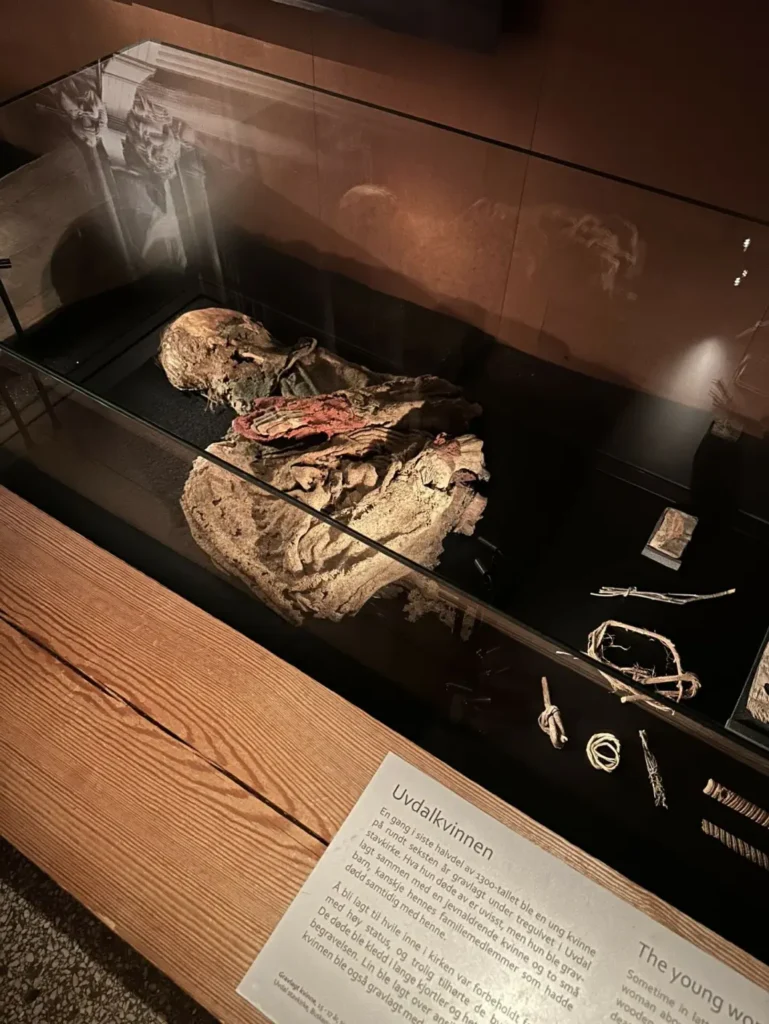
Because the remains were too fragile to excavate separately, archaeologists lifted the burial as a single block, together with the soil beneath it, and transported it to the Museum of Cultural History in Oslo.
Vedeler first encountered the grave in the early 1990s while cataloguing medieval textiles stored in the museum basement. The bodies were kept in large boxes, still accompanied by the clothing in which they had been buried.
Studies identified two children, aged approximately three to four and six to seven, and two teenage girls who were probably between 15 and 17 when they died.
Radiocarbon analysis produced dates between AD 1280 and 1410, although researchers consider the second half of the 14th century the most likely period for the burial.
Red Mittens Sewn onto Their Sleeves
The surviving clothes provide an unusually detailed view of how the girls were prepared for burial.
They wore several layers of linen and wool. Some garments appear to have been ordinary clothes used during life and later adapted for the funeral. Other pieces were probably added only after death.
The oldest teenager wore a linen undergarment, a pleated woollen dress and a blue hood. The careful cutting and construction of some of the garments point to skilled textile work.
Three of the bodies also had strips of linen wrapped around their heads. The fabric covered the forehead, eyes, nose and mouth, leaving almost no part of the face exposed.
The red mittens completed this covering of the body.
All four wore mittens made from similar woollen fabric. They had been attached to the sleeves with coarse stitches that contrasted sharply with the finer workmanship of the dresses and tunics.
This difference suggests that the mittens were not ordinary winter accessories. They were probably added while the bodies were being dressed for burial.
Their purpose remains unknown.
The mittens may simply have helped conceal every visible part of the body. They may also have carried a religious, social or symbolic meaning understood by those who arranged the funeral. No surviving written source explains the practice.
The burial preserves what people did, but not why they did it.
Could DNA Reveal Who They Were?
The grave probably dates to the period when the Black Death reached Norway. That has raised the possibility that the four girls died during a plague outbreak.
Vedeler has approached that explanation cautiously. Their bodies were not placed hurriedly into the ground. They were dressed in several layers, their heads were wrapped in linen and mittens were sewn onto each set of sleeves.
The time spent preparing them does not resemble the rushed treatment often associated with emergency epidemic burials.
Their position beneath the church floor and the quality of some of the textiles may indicate that they belonged to a family of local importance. Burial inside a medieval church was usually reserved for people with status or strong connections to the parish.
DNA analysis could establish whether the four were biologically related. A close relationship would support the possibility that the grave records a family tragedy. If they were unrelated, archaeologists would need to reconsider why they were buried together and dressed in the same distinctive way.
The testing is less likely to explain the red mittens.
Those four pieces of wool remain the burial’s most puzzling detail: roughly sewn onto carefully prepared clothes before the girls were placed beneath the church floor.
Original reporting: Ida Irene Bergstrøm, Science Norway, published July 22, 2026.
Academic source: Marianne Vedeler, “Medieval Clothing in Uvdal, Norway” (2007).