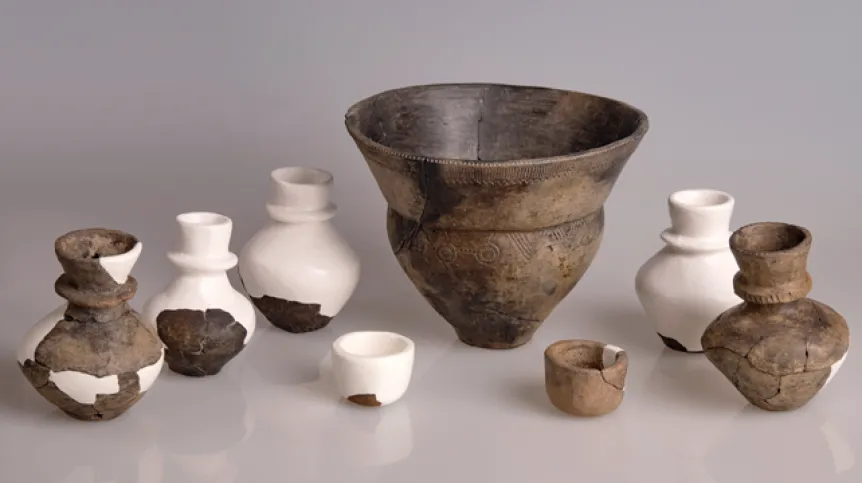
A set of carefully crafted ceramic vessels unearthed in central Poland is shedding new light on how Neolithic communities gathered, ate, and marked important moments together. The objects, dating back roughly 5,500 years, appear to have been used during ritual feasts involving processed dairy products—and may point to ceremonies shaped largely by women.
The discovery comes from the archaeological site of Sławęcinek in the Kujawy region, an area long known for its fertile soils and early farming settlements. What makes this find stand out is not just the pottery itself, but the story emerging from what was once inside it.
Milk, but not as we know it
Scientists analyzed microscopic food residues preserved in the ceramic surfaces using biomolecular techniques. The results showed traces of milk proteins from cattle as well as sheep or goats. But this was likely not fresh milk.
The findings were published in the journal Praehistorische Zeitschrift.
In Neolithic Europe, most adults could not digest lactose. Instead, communities processed milk into products closer to whey or early forms of cheese, reducing lactose and making it easier to consume. The vessels from Sławęcinek seem to have been part of that tradition—used not for everyday meals, but for special, shared drinking events.
This distinction matters. The pottery set is unusually consistent in form and craftsmanship, suggesting it was created as a single functional group rather than assembled randomly over time.
A carefully assembled ritual set
Among thousands of pottery fragments recovered at the site, researchers identified a coherent set: a large Funnel Beaker-style vessel, five distinctive flasks with flared collars, and two smaller cups. Together, they form what archaeologists describe as a libation set—objects likely used to serve and consume liquids in a structured setting.
Their context reinforces that interpretation. Some of the vessels were found deliberately broken, a practice often linked to ritual closure rather than accidental damage. Nearby, archaeologists uncovered dense concentrations of animal bones, mainly cattle and pigs, suggesting that large meals took place alongside these drinking events.
These were not quiet domestic moments. They were communal gatherings, likely tied to events that carried social weight.
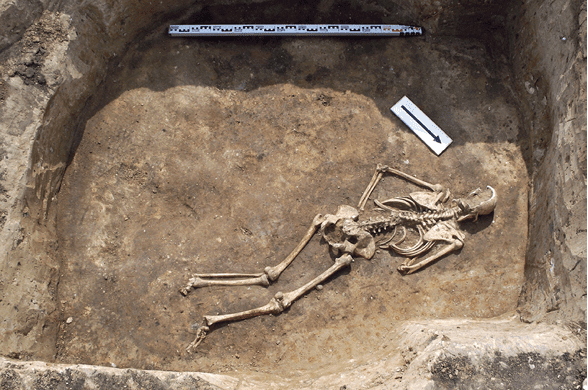
Feasting near the dead
One of the more striking aspects of the site is how closely these feasting remains sit beside burial areas. The proximity raises a strong possibility: that these dairy-based feasts formed part of funerary ceremonies.
Sharing food and drink in the presence of the dead is a pattern seen across many prehistoric societies. At Sławęcinek, the evidence suggests that such practices may have been embedded directly within the living space—taking place near homes rather than in distant ritual zones.
This blending of domestic and ceremonial space offers a more intimate view of Neolithic life. Ritual was not separate from daily existence; it unfolded within it.
A different social structure?
The burials themselves add another layer to the story. So far, the graves identified in this area appear to belong only to women. At the same time, certain vessel types typically associated with male burials elsewhere appear here in contexts linked to female activity.
That pattern has led researchers to explore a more complex social model. One possibility is a matrilineal system, where lineage and identity were traced through the mother’s line. Another is that these gatherings were connected to female-led ritual groups that played a central role in maintaining social cohesion.
It is a cautious interpretation, but not an unfounded one. In many traditional societies, women’s networks have been key to transmitting knowledge, organizing ceremonies, and sustaining community ties.
Within that framework, the use of dairy products takes on added meaning. Milk—especially when transformed through processing—may have carried symbolic associations with fertility, nourishment, and continuity.
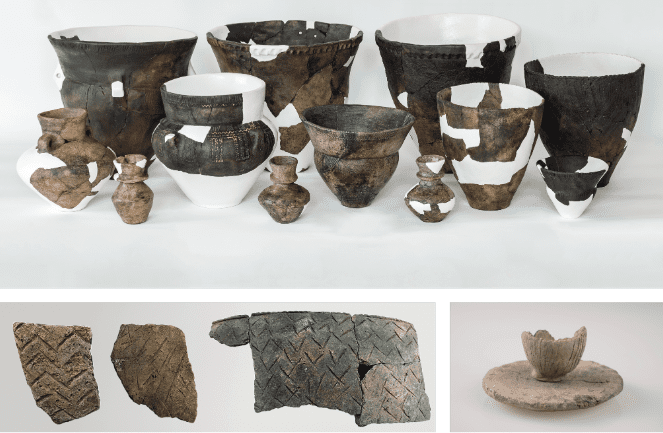
A vessel that may depict one of the earliest wagons
One of the vessels in the set carries a decoration that has drawn particular attention. Its surface features a simple but suggestive motif: two circles connected by lines.
Researchers believe this may represent a wagon with wheels, potentially placing it among the earliest known depictions of wheeled transport. Similar imagery is known from other sites in Poland, including the famous Bronocice vessel.
Radiocarbon dating places these objects in the second half of the fourth millennium BCE, aligning with the earliest archaeological evidence for the use of wheeled vehicles in both Europe and the Near East.
If the interpretation holds, the Sławęcinek vessel does more than document ritual life—it also hints at a moment when new technologies were beginning to reshape movement and exchange.
A settlement revealed by chance
The site itself was discovered unexpectedly in 2016 during construction work on a road bypass near Inowrocław. Excavations quickly expanded across nearly five hectares, revealing over a thousand archaeological features.
Since then, the material has been studied by an international team including researchers from Nicolaus Copernicus University in Toruń, the University of Łódź, the Polish Academy of Sciences, the University of York, and the University of Cambridge.
More than just food
What emerges from Sławęcinek is not simply a story about what people ate or drank. It is about how communities gathered, who took part, and what those moments meant.
The vessels, the feasts, the broken pottery, and the nearby burials all point to shared events that helped define social bonds. Whether tied to mourning, memory, or identity, these gatherings were structured—and possibly led—by women.
And in that sense, a set of ancient drinking vessels becomes something more: a trace of how early societies organized themselves, remembered their dead, and sustained their connections over generations.
Cover Photo: Reconstructed drinking set from Sławęcinek. The main beaker was recovered in two separate fragments from different pits, with the full forms based on ceramic pieces analyzed through biomolecular methods. Photo: W. Ochotny. Source: Praehistorische Zeitschrift.