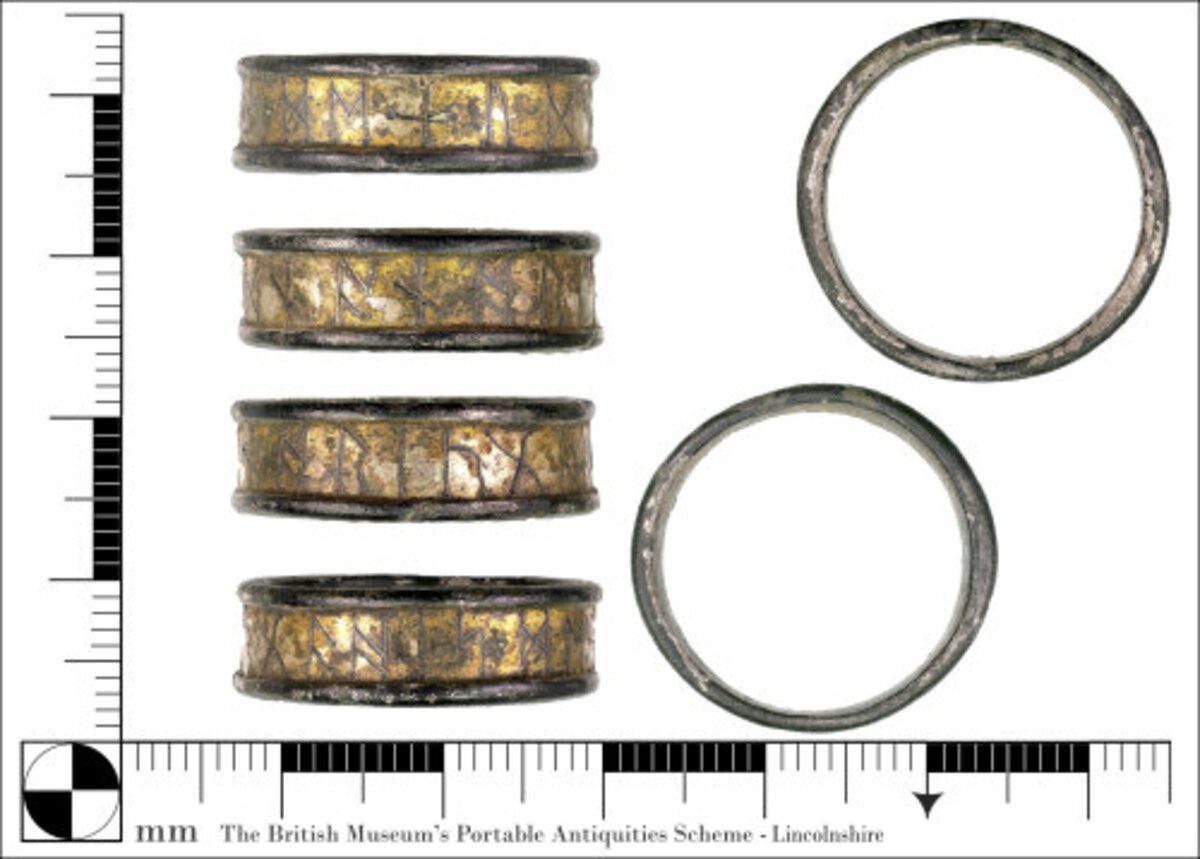
A small silver-gilt ring discovered in a Lincolnshire field is drawing unusual attention from archaeologists—not for its size, but for what it suggests about identity, literacy, and status in early medieval England.
The ring was found by metal detectorist Rafal Wesolowski near Quadring and later recorded by the Portable Antiquities Scheme (PAS) under the reference LIN-E70856. At first glance, it appears to be a finely made but modest piece of jewelry. Closer examination, however, places it among a rare group of inscribed rings from early medieval Britain—objects that are as enigmatic as they are uncommon.
Craftsmanship Points to Status
The ring is made of silver with gold gilding, measuring just over 23 mm in diameter and weighing 4.51 grams. Its surface shows careful finishing, including a structured band and precisely executed engraving.
One detail stands out immediately: the gilding remains on the band but not inside the engraved letters. This indicates that the inscription was added after the ring had already been gilded—a deliberate intervention rather than part of the original production.
There are also traces of niello, a dark inlay traditionally used to enhance contrast in engraved decoration. Together, these features suggest the object was not only decorative but handled with intention and meaning over time.
Archaeologists have therefore treated it not as a casual accessory, but as a personal item of significance, likely owned by someone of relatively high status.
The Inscription That Refuses to Settle
Encircling the outer band are 16 runic characters, reading:
+udnAnH(:)Ri*aHiSDe
The runes are written left to right, but their interpretation remains uncertain.
Specialists from the University of Nottingham, including Dr Martin Findell and Jasmin Higgs, have examined the sequence. One possible reading identifies a personal name—often suggested as “Udnan”—alongside a term that may correspond to the word “ring” (hring in Old English or Old Norse).
Even this cautious interpretation is far from settled. Runic inscriptions on objects like this are notoriously difficult to decode with confidence. In many cases, they resist clear linguistic structure, leaving open the possibility that they were not intended as straightforward statements.
A Pattern of Meaningful Objects
The Lincolnshire ring does not stand entirely alone. A small number of comparable finds are known from Britain, including rings discovered at Kingmoor in Cumbria and Wheatley Hill. These objects share a common trait: inscriptions that are fragmentary, ambiguous, or resistant to full translation.
Because of this, archaeologists have increasingly considered that such rings may have served amuletic or symbolic roles, rather than functioning purely as markers of ownership.
In this case, the inscription could still indicate possession—something like “Udnan’s ring”—but it might equally reflect belief, identity, or protection, encoded in a way that is no longer fully accessible to modern readers.
Evidence of a Lost Settlement
The wider archaeological context may prove just as important as the ring itself.
Additional finds from the same area, including a late Anglo-Saxon buckle, suggest the presence of activity beyond a single isolated object. Researchers are now considering the possibility that the ring comes from a previously unrecognized early medieval settlement.
If confirmed, this would reshape how the site is understood. The quality of the ring and the presence of inscribed material hint at a community of some standing, potentially including individuals familiar with symbolic or written expression—something far from universal in early medieval England.
A Rare Voice from Early Medieval Britain
Objects like this are valuable precisely because they sit outside the usual historical record. Most surviving written material from the period is tied to ecclesiastical or administrative contexts. Personal inscriptions, especially in runes, are exceptionally scarce.
This ring offers something different: a compact, intimate object carrying marks that were meant to be read—or at least recognized—by a specific audience. Whether that audience was broad or highly restricted remains unclear.
The use of runes also points to cultural connections across northern Europe, where similar writing traditions were shared, adapted, and reinterpreted across Anglo-Saxon and Scandinavian worlds.
From Discovery to Collection
Due to its age and precious metal content, the ring was reported under the Treasure Act and has now been formally declared treasure. It is expected that a local museum may acquire the object, ensuring both its preservation and public display.
For now, however, its most important role is not as a display piece, but as an unresolved artifact.
Its inscription has not been fully deciphered. Its owner remains unknown. Its exact purpose is still debated.
And that uncertainty is precisely what makes it valuable.
Portable Antiquities Scheme (PAS)
Cover Image Credit: Lincolnshire County Council