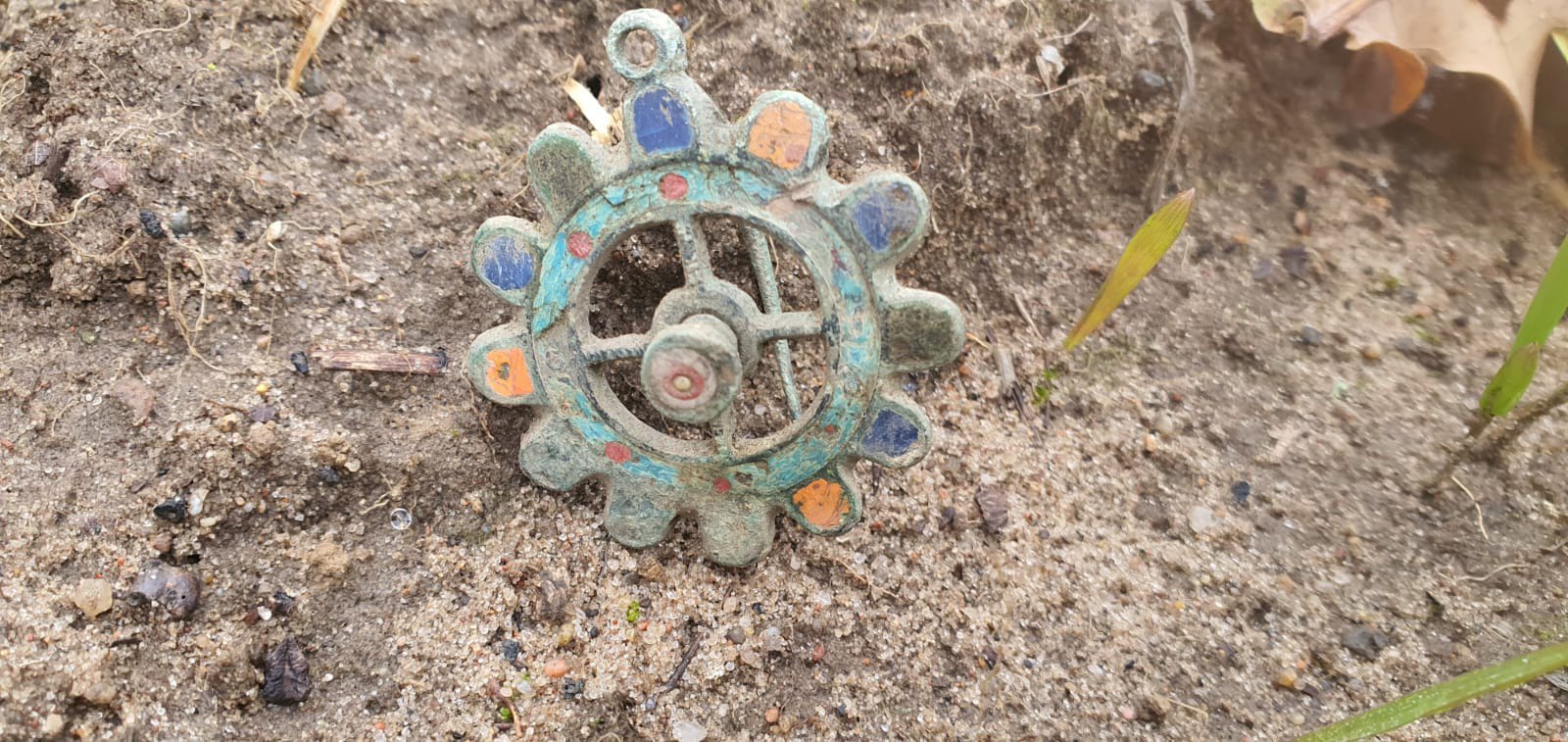
A rare Roman-period enamelled fibula discovered in Poland is offering new insight into cultural exchange and daily life nearly 2,000 years ago. Identified during a routine metal-detector survey near Grudziądz, the object represents only the second known example of its kind ever documented in the country.
Archaeologists say the discovery reinforces growing evidence that this region was deeply embedded in long-distance networks linking the Baltic coast with the Roman world. Far from being a remote frontier, the landscape around Grudziądz appears to have been part of a vibrant, multicultural zone shaped by trade, mobility, and shifting identities during the early centuries CE.
A Brooch Unlike Any Other Found in Poland
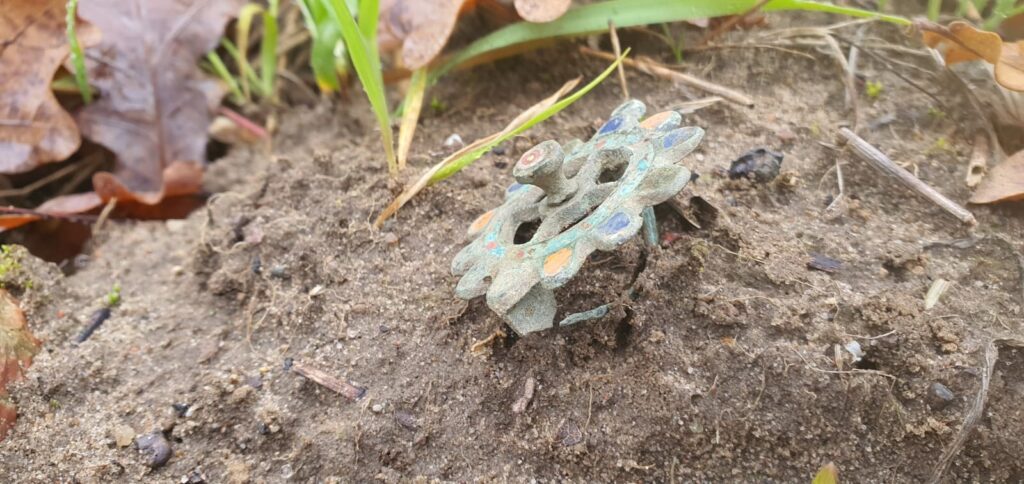
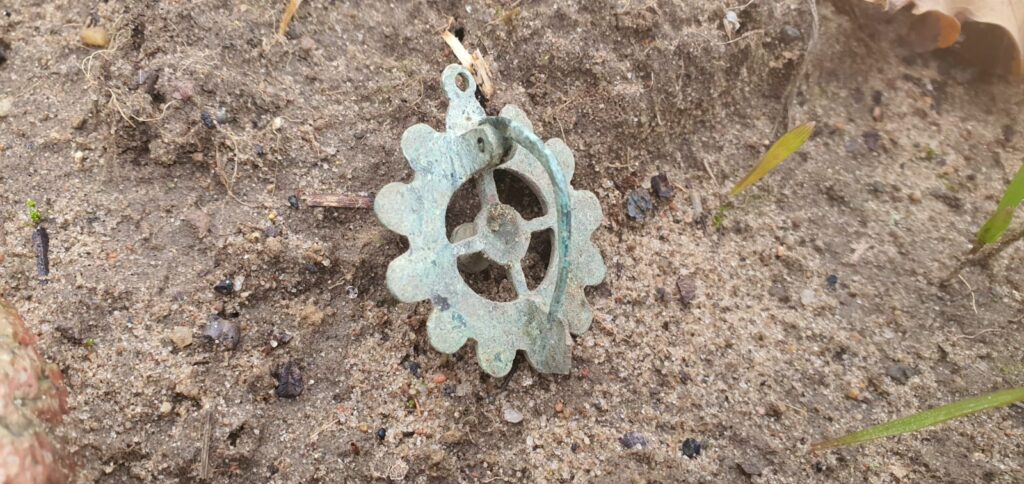
What makes the newly discovered fibula exceptional is not only its rarity, but its striking craftsmanship. The circular brooch is decorated with vivid enamel in white, blue, and red, arranged around a raised central boss. While a similar enamelled fibula has been recorded in northern Poland before, this example differs in a crucial detail: it features twelve decorative protrusions rather than eight, making it unique at the national level.
Specialists note that enamelled brooches of this type were produced across several Roman provinces—particularly in Gaul, Raetia, and regions along the Rhine and Danube—between the late 1st and mid-2nd centuries CE. Their presence so far north highlights how Roman aesthetic traditions circulated well beyond the Empire’s formal borders.
Connections to the Wielbark Culture
Based on stylistic features and regional context, researchers believe the fibula may be linked to the Wielbark Culture, a community often associated with Gothic migrations from Scandinavia into the southern Baltic region. Archaeological evidence suggests that Wielbark groups maintained wide-ranging contacts, blending local traditions with influences drawn from the Roman world.
Colorful enamelled brooches like this one were commonly used as dress fasteners and are frequently associated with female and child burials. In some cases, they may also have carried symbolic or amuletic meanings, functioning as cherished personal objects rather than purely utilitarian items.
A Landscape Rich in Cultural Layers
The discovery site itself has long attracted archaeological attention. Earlier investigations in the area uncovered a diverse array of finds, including Roman ceramics, multiple fibulae, hair ornaments, belt fittings, medieval coins, metal spurs, and even a Scythian arrowhead. Such diversity suggests prolonged or repeated occupation, possibly encompassing both a settlement and a nearby burial ground shaped by different cultural traditions over time.
Researchers emphasize that the site’s strategic position near the Amber Road likely played a decisive role in its importance. This major trade corridor carried Baltic amber southward to Roman markets, drawing merchants, travelers, and—at times—conflict into its orbit. The presence of foreign-style artifacts may reflect both peaceful exchange and more turbulent encounters along this economically valuable route.
Parallels With a Child’s Grave in Northern Poland
To better understand the brooch’s cultural context, specialists are comparing it with a closely related enamelled fibula excavated at the Babi Dół-Borcz burial site in the Kashubian region. That artifact was found in the grave of a young girl, accompanied by glass and amber beads, bronze jewelry, and textile tools—an assemblage firmly associated with the Wielbark Culture.
While researchers caution that definitive conclusions require further fieldwork, stylistic similarities suggest that both objects belong to the same broad cultural and chronological horizon. Ongoing analyses will explore whether the Grudziądz fibula was locally produced under Roman influence or arrived through long-distance exchange networks spanning much of Europe.
From Discovery to Public Display
Following standard heritage procedures, the brooch and associated finds were secured and reported to cultural authorities. After conservation and detailed documentation, the artifact is expected to go on public display at the Museum in Bydgoszcz, where it will be presented as part of the region’s Roman-period heritage.
Archaeological teams are also planning further investigations in the surrounding area, hoping to identify settlement remains or burial structures that could clarify the site’s role within regional networks of migration and exchange.
A Small Object With a Large Story
Though modest in size, the enamelled fibula offers a powerful glimpse into life on the edges of the Roman world. Objects like this demonstrate how fashion, craftsmanship, and symbolic meaning traveled vast distances—linking imperial workshops with communities far beyond Rome’s political reach.
For historians and archaeologists, the Grudziądz discovery reinforces a growing consensus: northern Poland during the Roman period was not an isolated periphery, but a dynamic crossroads where children, families, traders, and travelers participated in one of Europe’s most influential ancient exchange systems.
Grudziądzkie Stowarzyszenie Twierdza
Cover Image Credit: Grudziądz Fortress Association