
Archaeologists from the University of Central Lancashire have uncovered an exceptionally preserved sixth-century Anglo-Saxon sword in a cemetery in Kent. The weapon, buried around 1,500 years ago, is not just another grave good. It is a statement. Of authority. Of lineage. Of connection to a much larger European network.
The discovery, led by Professor Duncan Sayer, will feature on Digging for Britain, bringing international attention to what may become one of the defining Anglo-Saxon finds of the decade.
A Weapon Meant to Be Seen
The sword does not whisper status. It announces it.
Its hilt is decorated in silver and gilt. Rare runic inscriptions survive on the blade and metal fittings—an extraordinary detail in itself. Runes, used across northern Europe before the dominance of the Latin alphabet, carry cultural weight far beyond decoration. They signal literacy, identity, and perhaps even inherited meaning.
Organic elements rarely survive in early medieval graves. Here, they did. Traces of a wooden and leather scabbard were found intact, astonishingly lined with beaver fur. Such preservation is unusual—and suggests both favorable burial conditions and the wealth of the individual laid to rest.
Professor Sayer notes that swords of this caliber were more than battlefield tools. They were heirlooms. Political symbols. Objects tied to lordship and kinship networks. The burial position reinforces this reading: the man appears to have been interred embracing the weapon. Not beside it. With it.
That detail changes the tone entirely.
An Elite Cemetery in Kent
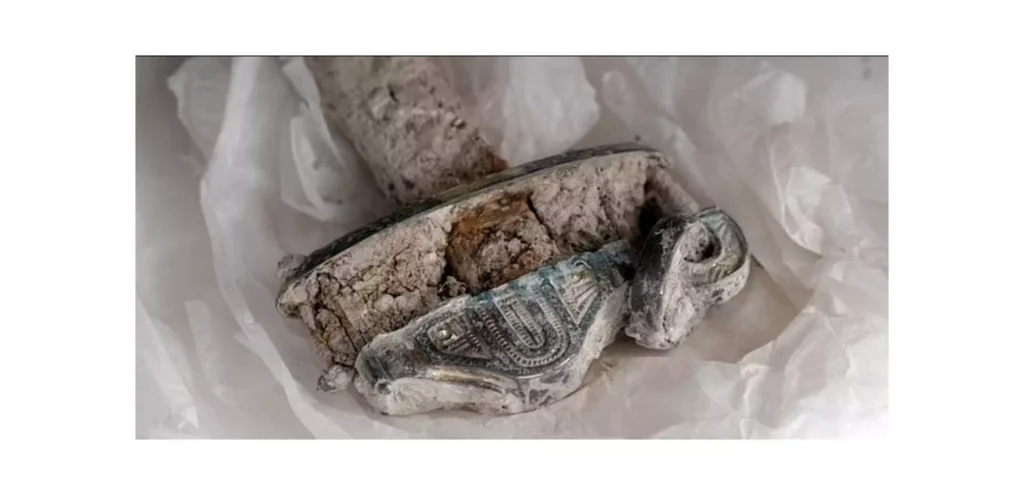
The sword was uncovered in an Anglo-Saxon cemetery that is rapidly proving to be one of southern England’s richest.
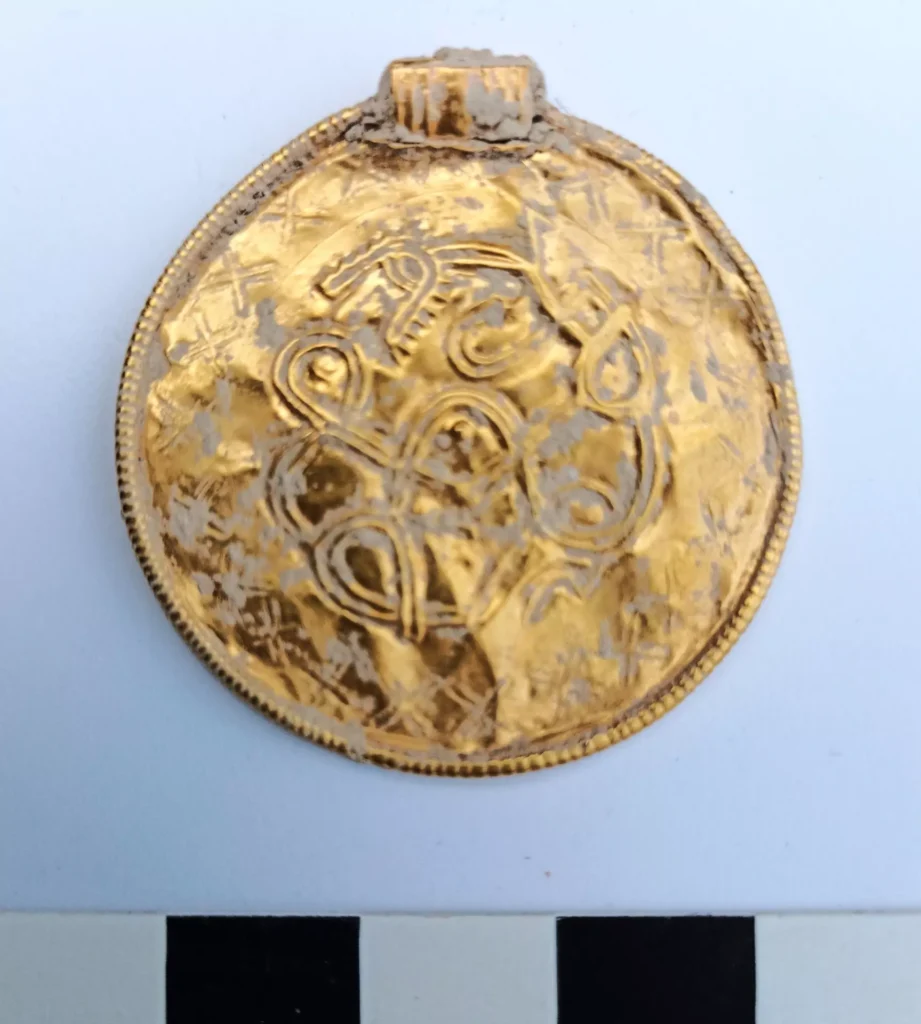
Nearby lay a gold pendant decorated with a serpent or dragon motif. Its craftsmanship suggests high social standing. Whether it belonged to a woman of status or functioned as a family heirloom remains under study—but its presence alongside the sword is striking. Two elite objects. Same cemetery. Same landscape of power.
Other graves contain spears, shields, seaxes, buckles, brooches, clasps, beads—and even a well-preserved wooden bucket. The pattern is familiar yet telling: weapons predominantly in male graves, jewelry and domestic items more common in female burials. Social roles are etched into the soil.
And yet, the richness of this cemetery suggests something more layered than simple role division. This was not a marginal community. It was plugged into broader networks.
Migration and a Connected Early Medieval Europe
Kent has long been understood as a gateway between Britain and the continent. The cemetery reinforces that view with physical evidence.
Several objects uncovered at the site display Scandinavian and Frankish connections. In one female grave dated to the late fifth century, Scandinavian items were present—clear markers of cross-regional contact. These were not isolated rural settlers cut off from the world. They were participants in it.
The material culture points toward migration, intermarriage, trade, and shifting political alliances in the post-Roman landscape. Early Anglo-Saxon England was not culturally sealed. It was dynamic. Fluid. International in ways that older narratives often underestimated.
Professor Sayer emphasizes that the cemetery offers crucial insight into early medieval political structures and elite identity. It speaks to authority negotiated through objects—swords, gold, imported goods. Power made visible.
A Site Only Partly Revealed
So far, archaeologists have fully excavated just 12 graves out of more than 200 identified at the site.
That number matters.
The majority of the cemetery remains untouched. Which means the narrative is still forming. More elite burials may lie beneath the soil. More inscriptions. More imported artifacts. More evidence of mobility in early medieval Britain.
When Alice Roberts, presenter of Digging for Britain, saw the sword, she described it as unlike anything she had encountered before—remarkable for its preservation and craftsmanship. For a scholar accustomed to extraordinary finds, that is not casual praise.
Why This Sword Matters
This discovery is not simply about an object.
It reshapes how we visualize sixth-century England. It reinforces Kent’s strategic position in early medieval Europe. It underscores the symbolic power of weapon burials in constructing elite identity. And it demonstrates that migration in this period was not abstract—it left material signatures.
A man buried holding his sword. A cemetery filled with gold and imported objects. A landscape that once stood at the crossroads of cultures.
After fifteen centuries underground, the message is clear: early Anglo-Saxon society was sophisticated, interconnected, and politically expressive.
And this cemetery near Canterbury may only be beginning to speak.