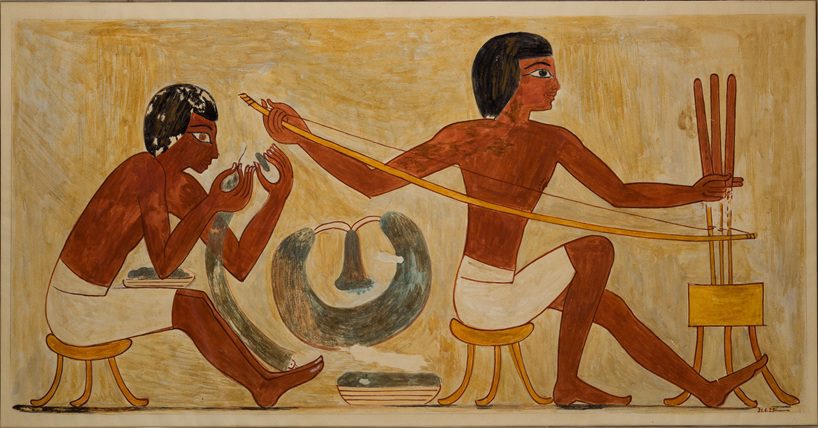
A small copper object — just 63 millimetres long — has quietly forced archaeologists to rethink the technological abilities of early Egypt.
Researchers from Newcastle University and the Academy of Fine Arts, Vienna have re-examined a century-old artefact from Upper Egypt and identified it as the earliest known rotary metal drill in ancient Egypt, dating to the Predynastic period (late 4th millennium BCE) — long before the first pharaohs ruled the Nile Valley.
The study, published in Egypt and the Levant, pushes back the evidence for mechanically controlled drilling in Egypt by more than two millennia.
A Misidentified Object in a Museum Collection
The artefact, catalogued as 1924.948 A in the Museum of Archaeology and Anthropology, University of Cambridge, was excavated roughly a century ago from Grave 3932 at Badari in Upper Egypt It was discovered in the burial of an adult man.
When first published in the 1920s, it was described simply as “a little awl of copper, with some leather thong wound round it.” The brief note drew little attention — and the object remained largely overlooked for decades.
Under magnification, however, the tool tells a different story.
Researchers observed fine striations, rounded edges, and slight curvature at the working end — wear patterns consistent with rotary motion rather than simple puncturing. These microscopic traces indicate repeated spinning, not just pushing or twisting by hand.
Evidence of an Early Bow Drill Mechanism
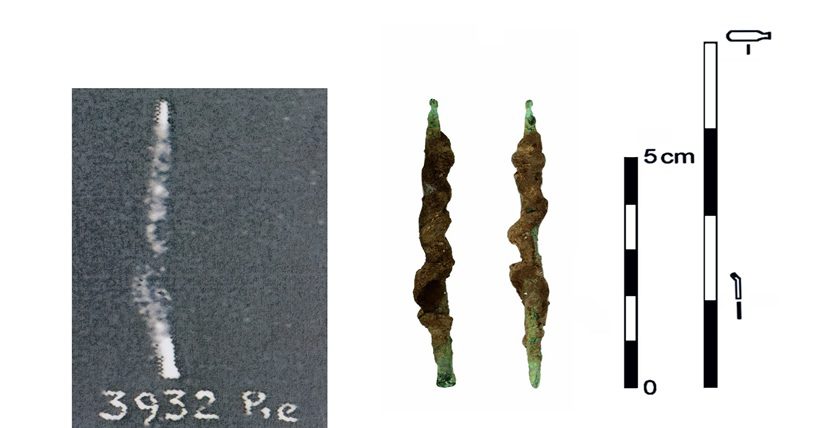
Even more revealing were six fragile coils of leather thong still wrapped around the shaft. The team argues these are remnants of a bowstring mechanism.
A bow drill works by wrapping a string around a shaft connected to a drill bit. Moving a bow back and forth spins the shaft rapidly, allowing for faster and more controlled drilling than a simple awl.
Lead author Dr Martin Odler explains that while ancient Egypt is famous for and jewellery, such achievements depended on practical technologies that rarely survive archaeologically. The drill, he notes, was essential for piercing wood, stone, and beads — enabling everything from furniture production to ornament crafting.
The re-analysis suggests that Egyptian craftspeople had mastered reliable rotary drilling during the Predynastic period — more than 2,000 years earlier than some of the best-preserved drill sets from later eras.
Predating New Kingdom Drill Sets by Two Millennia
Bow drills are well documented in later Egyptian history, particularly during the New Kingdom in the second millennium BCE. Tomb scenes from the West Bank of modern-day Luxor depict artisans drilling beads and woodworking with clearly recognizable bow drill systems.
Until now, securely identified early metal examples were lacking.
The Badari artefact predates those New Kingdom examples by over two thousand years, significantly revising the timeline of mechanical innovation in the Nile Valley.
An Advanced Copper Alloy
Chemical analysis using portable X-ray fluorescence (pXRF) revealed that the drill was made from an unusual copper alloy containing arsenic and nickel, along with notable amounts of lead and silver.
According to co-author Jiří Kmošek, this composition would have produced a harder and visually distinctive metal compared to standard copper. The presence of silver and lead may reflect deliberate alloying strategies — and potentially broader material exchange networks linking Egypt to the eastern Mediterranean during the fourth millennium BCE.
This was not simply early experimentation. It suggests controlled metallurgical knowledge.
A Reminder Hidden in Museum Storage
The research is linked to the UKRI-funded EgypToolWear project under the Horizon Europe Guarantee scheme. Beyond its technological implications, the discovery underscores the research potential of museum collections.
A small artefact described in a single line nearly a century ago now preserves evidence of early metalworking, mechanical engineering, and even organic remains of tool use.
In a field often dominated by pyramids and temples, this modest object offers something equally transformative — proof that sophisticated mechanical thinking existed in Egypt long before dynastic kings.
Cover Image: Bow drill in action, New Kingdom tomb painting from Western Thebes, Tomb of Rekhmire, object 31.6.25, The Metropolitan Museum of Art, public domain
Source: “The Earliest Metal Drill of Naqada IID Dating”, Martin Odler and Jiří Kmošek Ägypten und Levante / Egypt and the Levant (Vol. 35, 2025) DOI: 10.1553/AEundL35s289